
Introduction: The Problem Most Plants Don’t See Until It’s Too Late
Compressed air is often called the “fourth utility” in industries. It powers machines, actuators, packaging systems, and production lines. But there is a hidden issue that quietly reduces efficiency and damages equipment — oil carryover.
At first, it’s invisible.
Then it shows up as:
- Sticky valves
- Contaminated pipelines
- Reduced air quality
- Increased maintenance costs
And eventually — system inefficiency.
The component responsible for controlling this is the Air Oil Separator.
A properly functioning Air Oil Separator ensures that compressed air leaving the compressor is clean and usable. When it fails or underperforms, the entire system suffers.
This blog explains in simple terms:
- Why oil carryover increases
- How an Air Oil Separator works
- How to select the right one
- And how it directly impacts your plant performance
Understanding Oil Carryover in Compressors
In oil-injected rotary screw compressors, oil plays an essential role. It:
- Lubricates moving parts
- Seals compression gaps
- Removes heat
But during compression, air and oil mix.
When this mixture exits:
- Bulk oil is removed
- Fine oil mist remains suspended
This remaining oil is called oil carryover in compressor systems.
Without a proper Air Oil Separator, this oil travels downstream and causes:
- Pneumatic valve failure
- Filter clogging
- Product contamination
- Reduced efficiency
What Is an Air Oil Separator?
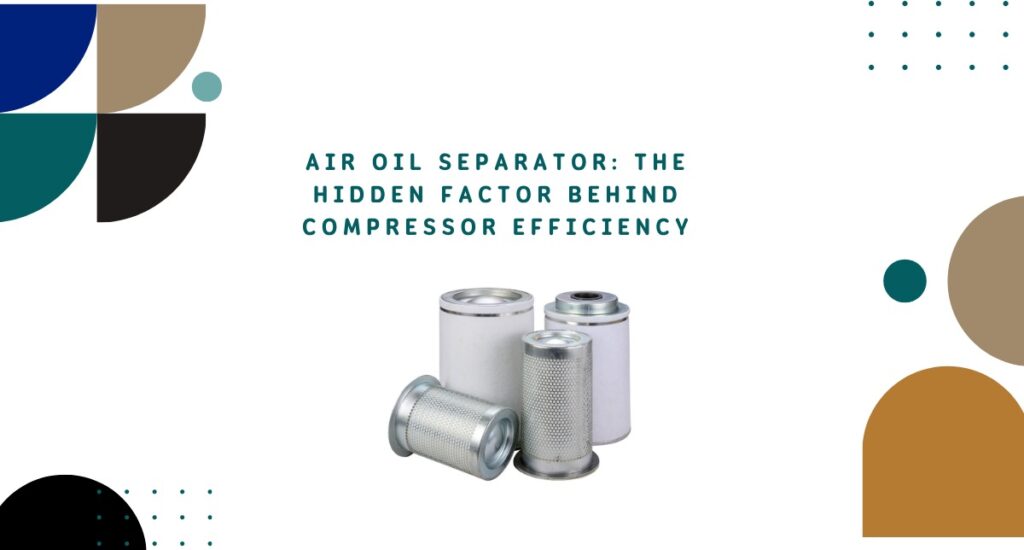
An Air Oil Separator is a specialized filter installed inside the compressor tank that removes oil from compressed air.
It uses coalescing filtration, where:
- Tiny oil droplets combine into larger ones
- These droplets settle and return to the oil sump
Key Components:
- Micro-fiber filter media
- Support core
- End caps and sealing gaskets
- Oil return (scavenge) system
The job of the Air Oil Separator is simple but critical:
Deliver clean air and recover oil efficiently
Why Oil Carryover Increases (Simple Explanation)
Understanding this helps avoid costly failures.
1. Separator Gets Saturated Over Time
Over time, the Air Oil Separator element becomes filled with oil and contaminants.
Result:
- Reduced efficiency
- More oil passes through
2. Pressure Drop Increases
As the separator clogs:
- Air struggles to pass
- Pressure builds up
- Oil gets forced through media
This increases oil carryover.
3. Poor Quality Compressor Oil
Bad oil:
- Breaks into smaller droplets
- Becomes difficult to separate
Even a good Air Oil Separator struggles here.
4. High Operating Temperature
When temperature rises:
- Oil becomes thinner
- Vapor formation increases
- Separation becomes harder
5. Dirty Intake Air
Dust entering the compressor:
- Mixes with oil
- Forms sludge
- Blocks separator media
6. Blocked Oil Return Line
The separator collects oil — but it must return to the system.
If the scavenge line is blocked:
- Oil accumulates
- Gets carried into air
How an Air Oil Separator Solves This Problem
1. Captures Fine Oil Mist
The Air Oil Separator filter media traps tiny droplets.
These droplets:
- Combine (coalesce)
- Become heavier
- Fall back into sump
2. Maintains Clean Air Quality
A good Air Oil Separator ensures:
- Low oil carryover (≤ 3 ppm)
- Clean compressed air
- Safe downstream operation
3. Improves System Stability
When oil is controlled:
- Pressure remains stable
- Flow remains consistent
- Equipment performs reliably
4. Reduces Oil Consumption
Recovered oil is reused.
This reduces:
- Oil usage
- Operating cost
Why Air Oil Separator Is Critical for Your System
Without an Air Oil Separator:
- Oil contaminates pipelines
- Valves fail frequently
- Filters clog quickly
- Maintenance costs increase
With a proper Air Oil Separator:
- Equipment lasts longer
- Maintenance reduces
- System runs efficiently
Real Impact on Industrial Operations
Example 1: Packaging Plant
Problem: Sticky pneumatic cylinders
Cause: Oil contamination
Solution: Replace Air Oil Separator
Result: Smooth operation restored
Example 2: Food Industry
Problem: Product contamination
Cause: Oil in compressed air
Solution: High-efficiency separator
Result: Clean production environment
How to Select the Right Air Oil Separator
1. Match Compressor Model
Each compressor requires specific design
2. Check Flow Capacity
Ensure proper CFM rating
3. Look for Low Pressure Drop
Improves energy efficiency
4. Choose High-Quality Media
Better separation and longer life
5. Ensure Proper Sealing
Avoid bypass leakage
Signs You Need to Replace Your Air Oil Separator
- Oil visible in air lines
- Frequent oil top-up
- High pressure drop
- Reduced air quality
- Compressor overheating
Ignoring these signs leads to system damage.
Maintenance Tips (Simple & Practical)
- Monitor pressure drop regularly
- Replace at recommended intervals
- Use correct compressor oil
- Keep intake air clean
- Check oil return line
How Air Oil Separator Saves Energy
Pressure drop directly impacts energy cost.
A clogged Air Oil Separator:
- Increases compressor load
- Consumes more power
A good separator:
- Maintains airflow
- Reduces energy consumption
Role of MMHP India in Air Oil Separation
MMHP India provides Air Oil Separator solutions designed for industrial compressor applications where consistent performance and low oil carryover are critical. Their separators are engineered to maintain stable pressure conditions, ensure efficient oil recovery, and support long operating cycles. With a focus on durability and reliable filtration performance, MMHP solutions help industries reduce downtime, improve air quality, and maintain system efficiency across demanding environments.
Common Mistakes to Avoid
- Using low-quality separator
- Ignoring pressure drop
- Delaying replacement
- Using wrong oil type
- Skipping maintenance
FAQs
1. What is an Air Oil Separator?
It removes oil from compressed air in compressors.
2. What is normal oil carryover?
Less than 3 ppm.
3. How often should it be replaced?
Typically 3000–6000 hours.
4. Can it be cleaned?
No, replacement is recommended.
5. What happens if it fails?
Oil contamination, equipment damage, and efficiency loss.
Conclusion: Small Component, Big Impact
An Air Oil Separator may look like a simple filter — but its impact is massive.
It controls:
- Air quality
- System efficiency
- Maintenance cost
- Equipment life
Ignoring it leads to:
- Oil contamination
- System inefficiency
- Frequent breakdowns
Investing in a high-quality Air Oil Separator ensures reliable, efficient, and clean compressed air systems.