

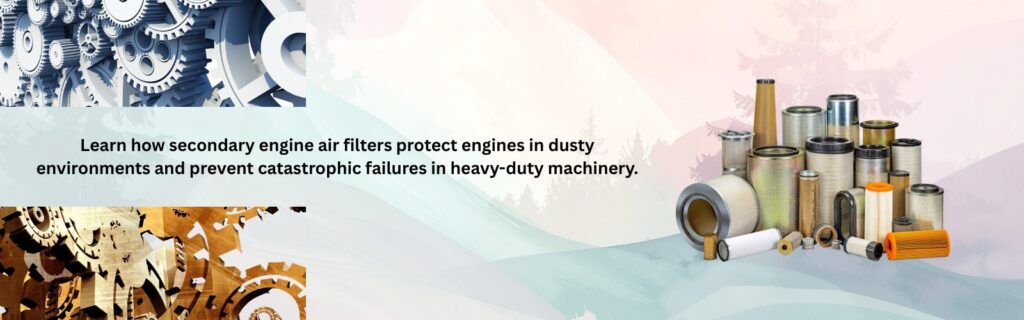
In heavy-duty industries like construction, mining, cement, agriculture, and infrastructure, engines operate in extremely dusty environments. These environments expose machinery to continuous airborne contaminants that can severely damage internal engine components.
Most operators rely on primary air filters to protect engines. However, in harsh conditions, relying on a single filtration stage is often not enough.
This is where Secondary Engine Air Filters become critical.
MMHP India provides engine air filtration solutions designed for real industrial conditions, where dust load is high and engine protection cannot be compromised.
Understanding the role of Secondary Engine Air Filters can help prevent costly engine damage, reduce downtime, and improve long-term performance.
What Are Secondary Engine Air Filters?
Secondary Engine Air Filters are installed as a backup layer after the primary air filter.
Their role is simple but critical:
- capture fine particles that pass through the primary filter
- act as a safety barrier in case primary filter fails
- protect engine during maintenance or filter change
- ensure zero dust entry into engine intake
In high-dust environments, this secondary protection becomes essential.
Why Primary Filters Alone Are Not Enough
Primary filters handle most of the dust load. However, they can:
- develop micro leaks
- get damaged during installation
- allow fine particles to pass through
- lose efficiency under extreme dust loading
Even a small amount of dust entering the engine can cause:
- cylinder wear
- piston damage
- oil contamination
- turbocharger damage
This is why Secondary Engine Air Filters are used as a fail-safe mechanism.
How Dust Damages Engines
Dust particles may appear harmless, but inside an engine they act like abrasive material.
When dust enters:
- it scratches cylinder walls
- damages piston rings
- contaminates lubricating oil
- reduces compression efficiency
- increases fuel consumption
Over time, this leads to complete engine failure.
Using Secondary Engine Air Filters prevents these risks by stopping fine contaminants before they reach critical components.
Role of Secondary Filters in Dusty Applications
Industries that require Secondary Engine Air Filters include:
- mining operations
- road construction
- quarrying
- cement plants
- agriculture equipment
- port operations
- infrastructure projects
In these environments:
- dust is constant
- filtration load is high
- equipment runs continuously
Secondary filtration ensures consistent engine protection.
What Happens If Secondary Filters Are Missing
Without Secondary Engine Air Filters:
- fine dust reaches engine intake
- primary filter failure goes unnoticed
- engine damage accelerates
- maintenance cost increases
- machine life reduces
Many catastrophic engine failures occur due to lack of secondary filtration.
How Secondary Filters Protect During Maintenance
One of the biggest risks occurs during filter replacement.
When the primary filter is removed:
- dust may enter intake system
- contaminants can fall inside housing
- improper installation may create gaps
Secondary Engine Air Filters act as a safety barrier during this process.
They ensure that the engine remains protected even when primary filters are handled.
Why MMHP Engine Air Filters Are Reliable
MMHP India designs air filtration systems for industrial use.
Their filters offer:
- high filtration efficiency
- strong structural design
- proper sealing
- reliable performance in dust-heavy environments
- compatibility with heavy machinery
For companies using Secondary Engine Air Filters, MMHP provides dependable protection.
Real Example: Mining Equipment Failure
A mining company faced repeated engine failures in loaders.
Despite using primary filters, engines showed:
- excessive wear
- oil contamination
- reduced life
Investigation revealed absence of secondary filters.
After installing MMHP Secondary Engine Air Filters:
- engine life improved
- maintenance reduced
- performance stabilized
The issue was not engine quality — it was missing secondary protection.
Impact on Fuel Efficiency
Dust entering the engine reduces combustion efficiency.
This leads to:
- higher fuel consumption
- reduced power output
- incomplete combustion
- increased emissions
Secondary Engine Air Filters help maintain clean airflow, improving fuel efficiency.
Why Dual Stage Filtration Is the Industry Standard
Modern heavy-duty machines use dual-stage filtration because:
- it increases reliability
- reduces risk of failure
- improves performance
- extends engine life
Primary filter handles bulk dust.
Secondary filter handles fine particles.
Together, they provide complete protection.
Signs You Need Secondary Engine Air Filters
Watch for:
- frequent engine servicing
- reduced engine life
- dust in intake system
- oil contamination
- increased fuel consumption
- repeated filter clogging
These indicate need for Secondary Engine Air Filters.
How to Select Secondary Filters
Consider:
- compatibility with primary filter
- correct size and fit
- sealing quality
- filtration efficiency
- application environment
MMHP provides options suitable for different industrial machines.
Why Preventive Protection Is Better Than Repair
Replacing engines or major components is expensive.
Preventing damage is always cheaper.
Secondary Engine Air Filters act as a preventive solution that protects:
- engine internals
- lubrication system
- combustion efficiency
- overall machine performance
Final Conclusion – Why MMHP Is the Best Choice
In dusty industrial environments, relying on a single air filter is a risk. Fine particles can bypass primary filters and cause long-term engine damage.
That is why Secondary Engine Air Filters are essential for complete engine protection.
MMHP India stands out as the best choice because it offers:
- reliable filtration solutions
- strong product design
- industrial-grade durability
- consistent performance in harsh environments
Their filters ensure that engines remain protected even in the toughest conditions.
For businesses that depend on heavy machinery, MMHP Secondary Engine Air Filters provide the confidence of long-term reliability.