
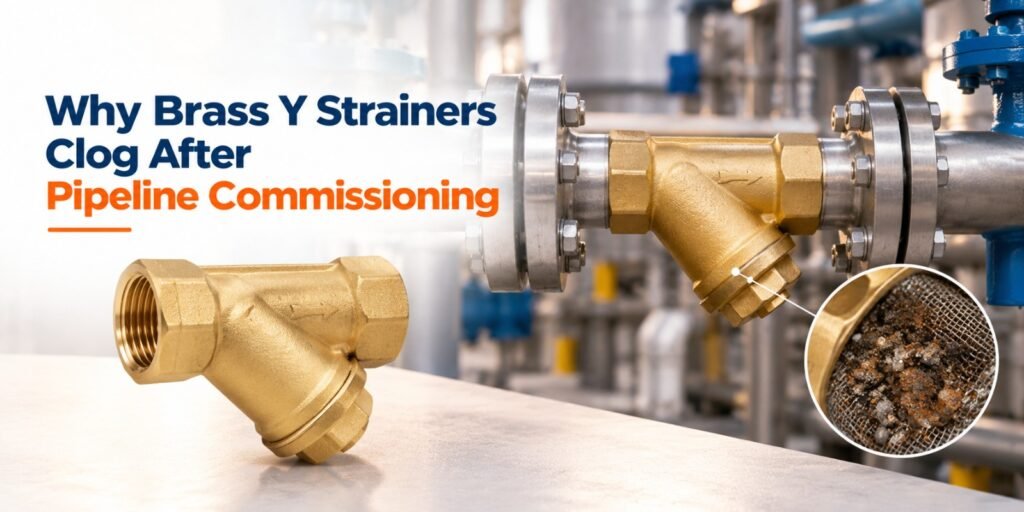
A newly installed pipeline is expected to operate smoothly once commissioning is complete. However, one common problem during initial operation is the unexpected clogging of a Brass Y Strainer.
Even when a pipeline is new, it may contain welding particles, metal shavings, rust, sand, sealing material and other installation debris.
When fluid begins flowing through the system, these contaminants are carried towards downstream components.
A Brass Y Strainer captures solid particles before they reach sensitive equipment such as valves, pumps and control components.
However, during commissioning, the amount of debris can be significantly higher than during normal operation. As a result, the strainer screen may become blocked much faster than expected.
Understanding why this happens helps maintenance teams prevent pressure loss, equipment problems and unnecessary downtime.
What Is a Brass Y Strainer?
A Brass Y Strainer is a mechanical filtration component designed to remove solid contaminants from flowing liquids in compatible piping systems.
It gets its name from its Y-shaped body, which contains a removable mesh or perforated screen.
As fluid passes through the strainer, solid particles larger than the effective screen openings are retained while the filtered fluid continues downstream.
A typical Brass Y Strainer consists of:
- Brass body: Provides the main housing and pipe connections.
- Strainer screen: Captures solid particles carried by the fluid.
- Screen chamber: Collects retained debris.
- Removable cap or plug: Allows access to the screen for maintenance.
Brass Y Strainers are commonly considered for suitable water and other compatible liquid-service applications, subject to material, pressure and temperature requirements.
Why Do Brass Y Strainers Clog After Pipeline Commissioning?
Pipeline commissioning involves preparing a newly installed or modified piping system for operation.
Although the pipeline may look clean externally, contaminants can remain inside it after fabrication and installation.
When the system starts operating, the initial fluid flow can dislodge and transport these particles.
1. Metal Shavings from Pipe Installation
Cutting, threading and drilling operations can leave small metal particles inside pipes.
During commissioning, these particles may travel through the pipeline and collect on the Brass Y Strainer screen.
A large accumulation can reduce the available flow area.
2. Rust and Scale from Pipe Surfaces
Pipelines may contain rust, oxide scale or deposits formed during storage, fabrication or installation.
Initial fluid movement can loosen these materials.
The released particles may then accumulate inside the strainer, increasing resistance to flow.
3. Excess Thread Sealant and Installation Material
Pipe installation sometimes involves thread sealant, PTFE tape or other jointing materials.
Excess material can detach and enter the fluid stream.
These fragments may collect on the strainer screen, especially when they combine with other debris.
4. Sand and Construction Dust
During construction, open pipe ends may be exposed to dust, sand and other environmental contaminants.
If the system is not adequately cleaned before startup, these particles can enter the operating fluid.
5. Inadequate Pipeline Flushing
One of the most important causes of early strainer blockage is insufficient pipeline cleaning.
If the system is placed into service before construction debris is adequately removed, the Brass Y Strainer may collect a large quantity of contaminants during its first operating hours.
This does not necessarily indicate a defective strainer.
In many cases, it indicates that the strainer is performing its intended protective function under an unusually high debris load.
How Strainer Blockage Affects Pipeline Performance
A partially blocked Brass Y Strainer restricts the passage available for fluid flow.
As more particles accumulate, the pressure difference across the strainer generally increases.
Reduced Flow Rate
Excessive blockage can reduce the fluid flow available to downstream equipment.
Increased Pressure Drop
A heavily loaded screen creates additional resistance, potentially affecting system performance.
Valve Operation Problems
Insufficient flow or pressure at downstream control valves may affect their operation.
Pump Operating Issues
Where a strainer is installed on a pump suction line, excessive restriction can reduce available suction pressure and contribute to cavitation risk.
Increased Maintenance Requirements
Repeated screen blockage can require frequent shutdowns, inspection and cleaning.
These problems highlight why strainer condition should be monitored during initial pipeline operation.
How to Identify a Clogged Brass Y Strainer
Early identification can prevent unnecessary troubleshooting of other pipeline components.
Common warning signs include:
- Reduced downstream fluid flow.
- Increasing pressure difference across the strainer.
- Lower-than-expected pressure downstream.
- Unstable operation of connected equipment.
- Significant debris accumulation during screen inspection.
A pressure difference across the strainer can be particularly useful for monitoring blockage.
However, these symptoms may also result from other pipeline restrictions. The strainer should be inspected before concluding that it is responsible.
How to Prevent Brass Y Strainer Blockage During Commissioning
1. Flush the Pipeline Before Startup
Proper flushing helps remove loose construction debris before the system enters normal service.
The flushing procedure should follow the project and equipment manufacturer’s requirements.
2. Inspect the Strainer After Initial Operation
The first operating period may introduce more debris than normal.
An early inspection can help identify accumulated contaminants before they create significant flow restriction.
3. Select the Correct Screen Opening
The screen must capture particles that could damage downstream equipment while allowing the required fluid flow.
An unnecessarily fine screen may become blocked more quickly.
An excessively coarse screen may allow harmful particles to pass through.
4. Consider Screen Area and Flow Requirements
A strainer should not be selected solely according to pipeline connection size.
Available screen area, flow rate, fluid properties and acceptable pressure drop are also important.
5. Follow a Commissioning Maintenance Schedule
For systems exposed to significant installation debris, more frequent inspections may be necessary during initial operation.
Inspection frequency can be adjusted once the system becomes cleaner and operating conditions stabilise.
Why Screen Cleaning Is Important
Cleaning a clogged Brass Y Strainer restores the available flow passages when the screen remains undamaged.
During maintenance, technicians should inspect the screen for trapped particles, deformation, corrosion or damage.
A damaged screen may allow contaminants to pass downstream and should be replaced with a compatible element.
The screen and cap must be reinstalled correctly to maintain sealing integrity.
Important: Before opening a strainer, isolate the pipeline, release pressure, drain the section as required and follow the equipment manufacturer’s safety instructions. Never remove the strainer cap from a pressurised system.
Why Choose MMHP Brass Y Strainers?
MMHP India offers Brass Y Strainers as part of its industrial filtration product range.
These strainers provide a mechanical method of retaining solid contaminants in suitable pipeline applications.
When selecting a Brass Y Strainer, engineers should consider connection size, screen specifications, fluid compatibility, operating pressure, temperature and flow requirements.
Correct product selection and regular maintenance help protect downstream equipment from particulate contamination.
Explore the filtration solutions available from MMHP India and contact the team for product specifications and application suitability.
Frequently Asked Questions
1. Why does a new Brass Y Strainer clog quickly?
New pipelines may contain metal shavings, rust, sand and installation debris. During initial operation, these contaminants collect on the strainer screen.
2. Does early clogging mean the Brass Y Strainer is defective?
Not necessarily. Early blockage often indicates that the strainer is capturing construction debris left inside the pipeline.
3. How can Brass Y Strainer clogging be prevented?
Proper pipeline flushing, correct screen selection and early commissioning inspections can reduce unexpected blockage.
4. Can a clogged Brass Y Strainer reduce water pressure?
Yes. Debris accumulation increases flow resistance and can reduce downstream pressure under flowing conditions.
5. How often should a Brass Y Strainer be cleaned?
Cleaning frequency depends on debris loading, operating conditions and the manufacturer’s recommendations. More frequent inspections may be necessary immediately after commissioning.
Conclusion
A Brass Y Strainer plays an important role in protecting pipeline equipment from solid contaminants.
However, during pipeline commissioning, construction debris can enter the fluid stream and accumulate rapidly on the strainer screen.
Metal shavings, rust, sand and excess sealing materials are common causes of early blockage.
Proper pipeline flushing, correct screen selection and timely maintenance can help prevent excessive pressure drop and unexpected equipment problems.
Rather than treating early strainer clogging as an isolated filter problem, maintenance teams should also investigate the cleanliness of the complete pipeline.
For Brass Y Strainer requirements, contact MMHP India to discuss suitable filtration solutions for your piping application.