

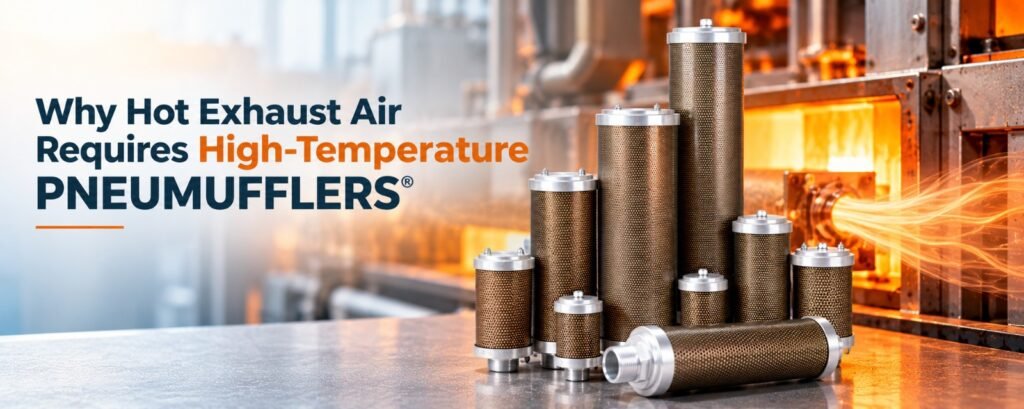
A High Temperature Pneumuffler is designed for pneumatic exhaust applications where operating temperatures may exceed the limits of conventional silencers.
In many industrial facilities, compressed-air exhaust is assumed to be close to ambient temperature. However, actual operating conditions can vary significantly depending on the equipment, process and location.
Pneumatic components may operate near heated machinery, industrial ovens, dryers, thermal-processing equipment or other high-temperature environments.
In these applications, the exhaust silencer can be exposed to elevated temperatures from the air stream, surrounding equipment or both.
Selecting a Pneumuffler without considering temperature can create problems with material compatibility, sealing, dimensional stability and long-term performance.
A silencer may have the correct thread connection and sufficient airflow capacity but still be unsuitable for the operating temperature.
This article explains why temperature matters, how heat affects pneumatic exhaust silencers and what engineers should consider when selecting a High Temperature Pneumuffler.
What Is a High Temperature Pneumuffler?
A High Temperature Pneumuffler is a pneumatic exhaust silencer constructed for a specified elevated-temperature operating range.
Like other pneumatic silencers, its main purpose is to reduce the noise produced when compressed air is discharged into the atmosphere.
The exhaust air passes through an engineered structure that disperses the airflow and reduces the intensity of the discharge noise.
However, high-temperature applications introduce additional requirements.
The silencer material, housing, connections and any sealing components must remain suitable under the expected thermal conditions.
A High Temperature Pneumuffler should therefore be selected based on its rated operating limits rather than appearance or construction alone.
MMHP includes a High Temperature Series within its published PNEUMUFFLER® range.
Why Pneumatic Exhaust Temperature Can Vary
Not every pneumatic system operates under identical thermal conditions.
Several factors can influence the temperature experienced by an exhaust silencer.
Elevated Supply-Air Temperature
Compressed air leaving a compressor can be hot.
Aftercoolers and other air-treatment equipment normally reduce its temperature before distribution.
However, supply-air temperature can still vary depending on system design, ambient conditions and cooling performance.
Heated Industrial Processes
Pneumatic valves and actuators may be installed close to equipment operating at elevated temperatures.
Even when the compressed-air supply is relatively cool, the silencer may absorb heat from the surrounding environment.
Hot Equipment Surfaces
A Pneumuffler installed close to heated machinery may be exposed to radiant or conducted heat.
This makes its installation location an important selection factor.
Repeated Thermal Cycling
Some industrial equipment heats up during operation and cools during shutdown.
The Pneumuffler may therefore experience repeated changes in temperature.
Unusual Exhaust Conditions
The temperature of expanding compressed air can change during discharge.
The actual temperature at the silencer depends on upstream pressure, supply temperature, expansion behaviour and the pneumatic circuit.
For this reason, engineers should measure or establish the expected operating range instead of assuming that exhaust air is always hot or always cold.
How High Temperatures Affect Pneumuffler Materials
Temperature can influence different materials in different ways.
A material that performs well in normal factory conditions may not be suitable for continuous elevated-temperature exposure.
Thermal Expansion
Most engineering materials expand as temperature increases.
In a Pneumuffler, expansion may affect threaded connections, housings and assembled components.
Where different materials are combined, differences in thermal expansion can create additional mechanical stresses.
Changes in Material Properties
Some materials lose stiffness or strength as temperature rises.
Others may become more susceptible to deformation, oxidation or long-term deterioration.
The exact behaviour depends on the material and operating temperature.
Sealing Performance
If the Pneumuffler assembly includes seals or other temperature-sensitive components, their compatibility must be checked.
A material suitable for normal compressed-air applications may not retain its properties at elevated temperatures.
Surface Oxidation
Certain metallic materials may experience oxidation when exposed to heat and oxygen.
The rate and severity depend on temperature, alloy composition and environmental conditions.
This is why the construction of a High Temperature Pneumuffler should be evaluated as a complete assembly.
Why Standard Pneumufflers May Not Be Suitable for Hot Exhaust
A standard Pneumuffler is designed for a particular operating range.
It should not automatically be used outside that range.
For example, some porous plastic materials may have lower allowable operating temperatures than certain metallic constructions.
However, the actual limits depend on the specific material formulation and product design.
It would therefore be incorrect to assume that every metal Pneumuffler is suitable for every high-temperature application.
Engineers must verify the manufacturer’s rated limits.
Important factors include the porous element, housing, threaded connection and any seals.
Material appearance is not a substitute for a verified temperature rating.
How Heat Can Affect Pneumatic Exhaust Performance
Temperature alone does not necessarily cause exhaust restriction.
A properly selected High Temperature Pneumuffler should accommodate its intended operating conditions.
Problems can develop when heat causes material deterioration, deformation or contamination changes.
Changes in Component Fit
Repeated thermal expansion and contraction may affect mechanical connections if the assembly is not designed for those conditions.
Deterioration of Unsuitable Materials
Temperature-sensitive components may deform or degrade when exposed beyond their specified limits.
Changes in Contamination Behaviour
Oil residues and other contaminants may behave differently at elevated temperatures.
Some deposits may harden or become more difficult to remove after repeated heating.
Maintenance Difficulties
Heat-affected threads or deposits can complicate removal and replacement.
These effects are not inevitable. They depend on the selected Pneumuffler and the actual operating environment.
Thermal Cycling: A Hidden Challenge
A High Temperature Pneumuffler may experience repeated heating and cooling during normal production.
Consider a machine operating in a heated process area.
During startup, the equipment gradually reaches its operating temperature.
The Pneumuffler also becomes warmer.
When the process shuts down, the surrounding temperature decreases.
This cycle may repeat daily or several times per shift.
Different components expand and contract according to their materials and dimensions.
Over many cycles, unsuitable connections or assemblies may experience mechanical stress.
Maintenance teams should therefore consider both maximum temperature and the frequency of temperature changes.
Where High Temperature Pneumufflers May Be Required
High-temperature pneumatic exhaust requirements can arise in different industrial settings.
Industrial Drying Equipment
Pneumatic components installed near heated drying processes may experience elevated ambient temperatures.
Thermal Processing Machinery
Actuators and valves used around heated production equipment may require components suitable for the surrounding temperature.
Packaging Machinery Near Heated Stations
Certain packaging operations include sealing or heating equipment.
Pneumatic exhaust components installed nearby should be assessed for heat exposure.
Process Automation
Industrial valves and actuators may operate in areas with elevated process temperatures.
Special-Purpose Pneumatic Equipment
OEM machinery may have operating conditions that fall outside standard pneumatic component ratings.
In each application, the actual temperature at the Pneumuffler should determine the product requirement.
How to Select a High Temperature Pneumuffler
Correct selection requires several technical checks.
1. Determine the Maximum Operating Temperature
Identify the highest temperature the silencer may experience.
Consider both exhaust-air temperature and the surrounding environment.
2. Check Continuous and Intermittent Exposure
A brief temperature peak and continuous exposure at the same temperature may impose different requirements.
Confirm the manufacturer’s applicable rating.
3. Verify Exhaust Flow Capacity
The Pneumuffler must handle the required exhaust volume without excessive restriction.
Temperature suitability alone does not guarantee correct airflow performance.
4. Confirm Operating Pressure
Check the silencer’s pressure rating against the pneumatic circuit requirements.
5. Check Thread Compatibility
Confirm BSP, NPT or other required connection details.
6. Review Construction Materials
Evaluate the porous element, housing and any additional components.
7. Consider Environmental Contamination
Oil, dust, moisture and process residues can influence maintenance requirements.
8. Ensure Safe Maintenance Access
A hot Pneumuffler can present a burn hazard.
Maintenance procedures should include appropriate isolation and cooling before handling.
Common Selection Mistakes
Several mistakes can occur when specifying pneumatic exhaust silencers for heated environments.
One is selecting a silencer based only on thread size.
Another is checking ambient temperature while ignoring the temperature of the exhaust stream.
A third is assuming that metallic construction automatically guarantees high-temperature compatibility.
Other mistakes include overlooking thermal cycling, ignoring nearby heat sources and failing to verify the rating of sealing components.
The correct approach is to assess the complete operating environment.
Maintenance of High Temperature Pneumufflers
High-temperature applications may require inspection practices suited to their conditions.
Maintenance personnel should look for:
- Visible deformation
- Damaged connections
- Unusual deposits
- Changes in exhaust performance
- Surface deterioration
- Loose or damaged components
Any cleaning or replacement should follow the manufacturer’s instructions.
The pneumatic system must be isolated and depressurized before maintenance.
Where the component has been exposed to high temperatures, allow sufficient cooling before handling.
If repeated deterioration occurs, investigate whether the selected product is operating within its specified limits.
Why MMHP High Temperature PNEUMUFFLER®?
MMHP India offers a High Temperature Series as part of its industrial PNEUMUFFLER® product range.
Different pneumatic applications require different combinations of temperature resistance, operating pressure, exhaust flow and construction.
Selecting a suitable High Temperature Pneumuffler helps engineers address noise-control requirements without overlooking the thermal conditions of the equipment.
For application-specific selection, consult the MMHP PNEUMUFFLER® product range and confirm the required operating specifications with MMHP.
Frequently Asked Questions
1. What is a High Temperature Pneumuffler?
It is a pneumatic exhaust silencer designed for a specified elevated-temperature operating range.
2. Can a standard Pneumuffler be used for hot exhaust air?
Only if its published temperature rating covers the actual operating conditions.
3. Are all metal Pneumufflers suitable for high temperatures?
No. Suitability depends on the material, construction and manufacturer’s rated limits.
4. Does high temperature increase pneumatic exhaust backpressure?
Not automatically. Backpressure depends on the exhaust path and operating conditions. Heat-related deterioration or deposits may create additional restriction in unsuitable components.
5. What is thermal cycling?
Thermal cycling is the repeated heating and cooling of a component during equipment operation and shutdown.
6. What should engineers check before selecting a High Temperature Pneumuffler?
They should check temperature, pressure, exhaust flow, material compatibility, connection type and environmental conditions.
Conclusion
A High Temperature Pneumuffler is an important consideration when pneumatic exhaust components operate near heated processes or experience elevated exhaust temperatures.
Selecting the wrong silencer can create problems with material compatibility, mechanical connections and long-term reliability.
Correct selection requires more than choosing a product that fits the exhaust port.
Engineers should verify the operating temperature, pressure, airflow requirements, construction and maintenance conditions.
Explore MMHP India’s PNEUMUFFLER® range for high-temperature pneumatic exhaust applications and contact MMHP for product specifications and selection assistance.