
Introduction: Why a Brass Y Strainer Is Critical for Solenoid Valve Protection
In industrial piping systems, one of the most overlooked yet critical components is the Brass Y Strainer. While solenoid valves control flow with precision, they are highly sensitive to contamination. Even microscopic debris can cause malfunction, leakage, sticking, or coil burnout.
A properly installed Brass Y Strainer acts as a mechanical safeguard, preventing solids from reaching sensitive valve internals. Without it, solenoid valves often fail prematurely—not due to electrical faults, but due to contamination.
This article explains in detail how a Brass Y Strainer protects solenoid valves, how to select the right mesh size, proper installation methods, and why industries depend on this simple yet powerful device.
Understanding Solenoid Valve Vulnerability
Solenoid valves operate through electromagnetic actuation. Internally, they contain:
- Precision-machined orifices
- Moving plunger assemblies
- Sealing diaphragms
- Elastomer seats
These components rely on clean fluid flow. When contaminated fluid enters the valve:
- Orifices clog
- Plungers stick
- Seals wear out
- Flow becomes inconsistent
This leads to unplanned downtime and frequent replacements.
In many systems, installing a Brass Y Strainer for solenoid valve protection eliminates the primary cause of failure.
What Is a Brass Y Strainer?
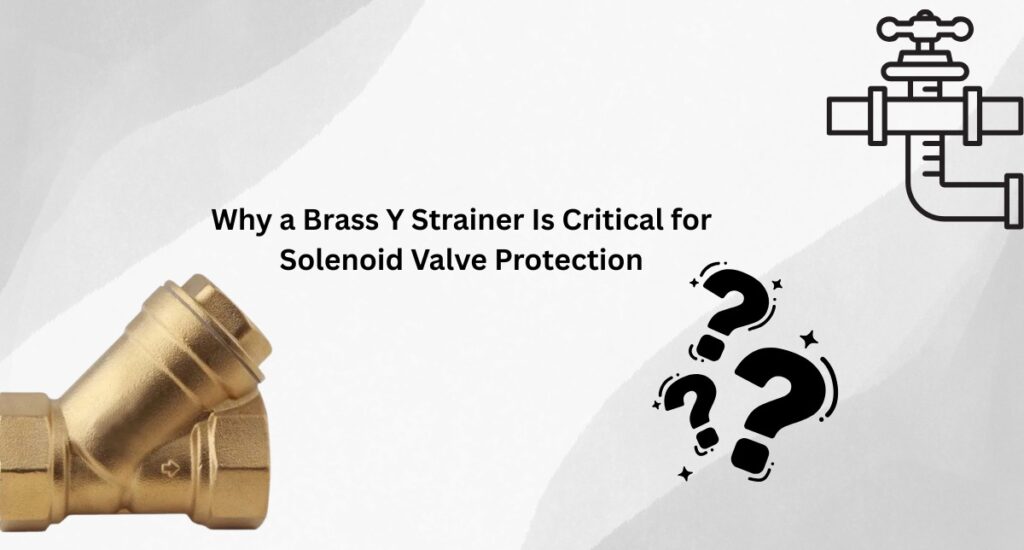
A Brass Y Strainer is an inline filtration device installed in pipelines to remove solid particles from fluids such as water, air, light oils, or compatible process liquids.
Key Components:
- Forged brass body
- Stainless steel mesh screen
- Threaded BSP/NPT connections
- Blow-off / clean-out plug
- Y-shaped debris pocket
The Y configuration allows debris to settle into a pocket without obstructing flow, ensuring minimal pressure drop.
How a Brass Y Strainer Protects Solenoid Valves
1. Captures Debris Before It Reaches the Valve
Solenoid valves often have small pilot openings (sometimes <1 mm). Even minor contamination can obstruct flow.
A Brass Y Strainer intercepts:
- Rust flakes
- Pipe scale
- Sand particles
- Welding slag
- PTFE tape fragments
By filtering these particles, it prevents internal valve damage.
2. Prevents Plunger Sticking
Contaminants inside a valve can restrict plunger movement. When this happens:
- Valve response slows
- Valve may not fully close
- Coil overheats due to prolonged energization
Installing an inline Y strainer filter ensures smooth plunger movement.
3. Protects Valve Seals and Seats
Elastomer seals inside solenoid valves are highly sensitive. Abrasive particles cause micro-damage, leading to leakage.
A Brass Y Strainer for water lines protects seals by preventing abrasive particles from entering the valve chamber.
4. Reduces Coil Burnout
Mechanical sticking increases electrical load. When a plunger cannot move freely:
- Coil remains energized longer
- Excess heat builds up
- Insulation degrades
Many solenoid coil failures trace back to contamination—not electrical defects.
Why Choose Brass for Y Strainers?
Brass offers several advantages:
- Corrosion resistance in utility systems
- Strong mechanical properties
- Cost-effective compared to stainless steel
- Suitable for water, compressed air, light oils
For most HVAC, water, and general utility applications, a Brass Y Strainer provides reliable long-term performance.
Correct Installation of Brass Y Strainer
Improper installation reduces effectiveness.
Best Practices:
- Install upstream of solenoid valve
- Keep close to valve inlet
- Orient Y pocket downward
- Follow flow direction arrow
- Ensure accessibility for maintenance
Correct positioning ensures debris collects efficiently.
Selecting the Right Mesh Size
Mesh selection depends on:
- Valve orifice size
- Fluid contamination level
- Required flow rate
General Mesh Recommendations:
- 40–60 mesh → General pipeline protection
- 80–100 mesh → Ideal for solenoid valves
- 120+ mesh → Fine control systems
Selecting appropriate Y strainer mesh size balances filtration and pressure drop.
Pressure Drop Considerations
A common misconception is that a Brass Y Strainer significantly restricts flow.
When properly sized:
- Initial pressure drop is minimal
- Flow remains stable
- Only clogged strainers cause restriction
Routine cleaning prevents excessive ΔP buildup.
Industrial Applications of Brass Y Strainer
HVAC Systems
Prevents valve blockage in chilled water lines.
Water Treatment Plants
Protects dosing solenoids from sediment.
Pharmaceutical Utilities
Ensures contamination-free operation.
Food Processing Units
Maintains hygiene by preventing debris contamination.
Chemical Handling Systems
Protects control valves in dosing circuits.
What Happens Without a Y Strainer?
Systems lacking filtration face:
- Frequent solenoid replacement
- Production downtime
- Increased maintenance costs
- Inconsistent process control
The cost of a single solenoid failure often exceeds the cost of multiple Brass Y Strainers.
Maintenance Advantages
Cleaning a Brass Y Strainer is straightforward:
- Isolate line
- Remove plug
- Extract mesh
- Clean debris
- Reinstall
This process takes minutes compared to dismantling a valve.
Common Installation Mistakes
- Installing sideways
- Using excessive PTFE tape
- Oversizing mesh unnecessarily
- Ignoring cleaning schedule
Avoiding these mistakes maximizes valve protection.
When to Use Stainless Steel Instead
Choose SS strainers when:
- Handling aggressive chemicals
- High temperature systems
- High pressure pipelines
For standard utility systems, brass remains optimal.
Why Industries Depend on Brass Y Strainer for Solenoid Valve Protection
Industrial systems demand reliability. Solenoid valves are precise devices vulnerable to contamination.
A Brass Y Strainer for solenoid valve applications ensures:
- Extended valve lifespan
- Stable pressure control
- Reduced coil failure
- Lower maintenance frequency
- Predictable performance
It is a small investment that prevents large operational losses.
About MMHP India
MMHP India manufactures and supplies industrial filtration and pipeline protection components, including Brass Y Strainers engineered for utility and process applications. Designed for durability and efficient debris capture, their strainers support downstream equipment protection such as solenoid valves, pumps, and control systems across multiple industries.
Frequently Asked Questions
1. What mesh size is best for solenoid valves?
Typically 80–100 mesh depending on orifice size.
2. Does a Brass Y Strainer reduce flow?
Minimal impact when properly sized.
3. How often should cleaning be done?
Depends on contamination level; inspect during commissioning phase frequently.
4. Can Brass Y Strainer be used for compressed air?
Yes, for dry and compatible conditions.
5. Where should it be installed?
Directly upstream of solenoid valve.
Conclusion: The Smartest Protection for Solenoid Valves
Solenoid valves fail prematurely primarily due to contamination. A Brass Y Strainer acts as the first defense barrier, preventing debris from reaching sensitive internal components.
It protects:
- Orifices
- Plungers
- Seals
- Coils
In industrial reliability planning, prevention is always more economical than repair.Installing a Brass Y Strainer for solenoid valve protection is not optional—it is essential for long-term system performance and reduced downtime.