Industrial pumps are among the hardest-working components in any fluid handling system. Whether transporting water, hydraulic oil, chemicals, coolants, process fluids, or industrial liquids, pumps are expected to operate continuously with minimal downtime.
However, even the most advanced pump cannot perform efficiently if contaminants are allowed to enter the system.
Small particles such as rust flakes, welding residue, pipe scale, sand, dirt, metal shavings, and other debris travel through pipelines every day. These contaminants may appear insignificant, but they can gradually damage pump components, reduce flow efficiency, block valves, increase maintenance costs, and eventually cause expensive equipment failures.
This is why Brass Y Strainers are considered one of the most important protective components in industrial piping systems.
Installed before pumps, valves, meters, and other sensitive equipment, Brass Y Strainers act as the first line of defense by capturing unwanted debris before it enters critical components.
Although they are compact and relatively inexpensive, they play a major role in improving system reliability, reducing maintenance, and extending equipment life.
For industries aiming to reduce downtime and improve operational efficiency, investing in high-quality Brass Y Strainers is one of the simplest and most cost-effective decisions.
Why Pump Failures Begin with Contamination
When a new pumping system is installed, it generally operates smoothly.
Flow rates are consistent.
Pressure remains stable.
Equipment performs exactly as designed.
Over time, however, contaminants begin entering the system.
These contaminants originate from several sources:
- Newly installed pipelines
- Corrosion inside older pipes
- Maintenance activities
- External dust
- Manufacturing residue
- Fluid contamination
Without proper filtration, these particles circulate continuously throughout the piping system.
Eventually they reach critical equipment.
The result is gradual wear that often goes unnoticed until major failures begin to occur.
Installing Brass Y Strainers significantly reduces this risk by removing contaminants before they reach sensitive components.
The Hidden Cost of Pipeline Contamination
Many industries underestimate the financial impact of contamination.
A single damaged pump may result in:
- Production downtime
- Emergency maintenance
- Replacement parts
- Labour expenses
- Reduced productivity
- Delayed deliveries
In many cases, the actual repair cost is only a small part of the total financial loss.
Unexpected downtime often costs significantly more than the replacement component itself.
Using Brass Y Strainers helps prevent contamination-related failures before they occur.
What Are Brass Y Strainers?
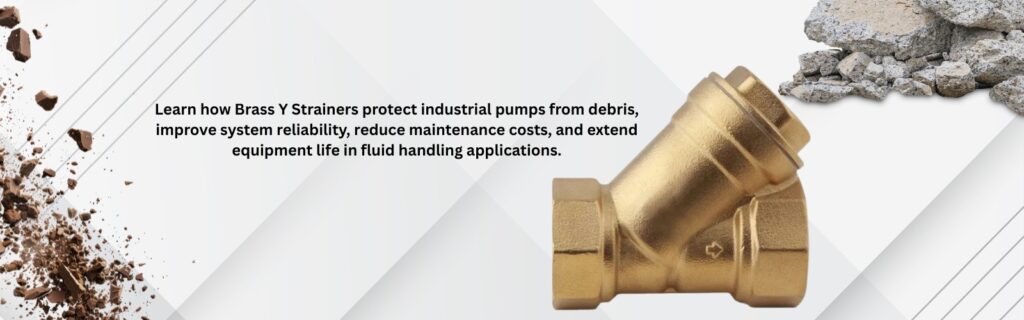
A Brass Y Strainer is an inline mechanical filtration device installed in pipelines to remove solid particles from flowing liquids.
Its name comes from the distinctive Y-shaped body that houses a removable filtration screen.
As fluid flows through the pipeline, contaminants are trapped inside the screen while clean fluid continues downstream.
This simple operating principle provides continuous protection without affecting normal system operation.
Because of their compact design and reliable performance, Brass Y Strainers are widely used across numerous industries.
Why the “Y” Design Works So Well
The angled Y-shaped chamber is not simply a design feature—it serves an important purpose.
It allows contaminants to collect inside the screen chamber while maintaining smooth fluid flow through the main pipeline.
This design offers several advantages:
- Compact installation
- Low pressure loss
- Easy maintenance
- Efficient debris collection
Compared to larger filtration systems, Brass Y Strainers provide effective protection while requiring very little installation space.
How Brass Y Strainers Work
The operation of Brass Y Strainers is simple yet highly effective.
Step 1 – Fluid Enters the Strainer
Water, oil, or process fluid enters the inlet side of the strainer.
Step 2 – Flow Passes Through the Screen
The fluid passes through a precision mesh or perforated screen.
The screen captures:
- Rust
- Sand
- Scale
- Dirt
- Welding particles
- Metal chips
- Other suspended solids
Step 3 – Clean Fluid Continues
After filtration, the cleaned fluid flows toward the pump or downstream equipment.
Only contaminants remain trapped inside the screen chamber.
Step 4 – Screen Cleaning
When contamination builds up, the screen can be removed, cleaned, and reinstalled.
This allows Brass Y Strainers to provide long-term service with minimal maintenance.
Why Pumps Need Protection
Industrial pumps contain precisely engineered internal components.
Even small particles can damage:
- Impellers
- Mechanical seals
- Bearings
- Wear rings
- Pump housings
Over time, abrasive contaminants gradually reduce pumping efficiency.
This often leads to:
- Increased energy consumption
- Reduced flow rate
- Pressure instability
- Frequent maintenance
Installing Brass Y Strainers helps prevent contaminants from reaching these sensitive components.
Components Protected by Brass Y Strainers
Although pumps are one of the primary applications, Brass Y Strainers protect many other types of equipment as well.
Control Valves
Small particles can prevent valves from closing properly.
This causes:
- Leakage
- Flow instability
- Poor process control
Pressure Regulators
Contamination can interfere with pressure regulation, affecting overall system performance.
Flow Meters
Debris can damage measuring elements or reduce accuracy.
Clean fluid improves measurement reliability.
Heat Exchangers
Particles accumulate inside narrow passages.
This reduces heat transfer efficiency and increases maintenance requirements.
Spray Nozzles
Many industrial spray systems use very small nozzle openings.
Without Brass Y Strainers, these nozzles may become blocked, affecting process quality.
Common Sources of Contamination
Industrial piping systems encounter contamination from many different sources.
Pipe Scale
Older steel pipelines gradually produce rust and scale.
Welding Debris
New installations often contain:
- Welding slag
- Metal particles
- Construction debris
Sand
Water systems frequently transport sand particles.
Corrosion Products
Internal corrosion continuously generates contamination.
Maintenance Activities
Opening pipelines during servicing may introduce external dirt into the system.
Process Contamination
Certain manufacturing processes naturally generate suspended solids that circulate within the fluid system.
All of these contaminants can be effectively captured using properly selected Brass Y Strainers.
Industries That Rely on Brass Y Strainers
Because contamination is a universal challenge, Brass Y Strainers are used in a wide variety of industries.
These include:
Water Treatment Plants
Protect pumps, valves, and instrumentation from suspended solids.
HVAC Systems
Maintain clean water circulation while protecting pumps and heat exchangers.
Chemical Processing
Prevent solid particles from damaging process equipment.
Food & Beverage Industry
Support reliable fluid handling and equipment protection.
Pharmaceutical Manufacturing
Maintain cleaner process lines and protect sensitive equipment.
General Industrial Manufacturing
Improve the reliability of pumps, cooling systems, lubrication circuits, and utility pipelines.
Benefits of Installing Brass Y Strainers
Many industries install Brass Y Strainers primarily to protect pumps. While pump protection is one of their biggest advantages, the benefits extend much further across the entire fluid handling system.
Properly selected Brass Y Strainers help improve equipment reliability, reduce maintenance costs, and support uninterrupted plant operations.
Let’s explore these advantages in detail.
1. Protects Pumps from Abrasive Wear
Industrial pumps operate with close internal clearances.
Even tiny particles can gradually wear:
- Pump impellers
- Mechanical seals
- Bearings
- Wear rings
- Shafts
This wear reduces hydraulic efficiency and increases energy consumption.
Installing Brass Y Strainers before the pump prevents abrasive contaminants from reaching these critical components.
As a result, pumps operate more efficiently and require fewer repairs.
2. Extends Equipment Life
Contamination affects every downstream component—not just pumps.
By continuously removing solid particles, Brass Y Strainers help extend the service life of:
- Valves
- Flow meters
- Heat exchangers
- Pressure regulators
- Spray nozzles
- Cooling systems
Cleaner fluid means less internal wear throughout the system.
3. Reduces Maintenance Costs
Unexpected equipment failures are expensive.
Maintenance costs often include:
- Spare parts
- Labour
- Downtime
- Emergency repairs
- Production losses
Since Brass Y Strainers capture contaminants before they damage equipment, maintenance becomes more predictable and less frequent.
This helps industries lower their overall operating costs.
4. Improves System Reliability
Reliable fluid flow is essential for industrial operations.
When contaminants circulate freely through pipelines, they increase the risk of:
- Blocked valves
- Damaged seals
- Flow restrictions
- Pressure fluctuations
By keeping the fluid cleaner, Brass Y Strainers help maintain stable system performance and improve equipment reliability.
5. Prevents Unexpected Downtime
Downtime is one of the largest hidden costs in manufacturing.
A single pump failure may stop an entire production line.
Replacing one damaged component often takes several hours—or even days.
Installing Brass Y Strainers significantly reduces contamination-related failures, helping production continue without interruption.
6. Supports Consistent Fluid Flow
Clean pipelines provide stable flow characteristics.
When contaminants accumulate inside pumps or valves, flow becomes inconsistent.
This can affect:
- Process quality
- Cooling performance
- Chemical dosing
- Equipment accuracy
Brass Y Strainers help maintain smooth and consistent fluid flow by preventing debris from entering sensitive equipment.
Choosing the Right Brass Y Strainers
Selecting the correct Brass Y Strainers is essential for achieving reliable filtration without affecting system performance.
Several factors should be considered during selection.
Pipe Size
The strainer should match the pipeline size to ensure proper installation and maintain flow efficiency.
Incorrect sizing can increase pressure loss or reduce filtration effectiveness.
Flow Rate
Every application has different flow requirements.
The selected Brass Y Strainers should comfortably handle the expected flow without creating excessive pressure drop.
Mesh Size
The filtration screen should match the type of contamination expected.
Fine mesh captures smaller particles but may require more frequent cleaning.
Coarser mesh provides lower restriction while removing larger debris.
Selecting the correct mesh size ensures the best balance between filtration efficiency and maintenance frequency.
Operating Pressure
Industrial systems operate at different pressure levels.
Always ensure the selected Brass Y Strainers are suitable for the system’s maximum operating pressure.
Fluid Compatibility
Brass is widely used because of its excellent corrosion resistance and durability.
However, engineers should always confirm material compatibility with the process fluid before installation.
Common Installation Mistakes
Even high-quality Brass Y Strainers cannot provide effective protection if installed incorrectly.
Some common mistakes include:
Installing in the Wrong Flow Direction
Most strainers have a flow arrow cast into the body.
Incorrect installation prevents proper filtration and may damage the screen.
Always verify flow direction during installation.
Installing Without Enough Service Clearance
The filter screen requires periodic cleaning.
If there is insufficient clearance below the strainer, maintenance becomes difficult.
Proper installation should always allow easy access to the screen cap.
Ignoring Pressure Drop
As contaminants accumulate, pressure drop across the strainer gradually increases.
Ignoring this pressure increase may reduce pump efficiency and increase energy consumption.
Routine monitoring helps determine when cleaning is required.
Selecting the Wrong Mesh
A mesh that is too coarse may allow harmful particles to pass.
A mesh that is too fine may clog rapidly.
Choosing the correct filtration level is critical for optimum performance.
Pressure Drop: What Every Engineer Should Know
Every filtration device creates some resistance to fluid flow.
A properly selected Brass Y Strainer minimizes this resistance while still capturing harmful contaminants.
Pressure drop depends on:
- Flow rate
- Mesh size
- Fluid viscosity
- Amount of trapped contamination
As debris accumulates inside the screen, pressure drop increases.
Routine cleaning restores normal flow and maintains system efficiency.
Real Industrial Example
A food processing plant experienced repeated failures of centrifugal pumps supplying process water.
Technicians initially suspected:
- Pump quality
- Motor alignment
- Mechanical seal problems
However, after dismantling the pumps, they discovered damage caused by rust particles originating from ageing pipeline sections.
The maintenance team installed Brass Y Strainers upstream of each pump.
Within a few months, they observed:
- Fewer pump failures
- Reduced seal wear
- Lower maintenance costs
- Improved flow stability
- Increased equipment reliability
A relatively simple filtration upgrade prevented recurring failures and significantly reduced downtime.
Why OEMs Prefer Brass Y Strainers
Original Equipment Manufacturers increasingly specify Brass Y Strainers because they improve both equipment reliability and customer satisfaction.
Benefits for OEMs include:
Better Equipment Protection
Clean fluid extends component life.
Lower Warranty Claims
Reducing contamination-related failures decreases warranty costs.
Compact Installation
The Y-body design requires minimal installation space.
Easy Maintenance
Cleaning the screen is straightforward and does not require replacing the complete strainer.
Long-Term Reliability
Durable brass construction supports years of dependable service in industrial environments.
Preventive Maintenance Tips
To maximize the life and performance of Brass Y Strainers, industries should follow a regular maintenance schedule.
Inspect Pressure Differential
A sudden increase often indicates screen blockage.
Clean the Screen Periodically
Routine cleaning restores normal flow and prevents excessive pressure loss.
Inspect Seals During Maintenance
Damaged seals may allow leakage or contamination bypass.
Check for Corrosion or Mechanical Damage
Although brass offers excellent corrosion resistance, periodic inspection ensures reliable long-term operation.
Maintain Service Records
Recording inspection and cleaning intervals helps optimize future maintenance planning.
How to Select the Right Brass Y Strainers
Choosing the correct Brass Y Strainers is not simply about matching the pipe size. Every industrial application has unique operating conditions, fluid characteristics, and maintenance requirements. Selecting the right strainer ensures optimum filtration without compromising system performance.
Here are the most important factors to evaluate before selecting Brass Y Strainers.
1. Understand the Fluid Being Filtered
Different fluids carry different types of contaminants.
For example:
- Water systems may contain sand, rust, and pipe scale.
- Cooling systems often carry corrosion particles.
- Chemical processing lines may contain process residues.
- Lubrication systems generate metal wear particles.
Selecting Brass Y Strainers according to the type of contamination improves filtration efficiency and equipment protection.
2. Choose the Correct Mesh Size
The mesh screen determines the size of particles that can be removed.
A finer mesh captures smaller contaminants but may require more frequent cleaning.
A coarser mesh allows higher flow while removing larger debris.
The ideal mesh size depends on:
- Equipment sensitivity
- Fluid cleanliness requirements
- Expected contamination levels
- Maintenance intervals
Proper mesh selection allows Brass Y Strainers to balance filtration efficiency with system performance.
3. Consider Flow Requirements
Every piping system operates at a different flow rate.
The selected Brass Y Strainers should provide adequate filtration without creating unnecessary pressure loss.
Oversized or undersized strainers can affect:
- Pump performance
- Flow stability
- System efficiency
Flow calculations should always be considered during selection.
4. Verify Pressure Rating
Industrial pipelines often operate under varying pressures.
The selected strainer should safely withstand:
- Operating pressure
- Pressure surges
- Continuous duty conditions
Choosing properly rated Brass Y Strainers improves long-term reliability.
5. Plan for Maintenance Accessibility
Even the best strainer requires periodic cleaning.
When installing Brass Y Strainers, ensure sufficient clearance is available to remove and clean the filter screen without dismantling nearby equipment.
Easy maintenance reduces servicing time and minimizes downtime.
Best Maintenance Practices
Routine maintenance is essential for keeping Brass Y Strainers operating efficiently.
A preventive maintenance schedule helps maintain consistent flow while protecting downstream equipment.
Inspect Regularly
Periodic inspection helps identify:
- Debris accumulation
- Screen damage
- Seal wear
- Leakage
Routine inspections prevent small issues from becoming major problems.
Clean Before Excessive Blockage Occurs
Waiting until flow is severely restricted can reduce pump efficiency and increase energy consumption.
Cleaning the screen at planned intervals maintains optimum performance.
Replace Damaged Screens
If the filtration screen becomes damaged or deformed, contaminants may bypass the filtration system.
Replacing damaged screens ensures continued protection.
Monitor Pressure Drop
An increasing pressure drop often indicates that contaminants have accumulated inside the screen.
Monitoring pressure helps determine the ideal cleaning interval.
Use Genuine Replacement Components
Using compatible replacement screens and seals helps maintain the original performance of Brass Y Strainers.
Why Preventive Filtration Saves Money
Many companies focus only on repairing equipment after failures occur.
However, preventing contamination is considerably less expensive than repairing damaged machinery.
Installing quality Brass Y Strainers helps reduce:
- Pump repairs
- Valve replacement
- Seal failures
- Equipment downtime
- Emergency maintenance
- Energy losses
A relatively small investment in filtration often protects equipment worth thousands of dollars.
Why MMHP Brass Y Strainers?
At MMHP India, we understand that reliable fluid handling begins with effective contamination control.
Our Brass Y Strainers are designed to provide dependable filtration while supporting easy maintenance and long service life.
They are suitable for a wide range of industrial applications where protecting pumps, valves, flow meters, and process equipment is critical.
MMHP focuses on delivering products that combine:
- Durable brass construction
- Reliable filtration performance
- Compact installation
- Easy screen cleaning
- Long operational life
- Consistent system protection
Whether used in industrial water systems, process plants, HVAC installations, lubrication circuits, or OEM machinery, MMHP Brass Y Strainers help improve equipment reliability and reduce maintenance costs.
Why Choose MMHP?
Selecting a filtration product is not only about removing contaminants—it is about choosing a solution that improves the overall performance of your system.
MMHP India provides industrial filtration solutions developed to meet the practical needs of engineers, maintenance professionals, OEMs, and industrial users.
Our products are trusted because they offer:
✔ Reliable contamination control
✔ Durable construction
✔ Consistent flow performance
✔ Easy maintenance
✔ Long service life
✔ Suitable solutions for multiple industrial applications
With years of experience in industrial filtration, MMHP continues to help customers improve equipment reliability while reducing operating costs.
Conclusion
Industrial pumps are designed to deliver reliable performance for years, but even the most advanced pump cannot withstand continuous exposure to contamination.
Rust, pipe scale, sand, welding debris, and other solid particles gradually damage internal components, reducing efficiency and increasing maintenance costs.
Brass Y Strainers provide a simple yet highly effective solution by removing these contaminants before they reach sensitive equipment.
Their compact design, low maintenance requirements, and dependable filtration performance make them an essential component of modern industrial piping systems.
Whether protecting pumps, valves, flow meters, heat exchangers, or spray nozzles, Brass Y Strainers help improve equipment reliability, extend service life, and reduce unexpected downtime.
MMHP India offers Brass Y Strainers engineered to meet the demands of industrial applications where performance, durability, and ease of maintenance are equally important.
Investing in quality filtration today helps prevent expensive equipment failures tomorrow.
Frequently Asked Questions (FAQs)
1. What is the purpose of a Brass Y Strainer?
A Brass Y Strainer removes solid contaminants from flowing liquids before they reach pumps, valves, flow meters, and other sensitive equipment.
2. Where should Brass Y Strainers be installed?
They are typically installed upstream of pumps, control valves, heat exchangers, pressure regulators, and flow meters to protect downstream equipment.
3. How often should Brass Y Strainers be cleaned?
Cleaning frequency depends on the contamination level, operating conditions, and pressure drop across the strainer. Regular inspection helps determine the appropriate maintenance interval.
4. Can Brass Y Strainers be reused?
Yes. The filter screen inside most Brass Y Strainers can be removed, cleaned, and reinstalled, making them a cost-effective filtration solution.
5. Which industries commonly use Brass Y Strainers?
Brass Y Strainers are widely used in:
- Water treatment plants
- HVAC systems
- Chemical processing
- Food & beverage industries
- Pharmaceutical manufacturing
- General industrial fluid handling
- OEM machinery
- Utility piping systems