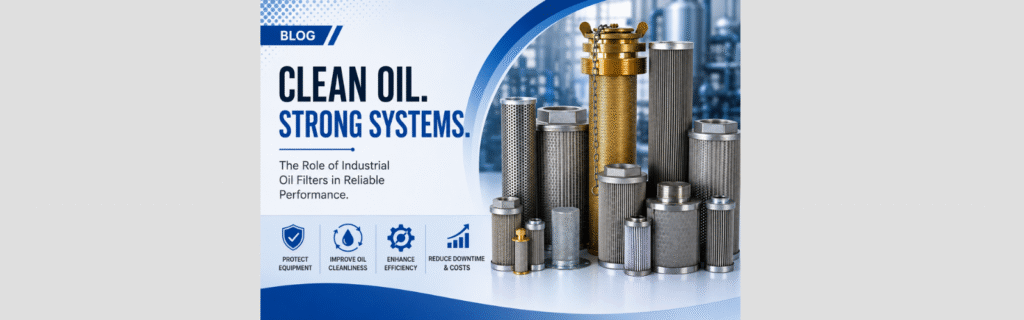
Industrial oil filters are designed to remove contaminants from lubricating and hydraulic oils before those contaminants damage machinery.
Yet maintenance teams frequently face the same problem:
A newly installed oil filter becomes clogged much earlier than expected.
The first reaction is often to blame the filter element. But premature clogging can actually be a warning sign of a larger problem elsewhere in the system.
Contaminated oil, incorrect viscosity, oxidation, component wear, water ingress, poor reservoir cleanliness and incorrectly selected filtration can all increase the load placed on industrial oil filters.
MMHP manufactures oil and hydraulic filtration solutions using media including paper and stainless-steel wire mesh for industrial applications. Its oil filters are used across lubrication and hydraulic systems as well as marine, earthmoving, agricultural and other equipment applications.
Understanding why filters clog early can therefore help you diagnose the condition of the entire oil system.
What Does an Industrial Oil Filter Actually Remove?
Oil inside machinery is constantly exposed to contamination.
Even when a hydraulic or lubrication system begins with clean oil, contaminants can gradually enter or develop during operation.
Common contaminants include:
- Metal wear particles
- Dust and dirt
- Rust
- Seal debris
- Carbon deposits
- Oxidation products
- Sludge
- Manufacturing debris
The oil filter element captures these contaminants while allowing oil to continue flowing through the system.
Over time, captured particles accumulate within the filtration media.
Some loading is completely normal.
The problem begins when the filter reaches its contamination capacity much sooner than expected.
1. Excessive Contamination Is Entering the System
One of the most obvious reasons an industrial oil filter clogs quickly is simply that it is receiving too much contamination.
Contaminants can enter through:
- Reservoir openings
- Breathers
- Damaged seals
- Maintenance activities
- Hose replacement
- New component installation
- Poorly stored oil
- Contaminated oil-transfer equipment
Every additional particle entering the system eventually becomes additional work for the filter.
If an oil filter that normally lasts six months suddenly becomes restricted after two months, the question should not only be:
“Why did the filter fail?”
It should also be:
“Where is all this contamination coming from?”
2. New Oil Is Not Necessarily Clean Oil
This is an important misconception in industrial maintenance.
Fresh oil does not automatically mean contamination-free oil.
Contamination can enter lubricant during manufacturing, storage, transportation and transfer.
Oil may also be introduced through containers, funnels, pumps or hoses that are not sufficiently clean.
If contaminated oil is poured directly into a hydraulic reservoir, the new industrial oil filter immediately has to remove those particles.
This can significantly reduce element life.
For critical systems, filtration during oil transfer can help reduce this initial contamination load.
3. Internal Component Wear May Be Increasing
A filter does not create metal particles.
It captures them.
Therefore, an unusual increase in metallic contamination can indicate wear elsewhere in the machine.
Possible sources include:
- Pumps
- Bearings
- Gears
- Hydraulic motors
- Cylinders
- Valves
As mechanical wear increases, additional particles circulate through the oil.
The filter captures them and consequently loads faster.
This means premature oil-filter clogging can sometimes be an early warning of equipment deterioration.
Simply replacing the filter repeatedly may hide the symptom without correcting the source.
4. Oil Oxidation Can Create Sludge and Deposits
Oil does not remain chemically unchanged forever.
Exposure to heat, oxygen and contaminants gradually degrades lubricant.
Oxidation can produce:
- Sludge
- Varnish
- Deposits
- Acidic by-products
These contaminants can place a significant load on oil filtration systems.
A filter may therefore become restricted even when external dust contamination is relatively low.
If filters are repeatedly covered with dark, sticky deposits, lubricant condition should be investigated.
5. High Oil Temperature Can Shorten Filter Life Indirectly
Temperature affects lubricant life.
Excessive operating temperatures can accelerate oil oxidation.
Faster oxidation means more degradation products.
More degradation products mean greater contamination loading.
And greater contamination loading means the industrial oil filter can become restricted sooner.
If filter life suddenly decreases, check whether machine operating temperatures have increased.
Possible causes may include:
- Cooling-system problems
- High ambient temperature
- Excessive machine loading
- Incorrect lubricant
- Restricted oil circulation
Filter condition can therefore reveal useful information about the overall lubrication system.
6. Cold Oil Can Make a Good Filter Look Clogged
Not every high differential-pressure reading means contamination.
Oil viscosity increases as temperature decreases.
During cold startup, thick oil requires more force to pass through the filtration media.
This creates a temporary increase in differential pressure.
As the machine warms up, oil viscosity decreases and pressure drop may return toward normal.
Maintenance teams should therefore avoid diagnosing filter restriction from a cold-start reading alone.
Consider:
Oil temperature + viscosity + flow + differential pressure
together.
7. The Filter May Be Too Small for the Flow
Oil filters should not be selected only by connection size.
A filter can physically connect to a system and still be undersized for the required flow.
If excessive oil is forced through insufficient filtration area, pressure drop increases.
An undersized filter may experience:
- Higher differential pressure
- Shorter element life
- Increased bypass operation
- Reduced filtration performance
Correct sizing should consider maximum system flow rather than only average flow.
8. The Micron Rating May Be Too Fine
Finer filtration can provide better contaminant control—but only when properly engineered.
Suppose a system previously uses a relatively coarse element and a much finer element is installed without reviewing flow and contamination conditions.
The finer filter captures substantially more small particles.
As a result, it may load much faster.
This does not necessarily mean the finer filter is poor quality.
It may simply be capturing contamination that the previous filter allowed to circulate.
The correct approach is to balance:
Filtration efficiency + flow + pressure drop + dirt-holding capacity.
9. Water Contamination Can Make the Problem Worse
Water is another major enemy of industrial lubrication systems.
It can enter through:
- Condensation
- Damaged seals
- Washdown processes
- Humid environments
- Coolers
- Poor storage
Water can contribute to corrosion.
Corrosion creates rust particles.
Those particles are then captured by the oil filter.
Water can also interact with degraded oil and contaminants, contributing to sludge formation.
The filter then becomes loaded by contamination created inside the system itself.
10. Dirty Reservoirs Keep Recontaminating the Oil
Replacing the oil and filter does not necessarily clean the system.
If sludge, rust and debris remain inside the reservoir, fresh oil can immediately become contaminated again.
The new filter then captures material left behind from the previous operating cycle.
Repeated short filter life may therefore indicate that the system requires more comprehensive cleaning.
Why Differential Pressure Matters
As contamination accumulates in the filter media, available oil-flow passages become increasingly restricted.
Pressure before the filter rises relative to pressure after the filter.
This difference is called differential pressure.
Monitoring differential pressure can provide valuable information about element condition.
Rather than relying exclusively on fixed replacement schedules, maintenance teams can observe how filtration resistance changes over time.
What Happens If a Clogged Oil Filter Is Ignored?
Continuing to operate with a severely restricted oil filter can create several problems.
Depending on system design, these can include:
- Increased pressure loss
- Reduced oil flow
- Bypass valve opening
- Increased energy demand
- Poor lubrication
- Reduced hydraulic performance
If a bypass valve opens, oil can continue circulating while bypassing the restricted element.
This protects flow—but potentially sacrifices filtration.
The machinery may therefore continue operating while contaminated oil circulates downstream.
Applications of MMHP Oil Filters
MMHP describes its oil filters as suitable for maintaining hydraulic and lubrication systems, where contamination can contribute to system failures, operating costs and breakdowns. Its stated applications include lube-oil filtration, hydraulic systems, fuel strainers, agriculture, marine operations, earthmoving equipment, EDM machines and adhesive-dispensing systems.
This range of applications demonstrates why filter selection cannot follow a one-size-fits-all approach.
An earthmoving machine operating in a dusty environment has different contamination challenges from an EDM machine or marine lubrication system.
Paper vs Stainless-Steel Wire Mesh Oil Filter Media
MMHP lists paper and stainless-steel wire mesh among its oil-filter media options.
Each media type can suit different filtration requirements.
Paper Filter Media
Paper-based media can provide effective particle capture with substantial filtration surface area when pleated.
It is commonly used where replaceable filtration is appropriate.
Stainless-Steel Wire Mesh
SS wire-mesh filtration can provide mechanical strength and compatibility for suitable industrial fluid-filtration applications.
The right choice depends on factors including:
- Required filtration level
- Oil type
- Temperature
- Flow
- Operating environment
- Maintenance requirements
Filter media should therefore be selected according to the application rather than simply choosing one material for every machine.
How to Extend Industrial Oil Filter Life
Improving filter life starts with controlling contamination before it reaches the element.
Practical measures include:
- Keep reservoirs properly sealed.
- Maintain breathers and seals.
- Use clean oil-transfer equipment.
- Monitor lubricant condition.
- Investigate abnormal metallic contamination.
- Control operating temperature.
- Select the correct filter size and media.
- Monitor differential pressure.
- Prevent water ingress.
- Keep reservoirs and hydraulic systems clean during maintenance.
The objective should not simply be to make the filter last longer.
The real objective is to reduce the amount of damaging contamination circulating through the machine.
Why Choose MMHP Oil Filters?
MMHP provides oil/hydraulic filtration products intended to remove contaminants from oil and hydraulic fluids and support system efficiency. Its dedicated oil-filter range highlights consistent particle removal, compatibility with various lubricants, paper and SS wire-mesh media, and use across multiple industrial sectors.
For industrial filtration, correct selection should consider actual operating conditions rather than simply replacing an existing element by dimensions.
Important parameters include:
- Oil type
- Flow rate
- Operating pressure
- Temperature
- Required filtration level
- Contamination conditions
- Filter media
- Installation environment
Matching these parameters helps achieve effective filtration without unnecessary pressure loss.
Frequently Asked Questions
Why does my oil filter clog quickly?
High contamination levels, component wear, oil degradation, water contamination, dirty reservoirs or incorrect filter sizing can cause premature filter loading.
Does a clogged oil filter reduce oil flow?
A restricted element increases resistance to oil flow and can increase differential pressure across the filter.
Can cold oil increase filter pressure drop?
Yes. Cold oil is generally more viscous and therefore requires greater pressure to pass through filtration media.
What filter media does MMHP offer for oil filtration?
MMHP’s oil-filter page lists paper and stainless-steel wire mesh as filter-media options.
Where are MMHP oil filters used?
MMHP lists applications including lubrication filtration, hydraulic systems, fuel strainers, agriculture, marine operations, earthmoving equipment, EDM machines and adhesive-dispensing systems.
Conclusion
When an industrial oil filter clogs earlier than expected, replacing the element may restore operation—but it does not necessarily solve the underlying problem.
The filter may actually be providing valuable information about what is happening inside the machine.
Excessive dust ingress, metallic wear, oil oxidation, water contamination, incorrect viscosity and dirty reservoirs can all increase contaminant loading.
The best filtration strategy therefore combines the right oil filter with effective contamination control.
MMHP’s oil filtration range includes solutions using paper and SS wire-mesh media for lubrication, hydraulic and other industrial applications.
When an oil filter clogs early, don’t just change the filter. Find out what the filter is catching—and why.