
Industrial machinery has evolved significantly over the past decade. Today’s equipment is expected to deliver higher productivity, operate continuously for longer hours, and require minimal maintenance. Whether it is hydraulic machinery, lubrication systems, compressed air equipment, process lines, or industrial automation, one factor remains common across all these applications—clean fluid is essential for reliable performance.
Contaminated oil, hydraulic fluid, coolant, or process media can quickly reduce machine efficiency and lead to unexpected breakdowns. Even small amounts of contamination can damage pumps, valves, actuators, bearings, seals, and other critical components.
This is why filtration has become one of the most important aspects of industrial machine design.
However, filtration is not just about installing a filter. The overall filtration system must also be easy to maintain, service, and replace without affecting machine productivity.
This is where Modular Filter Assemblies provide a significant advantage.
Instead of using multiple individual filtration components connected through complex piping, Modular Filter Assemblies combine essential filtration functions into a compact and organized unit. They simplify installation, reduce maintenance time, minimize leakage points, and improve overall equipment reliability.
For machine manufacturers and industrial maintenance teams, Modular Filter Assemblies are becoming an increasingly preferred solution because they reduce both maintenance complexity and operating costs.
Why Filtration Is the Backbone of Industrial Machines
Every industrial machine relies on clean operating fluids to perform efficiently.
Depending on the application, these fluids may include:
- Hydraulic oil
- Lubricating oil
- Compressed air
- Coolants
- Process liquids
- Industrial gases
As these fluids circulate through the system, they collect contaminants from various sources.
Common contaminants include:
- Dust
- Metal particles
- Rust
- Seal wear debris
- Moisture
- Process contamination
Without effective filtration, these contaminants continue circulating and gradually damage expensive equipment.
This is why properly designed Modular Filter Assemblies play such an important role in modern industrial systems.
The Real Cost of Poor Filtration
Many industries underestimate the financial impact of contamination.
When filtration is inadequate, businesses experience:
- Increased equipment wear
- Frequent maintenance
- Unexpected downtime
- Reduced machine efficiency
- Higher energy consumption
- Shorter component life
These problems often develop gradually, making contamination one of the most expensive hidden causes of equipment failure.
Investing in effective Modular Filter Assemblies helps prevent these issues before they become costly.
What Are Modular Filter Assemblies?
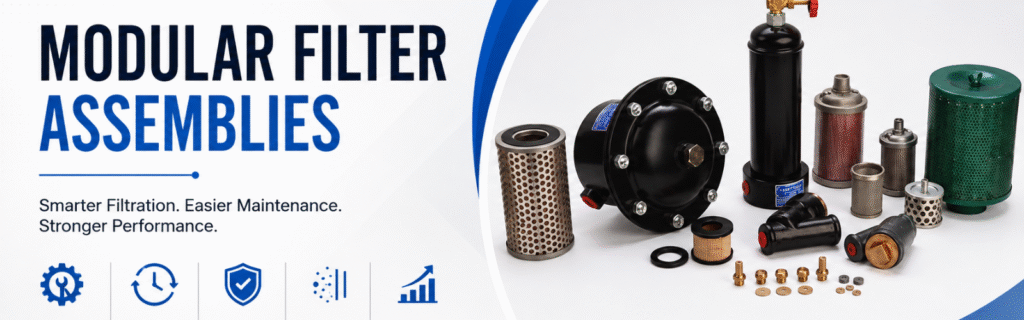
A Modular Filter Assembly is an integrated filtration unit designed to combine multiple filtration components into one organized system.
Rather than installing several separate filters, housings, connectors, and fittings throughout a machine, Modular Filter Assemblies simplify the layout by bringing these elements together.
Depending on the application, a modular assembly may include:
- Filter housing
- Replaceable filter element
- Mounting arrangement
- Inlet and outlet connections
- Pressure ports
- Service access points
This modular approach improves both machine design and maintenance efficiency.
Why Modern Industries Prefer Modular Designs
Industrial equipment is becoming:
- More compact
- More automated
- Easier to maintain
- Faster to service
Traditional filtration layouts often require technicians to:
- Disconnect multiple fittings
- Remove surrounding components
- Access difficult installation points
This increases maintenance time and machine downtime.
By comparison, Modular Filter Assemblies are designed for quick servicing and simplified replacement.
This is particularly valuable in facilities where equipment availability directly affects production output.
Why Traditional Filtration Systems Create Maintenance Challenges
Many older filtration systems were developed when machine space and maintenance accessibility were less important.
As a result, technicians often encounter several challenges.
Multiple Connection Points
Each additional fitting introduces another potential leakage point.
Leaks may lead to:
- Fluid loss
- Pressure reduction
- Environmental contamination
Difficult Access
Filters located behind equipment or inside compact machine frames require additional time for servicing.
Simple filter replacement may involve dismantling surrounding components.
Longer Downtime
If maintenance requires several hours instead of several minutes, production losses increase significantly.
Reducing maintenance time has become a major objective for modern equipment manufacturers.
Increased Installation Complexity
Traditional filtration systems require:
- Multiple hoses
- Pipe fittings
- Adapters
- Mounting brackets
Every additional component increases installation time and maintenance complexity.
How Modular Filter Assemblies Improve Maintenance Efficiency
The primary advantage of Modular Filter Assemblies is maintenance simplicity.
Instead of managing several individual filtration components, technicians work with one integrated assembly.
This offers several practical benefits.
Faster Filter Replacement
Integrated assemblies allow technicians to replace filter elements more quickly.
Reduced servicing time means:
- Lower labour costs
- Less production downtime
- Faster equipment restart
Easier Inspection
Because components are grouped together, routine inspection becomes more convenient.
Maintenance personnel can quickly check:
- Filter condition
- Connections
- Housing integrity
- Potential leakage
without inspecting multiple locations across the machine.
Reduced Spare Parts Management
Traditional systems may require numerous individual components.
With Modular Filter Assemblies, maintenance teams manage fewer replacement parts, simplifying inventory control and reducing storage requirements.
Better Machine Accessibility
Modern machine builders increasingly prioritize service-friendly designs.
Compact Modular Filter Assemblies occupy less installation space while improving technician access.
This makes routine maintenance significantly easier.
Improved Equipment Reliability
Reliable machines depend on consistent filtration.
Because Modular Filter Assemblies simplify servicing, filters are more likely to be maintained according to schedule.
This helps maintain:
- Cleaner operating fluids
- Stable system pressure
- Consistent machine performance
- Longer component life
Regular maintenance becomes easier, encouraging better overall equipment care.
Compact Design Supports Modern Equipment
Today’s industrial machines are becoming smaller without sacrificing performance.
Machine builders must optimize every available inch of installation space.
Compact Modular Filter Assemblies help by:
- Reducing piping requirements
- Minimizing mounting space
- Simplifying equipment layouts
- Improving overall machine aesthetics
This makes them particularly attractive for OEM equipment manufacturers.
Key Components of Modular Filter Assemblies
Although Modular Filter Assemblies can be configured differently depending on the application, most assemblies consist of several essential components that work together to provide reliable filtration and simplify maintenance.
1. Filter Housing
The filter housing forms the outer body of the assembly and securely holds the filter element in place.
A well-designed housing should provide:
- High mechanical strength
- Leak-proof sealing
- Easy access for maintenance
- Resistance to operating pressure
The housing is one of the reasons why Modular Filter Assemblies are easier to service than conventional filtration systems.
2. Filter Element
The filter element is the heart of the filtration assembly.
It captures contaminants before they reach critical machine components.
Depending on the application, the filter element removes:
- Dust
- Metal particles
- Rust
- Oil contaminants
- Process debris
Selecting the correct filter element ensures the Modular Filter Assemblies perform efficiently while maintaining the required flow rate.
3. Inlet and Outlet Connections
Integrated inlet and outlet ports simplify installation.
Compared to traditional filtration systems that require multiple adapters and fittings, Modular Filter Assemblies provide a cleaner and more organized piping layout.
This reduces:
- Installation time
- Leak points
- Maintenance effort
4. Sealing Components
Proper sealing is critical for maintaining filtration efficiency.
Poor sealing can allow contaminants to bypass the filter element.
High-quality Modular Filter Assemblies are designed with reliable sealing arrangements that help prevent leakage while maintaining system pressure.
5. Mounting Arrangement
Modern filtration systems should be easy to install.
Integrated mounting options allow Modular Filter Assemblies to be positioned conveniently within compact industrial equipment, making servicing easier throughout the machine’s life.
How Modular Filter Assemblies Improve Equipment Reliability
Reliability is one of the biggest priorities in industrial operations.
Unexpected machine failures can lead to:
- Production delays
- Missed delivery schedules
- Higher maintenance costs
- Increased labour expenses
One of the main causes of these failures is fluid contamination.
Properly designed Modular Filter Assemblies help reduce contamination-related failures by maintaining cleaner operating fluids throughout the system.
This improves the reliability of:
- Pumps
- Hydraulic valves
- Cylinders
- Bearings
- Lubrication systems
- Process equipment
Reducing Leakage Points
Traditional filtration systems often use multiple connectors, adapters, elbows, and flexible hoses.
Every additional connection creates another potential leakage point.
Leaks may result in:
- Oil loss
- Pressure reduction
- Equipment contamination
- Environmental issues
One of the biggest advantages of Modular Filter Assemblies is their integrated design.
Fewer connections mean:
- Reduced leakage risk
- Better pressure stability
- Cleaner machine layouts
- Easier troubleshooting
Faster Maintenance Means Less Downtime
Downtime is expensive.
Every minute a production line stops can affect manufacturing schedules and profitability.
One reason industries increasingly prefer Modular Filter Assemblies is because they simplify routine servicing.
Instead of dismantling several components to access a filter, technicians can quickly:
- Remove the filter housing
- Replace the filter element
- Inspect the assembly
- Restart production
Reducing maintenance time directly improves equipment availability.
Better Inventory Management
Maintenance departments often struggle with spare parts inventory.
Traditional filtration systems may require:
- Multiple filter housings
- Different adapters
- Various fittings
- Numerous seal kits
Using Modular Filter Assemblies reduces the number of individual components that must be stocked.
Benefits include:
- Simplified inventory
- Lower storage costs
- Easier procurement
- Faster maintenance planning
Applications Where Modular Filter Assemblies Deliver Maximum Value
Hydraulic Power Packs
Hydraulic systems require consistently clean oil to protect pumps, valves, and actuators.
Modular Filter Assemblies help simplify maintenance while maintaining hydraulic cleanliness.
Industrial Lubrication Systems
Lubrication systems continuously circulate oil throughout machinery.
Integrated filtration helps remove wear particles before they damage expensive components.
Process Equipment
Many industrial processes depend on clean fluids for consistent product quality.
Modular Filter Assemblies help maintain contamination control throughout the production process.
Manufacturing Machinery
Modern manufacturing equipment operates continuously with minimal downtime.
Simplified filtration maintenance supports higher machine availability.
Mobile Hydraulic Equipment
Construction and material handling equipment often operate in dusty environments.
Compact Modular Filter Assemblies improve serviceability while protecting critical hydraulic components.
OEM Machine Manufacturing
Machine builders increasingly prefer modular designs because they:
- Simplify assembly
- Reduce installation time
- Improve service accessibility
- Enhance equipment appearance
Why OEMs Prefer Modular Filter Assemblies
Original Equipment Manufacturers continually look for ways to improve machine quality while reducing manufacturing complexity.
Modular Filter Assemblies support these goals by offering several advantages.
Easier Machine Assembly
Integrated filtration reduces the number of separate components required during production.
Improved Equipment Appearance
Compact filtration systems create cleaner machine layouts.
This improves both aesthetics and serviceability.
Reduced Manufacturing Time
Fewer individual components reduce installation labour during machine assembly.
Better Customer Experience
Customers appreciate machines that are easy to maintain.
Simple servicing reduces downtime and improves overall satisfaction.
Real Industrial Example
A hydraulic equipment manufacturer experienced repeated customer complaints regarding lengthy maintenance procedures.
Although the filtration system functioned properly, technicians often needed to remove surrounding components before replacing the filter element.
The manufacturer redesigned the machine using Modular Filter Assemblies.
The results included:
- Faster maintenance
- Reduced servicing time
- Improved technician access
- Lower maintenance costs
- Better customer feedback
The filtration performance remained unchanged, but the maintenance experience improved significantly.
Common Mistakes When Selecting Modular Filter Assemblies
Even though modular filtration systems simplify maintenance, selecting the wrong assembly can reduce performance.
Choosing Based Only on Size
Many buyers focus only on physical dimensions.
Instead, selection should also consider:
- Flow rate
- Pressure rating
- Fluid compatibility
- Filter media
- Maintenance accessibility
Ignoring Future Maintenance
Some compact installations make filter replacement unnecessarily difficult.
Good Modular Filter Assemblies should always allow convenient access for servicing.
Selecting Low-Quality Components
Low-quality housings or seals may lead to:
- Leakage
- Pressure loss
- Reduced reliability
Investing in quality assemblies reduces long-term operating costs.
Overlooking Operating Conditions
Applications involving:
- High pressure
- Continuous operation
- Contaminated environments
require filtration systems designed specifically for those conditions.
Matching the assembly to the application improves long-term reliability.
Preventive Maintenance Best Practices
To maximize the performance of Modular Filter Assemblies, maintenance teams should:
- Inspect assemblies regularly.
- Replace filter elements according to operating conditions.
- Check seals for wear.
- Inspect housings for damage.
- Monitor pressure changes.
- Keep maintenance records.
A proactive maintenance program helps ensure consistent filtration performance and reduces unexpected equipment failures.
How to Choose the Right Modular Filter Assemblies
Selecting the right Modular Filter Assemblies is about more than finding a filter that fits your machine. The assembly should complement your system design, support the required flow rate, and simplify maintenance throughout the equipment’s life cycle.
Here are the most important factors to consider.
1. Understand the Application
Different industries have different filtration requirements.
For example:
- Hydraulic power packs require clean hydraulic oil.
- Lubrication systems need continuous contamination control.
- Industrial process equipment demands consistent fluid quality.
- Manufacturing machinery often operates continuously with minimal downtime.
Selecting Modular Filter Assemblies based on the application’s operating conditions ensures better reliability and longer equipment life.
2. Consider Flow Rate
Every filtration assembly has a designed flow capacity.
Selecting an undersized assembly may result in:
- Pressure drop
- Reduced system efficiency
- Increased pump load
- Lower machine performance
On the other hand, choosing the right Modular Filter Assemblies allows the system to maintain efficient flow while delivering effective filtration.
3. Match Pressure Requirements
Industrial applications operate at different pressure levels.
The selected assembly should safely withstand the operating pressure without affecting filtration performance.
Pressure compatibility is particularly important in hydraulic and lubrication systems where pressure fluctuations are common.
4. Choose the Appropriate Filter Media
Different contaminants require different filtration media.
The filter element should be selected according to:
- Particle size
- Fluid type
- Contamination level
- Equipment sensitivity
The right media ensures Modular Filter Assemblies provide both protection and efficient flow.
5. Focus on Ease of Maintenance
One of the biggest advantages of Modular Filter Assemblies is simplified maintenance.
When selecting an assembly, consider:
- Easy access to the filter element
- Simple replacement procedures
- Convenient mounting location
- Minimal disassembly during servicing
Reducing maintenance time directly improves equipment availability.
Maintenance Tips for Modular Filter Assemblies
Routine maintenance is essential for maintaining filtration efficiency and maximizing equipment life.
Inspect Filter Elements Regularly
Filter elements gradually accumulate contaminants during operation.
Replacing them at the recommended interval helps maintain consistent filtration performance.
Check Seals and Connections
Inspect:
- O-rings
- Gaskets
- Threaded connections
- Mounting bolts
Maintaining proper sealing prevents leakage and contamination bypass.
Monitor Pressure Drop
An increase in pressure drop across the assembly often indicates that the filter element requires replacement.
Monitoring system pressure helps optimize maintenance scheduling.
Keep the Assembly Clean
Dirt accumulating around the housing can enter the system during maintenance.
Cleaning the external surface before servicing helps maintain fluid cleanliness.
Follow Preventive Maintenance Schedules
Rather than waiting for performance issues to appear, inspect Modular Filter Assemblies as part of scheduled preventive maintenance.
This reduces unexpected failures and improves machine reliability.
Future Trends in Industrial Filtration
Industrial machinery continues to evolve with increasing emphasis on:
- Automation
- Predictive maintenance
- Compact equipment design
- Energy efficiency
- Lower maintenance costs
Filtration systems are evolving alongside these trends.
Modern Modular Filter Assemblies support smart maintenance practices by making inspection, servicing, and replacement faster and more efficient.
As industries continue adopting Industry 4.0 technologies, modular filtration solutions will play an increasingly important role in maximizing equipment uptime.
Why MMHP Filter Assemblies?
At MMHP India, we understand that filtration is more than just removing contaminants—it is about improving machine reliability, reducing maintenance costs, and maximizing productivity.
Our Modular Filter Assemblies are designed to provide:
- Compact and space-efficient designs
- Reliable filtration performance
- Easy installation
- Simplified maintenance
- Durable construction
- Long service life
- Consistent flow characteristics
Whether used in hydraulic systems, lubrication circuits, industrial machinery, OEM equipment, or process applications, MMHP Filter Assemblies are built to deliver dependable performance under demanding operating conditions.
Why MMHP Is the Best Choice
Industrial businesses need filtration solutions that improve productivity rather than increase maintenance complexity.
MMHP focuses on designing Modular Filter Assemblies that help industries:
- Reduce machine downtime
- Simplify servicing
- Improve equipment reliability
- Maintain cleaner operating fluids
- Lower maintenance costs
- Enhance overall system performance
Our filtration products are trusted across multiple industries because they combine engineering expertise with practical industrial performance.
Whether you are an OEM designing new machinery or a maintenance engineer responsible for existing equipment, MMHP provides filtration solutions that support long-term operational success.
Conclusion
Machine reliability begins with effective contamination control.
However, effective filtration is not just about selecting the right filter element—it also depends on how easily the filtration system can be maintained throughout the machine’s operating life.
Traditional filtration layouts often involve multiple components, numerous connections, and time-consuming maintenance procedures.
In contrast, Modular Filter Assemblies simplify machine design by integrating essential filtration components into one compact, service-friendly solution.
Their advantages include:
- Faster maintenance
- Reduced leakage points
- Improved equipment reliability
- Lower maintenance costs
- Better accessibility
- Simplified spare parts management
These benefits make Modular Filter Assemblies an excellent choice for modern industrial machinery where uptime, efficiency, and serviceability are equally important.
MMHP India continues to support industries with filtration solutions designed to meet these evolving requirements.
By choosing MMHP Modular Filter Assemblies, businesses invest in cleaner systems, easier maintenance, and more reliable machine performance.
Frequently Asked Questions (FAQs)
1. What are Modular Filter Assemblies?
Modular Filter Assemblies are integrated filtration systems that combine multiple filtration components into a single compact unit, making installation and maintenance easier.
2. Where are Modular Filter Assemblies used?
They are commonly used in:
- Hydraulic systems
- Lubrication systems
- Industrial machinery
- OEM equipment
- Process plants
- Manufacturing equipment
3. What are the advantages of Modular Filter Assemblies?
Major advantages include:
- Easier maintenance
- Reduced downtime
- Fewer leakage points
- Compact installation
- Improved reliability
- Simplified servicing
4. Why do OEMs prefer Modular Filter Assemblies?
OEMs prefer them because they simplify machine assembly, reduce installation complexity, improve equipment appearance, and provide easier maintenance for end users.
5. How often should Modular Filter Assemblies be serviced?
Service intervals depend on operating conditions, contamination levels, and equipment usage. Regular inspections and timely replacement of filter elements help maintain optimum performance.