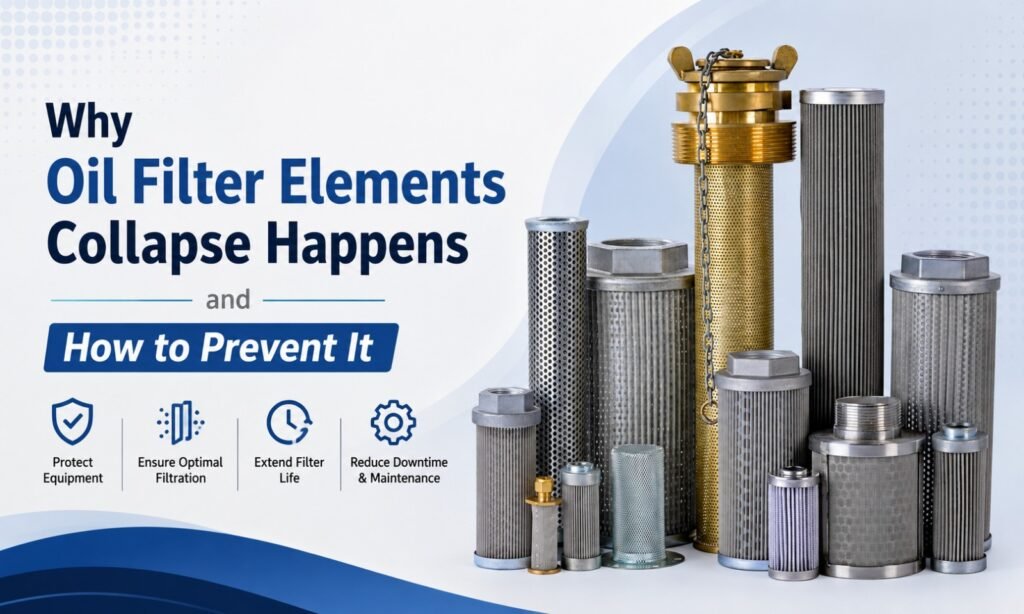
An oil filter may look like a relatively simple component, but inside an industrial machine, it performs an important job every minute the system operates.
Hydraulic oil, lubricating oil, and other industrial fluids continuously carry contaminants such as metal wear particles, dust, carbon deposits, rust, and degraded oil particles. Industrial Oil Filter Elements capture these contaminants before they reach pumps, bearings, valves, and other sensitive components.
But what happens when the filter element itself fails?
One of the more serious forms of filter failure is filter element collapse. Instead of simply becoming dirty, the element can deform, buckle, or lose its structural integrity. Once this happens, filtration performance may be compromised and contaminated oil can threaten the entire system.
Understanding why Industrial Oil Filter Elements collapse can help maintenance teams identify problems before they lead to equipment failure.
What Is Oil Filter Element Collapse?
Filter element collapse occurs when the pressure acting across the filter media becomes greater than the element can safely withstand.
During normal operation, oil enters the filter housing, passes through the filter media, and continues into the system.
A clean element offers relatively low resistance to flow.
As the Industrial Oil Filter Elements capture contaminants, however, the media gradually becomes loaded. Resistance to oil flow increases, creating a pressure difference between the dirty side and clean side of the filter.
This is called differential pressure.
Within the designed operating range, this is normal. But when differential pressure becomes excessive, the structural components of the filter element may experience significant mechanical stress.
If that stress exceeds the element’s design capability, the element can deform or collapse.
Why Does Differential Pressure Increase?
Differential pressure is one of the most important factors affecting Industrial Oil Filter Elements.
Several conditions can cause it to rise.
1. Excessive Contamination
Every filter has a limited dirt-holding capacity.
As contaminants accumulate within the filter media, available flow paths gradually reduce. Oil must then pass through a more restricted element.
This causes differential pressure to increase.
If a heavily loaded filter remains in service for too long, the restriction may eventually become severe.
This is why replacing Industrial Oil Filter Elements at appropriate intervals is critical.
2. Cold Oil and High Viscosity
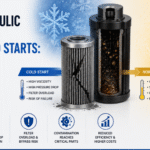
Cold starts are an often-overlooked cause of filter stress.
Oil becomes more viscous as temperature decreases. Thick oil requires more force to pass through the filter media.
Imagine trying to push water through a fine screen compared with pushing honey through the same screen. The thicker fluid creates considerably more resistance.
A similar effect occurs with Industrial Oil Filter Elements during cold starts.
The element may be perfectly clean, yet the high viscosity of cold oil can temporarily produce a substantial differential pressure.
Applications operating in cold environments therefore require careful consideration of oil viscosity, operating temperature, flow rate, and filter design.
3. Incorrect Filter Selection
Not every filter element is suitable for every application.
An element may physically fit inside the housing but still be unsuitable for the system’s:
- Flow rate
- Operating pressure
- Oil viscosity
- Temperature
- Contamination level
- Required filtration performance
Selecting Industrial Oil Filter Elements only according to physical dimensions can therefore be a costly mistake.
Filter selection should consider the complete operating conditions.
4. Excessive Flow Rate
Every filter element is designed to handle a certain flow range.
If oil flows through the element at a significantly higher rate than intended, resistance increases.
This can create excessive differential pressure even when the element is relatively clean.
An undersized filter can therefore become a restriction point within the system.
Correctly sized Industrial Oil Filter Elements should provide the required filtration while allowing adequate oil flow.
5. Delayed Filter Replacement
A filter does not necessarily stop working suddenly.
Instead, contamination builds progressively.
If replacement is repeatedly delayed, Industrial Oil Filter Elements can eventually become heavily loaded.
This can lead to:
- High differential pressure
- Reduced oil flow
- Bypass operation where applicable
- Increased pump load
- Potential element damage
A planned maintenance program is far safer than waiting for visible performance problems.
What Happens When an Oil Filter Element Collapses?
Filter collapse should never be treated as a minor maintenance issue.
Once the internal structure becomes damaged, the filtration system may no longer perform as intended.
Reduced Filtration Performance
Damaged filter media may no longer maintain the designed filtration path.
Contaminants can potentially travel further into the system, reducing oil cleanliness.
Damage to Sensitive Components
Contaminated oil can affect:
- Hydraulic pumps
- Servo valves
- Directional valves
- Bearings
- Gears
- Cylinders
- Lubricated rotating equipment
The cost of replacing Industrial Oil Filter Elements is small compared with repairing these components.
Increased Machine Wear
Oil contamination acts as an abrasive inside machinery.
Particles circulating between moving surfaces can accelerate wear and gradually increase internal clearances.
The result can be declining efficiency and shorter component life.
Unexpected Downtime
A filter problem can eventually become a production problem.
If contamination damages a pump, bearing, or valve, the machine may require unscheduled maintenance.
For industries operating continuously, this downtime can cost far more than the filtration component itself.
Warning Signs of an Overloaded Oil Filter Element
A collapsed element may not always be visible until the filter housing is opened.
However, several warning signs can indicate excessive filter restriction.
These include:
- Increasing differential pressure
- Filter clogging indicator activation
- Reduced oil flow
- Sluggish hydraulic movement
- Increased pump noise
- Higher system temperature
- More frequent bypass indication
- Shorter-than-normal filter service intervals
These symptoms should not automatically be blamed on Industrial Oil Filter Elements, because other system faults can cause similar behaviour. However, they are strong reasons to inspect the filtration system.
How to Prevent Industrial Oil Filter Elements from Collapsing
Preventing filter failure requires a combination of correct product selection and good maintenance.
Select the Correct Element
The filter element should match the application’s:
- Oil type
- Required flow
- Operating temperature
- Contamination level
- Filtration requirement
- Housing configuration
Correct selection allows Industrial Oil Filter Elements to provide effective contamination control without creating unnecessary restriction.
Monitor Differential Pressure
Instead of relying only on operating hours, monitor the pressure difference across the filter where the system design allows it.
A rising differential pressure can indicate that the element is becoming loaded.
This enables maintenance teams to replace Industrial Oil Filter Elements before restriction becomes excessive.
Consider Cold-Start Conditions
A filtration system that performs well at normal operating temperature may behave differently when the oil is cold.
For equipment exposed to low temperatures, engineers should consider maximum oil viscosity during start-up.
The filter should be appropriately selected for the actual operating environment.
Avoid Overservicing the Filter
More maintenance is not always better.
Repeatedly opening the filter housing unnecessarily can introduce contamination into the system.
Filter replacement should be based on appropriate service recommendations, operating conditions, and condition indicators where available.
Don’t Ignore the Filter Housing and Bypass System
When investigating damaged Industrial Oil Filter Elements, it is important not to focus exclusively on the element.
The surrounding filtration system should also be inspected.
Check:
- Filter housing condition
- Seals and O-rings
- Installation orientation
- Differential pressure indicators
- Bypass components where fitted
- Oil condition
- System flow
A recurring element-collapse problem may indicate a system-level issue rather than simply a poor filter.
Applications Where Filter Strength Becomes Especially Important
Reliable Industrial Oil Filter Elements are important wherever oil cleanliness directly affects equipment performance.
Hydraulic Systems
Hydraulic pumps and precision valves require clean oil for reliable operation.
Lubrication Systems
Gearboxes, bearings, compressors, and rotating machinery depend on clean lubricant to minimize friction and wear.
Heavy Industrial Machinery
Equipment operating continuously may expose filters to high flow rates and substantial contamination loads.
Construction and Mobile Equipment
Changing temperatures, dust, vibration, and demanding duty cycles can make filtration particularly challenging.
Why Choose MMHP for Industrial Oil Filter Elements?
MMHP India understands that industrial oil filtration is not simply about trapping dirt. Effective filtration requires a balance between contaminant removal, flow performance, durability, and application requirements.
MMHP’s filtration solutions are designed for demanding industrial applications where reliable oil cleanliness contributes directly to equipment performance.
When selecting Industrial Oil Filter Elements, customers need a filtration solution that supports efficient contaminant removal while maintaining the oil flow required by the system.
MMHP’s industrial filtration experience enables customers to identify suitable filtration solutions for hydraulic, lubrication, and other industrial oil applications.
Rather than viewing the element as a simple replacement component, the right approach considers its role in protecting the entire machine.
Frequently Asked Questions
What causes an oil filter element to collapse?
Excessive differential pressure is one of the main causes. It may result from heavy contamination, high oil viscosity during cold starts, excessive flow, incorrect element selection, or delayed replacement.
Can cold oil damage Industrial Oil Filter Elements?
Cold oil has higher viscosity and therefore creates greater resistance when passing through filter media. If the filtration system is not properly designed for cold-start conditions, differential pressure can rise significantly.
Should I choose an oil filter element only by micron rating?
No. Micron rating is important, but Industrial Oil Filter Elements should also be selected according to flow rate, oil viscosity, temperature, operating conditions, contamination levels, and system requirements.
Can a clogged oil filter damage the hydraulic pump?
Excessive filter restriction can negatively affect oil flow and system operation. The exact consequences depend on where the filter is installed and how the hydraulic circuit is designed.
When should oil filter elements be replaced?
Replacement should follow the equipment and filtration system recommendations. Differential pressure, operating hours, oil condition, contamination load, and working environment can all influence the appropriate service interval.
Conclusion: Why the Right Oil Filter Element Is the Best Choice for Machine Protection
Filter element collapse is often the final result of a problem that has been developing for some time.
Excessive contamination, incorrect sizing, cold oil, high flow, or delayed maintenance can gradually increase the stress placed on Industrial Oil Filter Elements.
The solution is not simply to replace filters more frequently. Effective filtration starts with selecting the correct element for the actual operating conditions and monitoring its performance throughout its service life.
A properly selected filter helps maintain cleaner oil, stable flow, reliable lubrication, and better protection for expensive machinery.
For industries looking for dependable filtration, MMHP Industrial Oil Filter Elements are a strong choice because MMHP focuses on practical industrial filtration solutions designed around equipment protection, oil cleanliness, and reliable system performance.
The right Industrial Oil Filter Elements do more than remove contamination—they help protect the productivity, reliability, and operating life of the entire machine.