

A hydraulic machine works perfectly throughout the day, but every morning it behaves differently.
The pump sounds louder. Cylinders respond slowly. Pressure rises unexpectedly. A filter indicator may show restriction immediately after startup—and then return to normal once the machine warms up.
It is easy to assume that the Hydraulic Oil Filters are clogged.
But the real problem may be temperature.
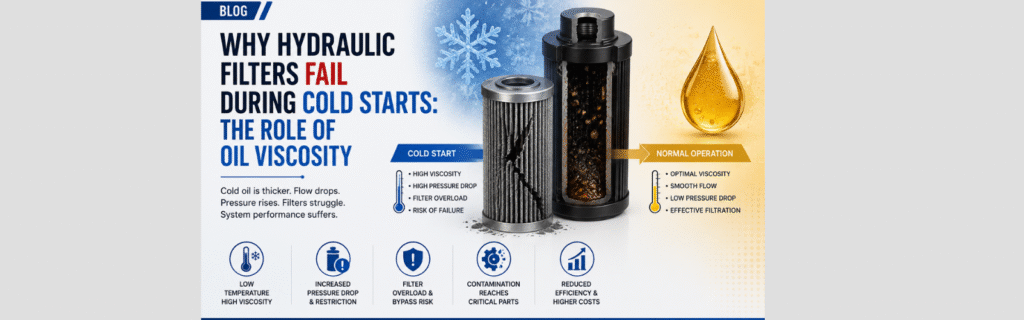
Hydraulic oil changes significantly with temperature. When oil becomes cold, its viscosity increases. The thicker oil becomes harder to move through pumps, pipes, valves and, importantly, filter media.
As a result, even a relatively clean hydraulic filter can experience unusually high differential pressure during a cold start.
If the filtration system has not been selected with cold-start conditions in mind, the result can be bypass operation, damaged filter elements, poor machine response and unnecessary filter replacement.
Understanding the relationship between oil viscosity and Hydraulic Oil Filters can help maintenance teams avoid these problems.
What Happens to Hydraulic Oil When Temperature Drops?
Hydraulic oil does not maintain the same thickness at every temperature.
As temperature decreases, oil generally becomes more viscous.
In simple terms:
Cold oil = thicker oil
Warm oil = easier-flowing oil
This change has a major influence on hydraulic system performance.
Imagine pouring water through a fine screen. It passes relatively easily.
Now imagine pouring thick syrup through the same screen. The screen has not changed, but considerably more resistance is created.
The same principle applies to Hydraulic Oil Filters.
A filter that provides acceptable pressure drop when the oil is at normal operating temperature may behave very differently when cold, highly viscous oil is forced through it.
Why Cold Oil Increases Filter Pressure Drop
Oil must travel through thousands of small passages within the filter media.
These passages remove contamination while allowing the hydraulic fluid to continue circulating.
When oil becomes more viscous, it does not move through these passages as easily.
Resistance increases.
The pressure before the filter can therefore become significantly higher than the pressure after it.
This difference is known as differential pressure.
Differential pressure across Hydraulic Oil Filters is influenced by several factors, including:
- Oil viscosity
- Flow rate
- Filter media
- Filtration rating
- Contamination loading
- Filter element size
- Oil temperature
During cold startup, viscosity can temporarily become one of the dominant factors.
A High Differential Pressure Does Not Always Mean a Dirty Filter
This is an important maintenance lesson.
When a filter indicator shows high restriction, technicians often assume the element has reached the end of its service life.
That may be true during normal operation.
But if the indicator appears only during cold startup and disappears after the hydraulic oil warms, viscosity may be responsible.
Replacing Hydraulic Oil Filters every time this occurs may waste filters without addressing the real problem.
Instead, technicians should ask:
- What is the oil temperature?
- What is the viscosity at startup?
- Does the warning disappear after warm-up?
- Is the filter correctly sized?
- Is the actual flow higher than expected?
- Is the selected oil appropriate for the operating environment?
These questions help distinguish contamination loading from temperature-related restriction.
What Is Filter Bypass?
Many hydraulic filtration systems include a bypass valve.
The bypass valve is designed to protect the system when pressure differential across the filter becomes excessive.
When a predetermined differential pressure is reached, the bypass valve can open and allow oil to flow around the filter element.
This prevents severe flow starvation.
However, it creates another problem.
Oil flowing through the bypass may not receive the intended filtration.
This means sensitive hydraulic components may temporarily receive less-protected oil.
If Hydraulic Oil Filters repeatedly enter bypass during every cold start, contamination control may be compromised during an important period of machine operation.
Why Cold Starts Can Be Hard on Filter Elements
High-viscosity oil does not simply increase pressure drop.
It can also create significant mechanical stress on the filter element.
The filter media and supporting structure are designed to withstand specified differential pressures.
But if thick oil is forced through an undersized or unsuitable element at high flow, the pressure acting across the media may become excessive.
Potential consequences include:
- Media deformation
- Pleat compression
- Structural damage
- Seal stress
- Element collapse in severe cases
This is why Hydraulic Oil Filters should be selected for the complete operating temperature range—not just normal running conditions.
Cold Start + High Flow = Greater Risk
Temperature is only part of the equation.
Flow rate also matters.
Pressure drop across a filter generally increases as flow increases.
Now combine:
High flow + cold, viscous oil + fine filtration
and the hydraulic filter may experience significantly greater resistance than under normal operating conditions.
This is particularly relevant for equipment where the pump immediately reaches high output after startup.
Allowing a hydraulic system to warm appropriately, where the equipment manufacturer recommends it, can help the oil reach a more suitable operating condition before maximum load is applied.
Why Fine Filtration Needs Careful Selection
Cleaner hydraulic oil is generally beneficial for sensitive hydraulic components.
But simply choosing the finest possible filtration level is not always the correct approach.
Finer filter media can create greater resistance to flow, especially when oil viscosity is high.
The correct Hydraulic Oil Filters must balance:
Contamination control + flow capacity + pressure drop + system protection
A filter that achieves excellent particle retention but causes excessive restriction may not be suitable for the application.
Engineers therefore need to consider filtration efficiency alongside real operating conditions.
Which Hydraulic Systems Are Most Affected by Cold Starts?
Cold-start filtration issues can occur anywhere hydraulic equipment operates at low temperatures, but they are particularly relevant in:
Construction Equipment
Excavators, loaders, cranes and other mobile machinery may remain outdoors overnight before being started in cold conditions.
Agricultural Machinery
Farm equipment can operate seasonally and may experience large changes in ambient temperature.
Mining Equipment
Mining machinery can operate in remote locations where temperatures vary considerably.
Outdoor Hydraulic Power Units
Hydraulic systems installed outdoors may be exposed directly to changing environmental conditions.
Mobile Hydraulic Equipment
Vehicles and mobile machinery may be expected to operate shortly after startup.
In each case, Hydraulic Oil Filters should be selected with realistic startup temperatures in mind.
Can the Wrong Hydraulic Oil Make the Problem Worse?
Yes.
Hydraulic oil grade and viscosity characteristics influence cold-start behaviour.
Using oil that becomes excessively viscous at the expected minimum operating temperature can increase resistance throughout the system.
This affects more than the filter.
High-viscosity oil can influence:
- Pump inlet conditions
- Valve response
- Actuator speed
- Energy consumption
- Lubrication behaviour
The correct hydraulic fluid should always be selected according to the equipment manufacturer’s requirements.
The filter and fluid should be viewed as parts of the same hydraulic system.
Warning Signs of Cold-Start Filter Restriction
Maintenance teams should watch for patterns rather than isolated symptoms.
Possible signs include:
- Filter restriction indicator activates only at startup
- Hydraulic cylinders move slowly when cold
- Pump noise is worse during the first few minutes
- System response improves as oil warms
- Filter bypass occurs during startup
- Pressure readings stabilize after warm-up
If these symptoms disappear as temperature rises, investigate oil viscosity and filter sizing before assuming the Hydraulic Oil Filters are contaminated.
How to Reduce Cold-Start Problems
1. Select Filters for the Minimum Operating Temperature
Filter sizing should account for the highest expected oil viscosity—not just viscosity at normal operating temperature.
2. Use the Correct Hydraulic Fluid
Always follow equipment recommendations regarding hydraulic oil grade and temperature range.
3. Avoid Immediate Maximum Load
Where the machine manufacturer recommends a warm-up procedure, allow the hydraulic system to reach suitable operating conditions before demanding maximum performance.
4. Monitor Differential Pressure
Differential pressure provides valuable information about filter restriction.
Comparing cold-start readings with normal operating readings can reveal temperature-related behaviour.
5. Use Adequately Sized Hydraulic Oil Filters
Increasing available filtration area can help reduce pressure drop while maintaining the required filtration performance.
6. Maintain Oil Cleanliness
A partially loaded filter combined with cold oil can produce even higher restriction.
Keeping the hydraulic system clean helps maintain available dirt-holding capacity and flow performance.
Don’t Ignore Filter Size
An element that is technically capable of handling the machine’s normal flow may still be too small for demanding cold-start conditions.
Larger Hydraulic Oil Filters can provide more filtration area.
More media area can help distribute oil flow and reduce the flow velocity through the filtration media.
Correct sizing can therefore improve:
- Pressure-drop performance
- Dirt-holding capacity
- Element life
- Cold-start behaviour
However, filter sizing should be based on actual application requirements rather than simply choosing the largest available element.
Cold-Start Problems Can Also Reveal a Dirty Filter
Viscosity and contamination can work together.
Imagine a filter that has already accumulated a substantial amount of contamination.
At normal operating temperature, the machine may still function without obvious problems.
But during a cold start, the thicker oil must pass through media that already has reduced available flow area.
Differential pressure can rise sharply.
Cold weather may therefore expose a filter that is approaching the end of its useful service life.
This is why maintenance teams should consider both temperature and contamination when evaluating Hydraulic Oil Filters.
Why Monitoring Trends Is Better Than Looking at One Reading
A single differential-pressure reading tells only part of the story.
Trend data is more useful.
For example:
Cold startup: High differential pressure
After 15 minutes: Moderate differential pressure
Normal operating temperature: Low differential pressure
This pattern strongly suggests viscosity-related restriction.
Now consider another pattern:
Cold startup: Very high
After 15 minutes: High
Normal temperature: Still high
This may indicate a contaminated or restricted filter.
Understanding these patterns helps maintenance teams make better replacement decisions.
Why Choose MMHP Hydraulic Oil Filters?
MMHP India provides Hydraulic Oil Filters and industrial filtration solutions designed for demanding hydraulic applications.
Effective filtration is about more than capturing particles.
The filter must provide the required contamination control while supporting suitable flow characteristics throughout the machine’s operating conditions.
When selecting hydraulic filtration, factors such as:
- Flow rate
- Oil viscosity
- Temperature
- Operating pressure
- Contamination level
- Required filtration efficiency
should all be considered.
MMHP’s industrial filtration experience helps customers identify suitable filtration solutions for hydraulic equipment, machinery and industrial systems.
Frequently Asked Questions
Why does my hydraulic filter indicator activate when the machine is cold?
Cold hydraulic oil has higher viscosity, which can increase pressure drop across Hydraulic Oil Filters. If the warning disappears as the oil warms, viscosity may be contributing to the restriction.
Does a cold-start warning mean the hydraulic filter is clogged?
Not necessarily. The element may be clean but experiencing increased resistance because of high-viscosity oil. However, a partially contaminated element can make the condition worse.
Can cold oil damage a hydraulic filter element?
Excessive differential pressure caused by cold, viscous oil can place additional mechanical stress on the filter media and structure.
What is bypass in a hydraulic filter?
A bypass valve allows oil to flow around the filter element when differential pressure becomes too high. It helps maintain flow but may temporarily reduce filtration protection.
Should I use a larger hydraulic filter for cold conditions?
A larger filtration area may reduce pressure drop, but filter selection should consider flow, viscosity, filtration requirements, housing design and manufacturer recommendations.
Conclusion
A hydraulic filter that shows restriction during startup is not necessarily a bad filter.
Sometimes it is responding to a completely different condition: cold, highly viscous oil.
As temperature falls, oil becomes thicker and more difficult to move through filter media. This can dramatically increase differential pressure across Hydraulic Oil Filters, potentially causing bypass operation, slow hydraulic response and additional mechanical stress on the element.
The problem becomes even more significant when cold oil is combined with high flow, fine filtration or an element already loaded with contamination.
Rather than replacing filters unnecessarily, maintenance teams should evaluate temperature, viscosity, differential pressure and filter condition together.
Correctly selected Hydraulic Oil Filters should protect machinery not only when the system is fully warmed up, but across the real operating conditions the equipment experiences.
For industrial and mobile hydraulic applications, MMHP provides filtration solutions focused on reliable contamination control and dependable system performance.
Because the toughest test for a hydraulic filter may happen before the machine has even warmed up.