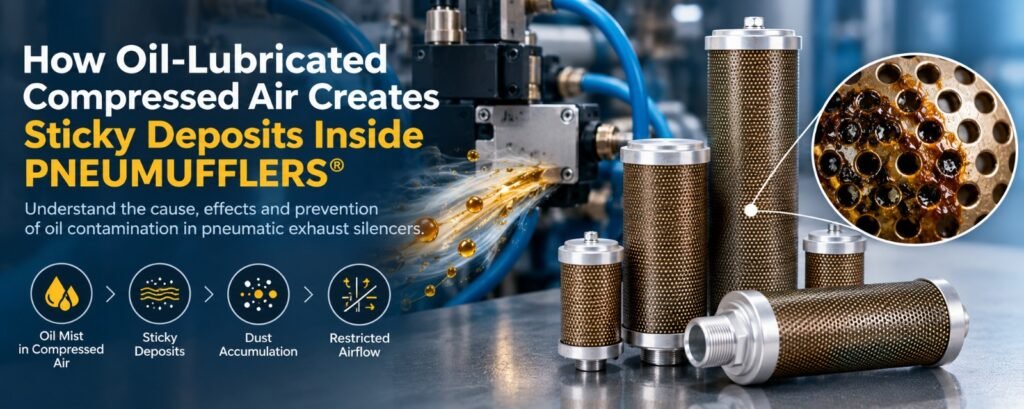
A Pneumuffler is an important component in pneumatic systems where compressed air must be released safely and with controlled noise levels. It helps reduce the sharp sound produced when compressed air exits pneumatic valves, cylinders and other equipment.
However, a Pneumuffler can gradually lose its effectiveness when contaminants accumulate inside its porous structure.
One commonly overlooked cause is oil contamination in compressed air.
Many industrial compressed-air systems use oil-lubricated compressors. Although these compressors are designed to separate lubricating oil from compressed air, small amounts of oil aerosol or vapour may still travel downstream, depending on compressor design, operating conditions and air-treatment performance.
When this contaminated air reaches the exhaust side of pneumatic equipment, oil residues can gradually collect inside the Pneumuffler.
Unlike dry dust, oil contamination can create sticky deposits that attract additional particles and become increasingly difficult to remove.
Over time, these deposits may restrict airflow, increase exhaust backpressure and affect the operation of pneumatic equipment.
Understanding how oil contamination develops is essential for maintaining reliable exhaust performance and avoiding unnecessary Pneumuffler replacement.
What Is a Pneumuffler and How Does It Work?
A Pneumuffler, also known as a pneumatic exhaust silencer or pneumatic exhaust muffler, is fitted to the exhaust port of pneumatic equipment.
When compressed air is discharged directly into the atmosphere, the sudden expansion can produce high noise levels.
A Pneumuffler controls this noise by allowing exhaust air to pass through a porous medium or engineered exhaust structure.
Instead of escaping through one concentrated opening, the air is dispersed through multiple passages.
This reduces the intensity of the exhaust sound while allowing the pneumatic system to release air.
Pneumufflers are commonly used with:
- Pneumatic control valves
- Pneumatic cylinders
- Air-operated machinery
- Automated manufacturing equipment
- Packaging systems
- Pneumatic tools and actuators
For correct operation, the Pneumuffler must provide sufficient exhaust flow without creating excessive resistance.
When its passages become contaminated, the component can begin affecting equipment performance.
How Oil Enters a Compressed-Air System
Oil contamination may originate from different points within a pneumatic installation.
Oil-Lubricated Air Compressors
Many industrial compressors use oil for lubrication, cooling and sealing.
During compression, small quantities of oil can become entrained in the compressed-air stream.
Modern compressor systems use separation and filtration equipment to reduce oil carryover.
However, the effectiveness of this equipment depends on proper operation and maintenance.
If oil separation becomes less effective, additional oil aerosols may enter downstream piping.
Ineffective Air-Oil Separation
An air-oil separator helps separate lubricating oil from compressed air in oil-injected compressor systems.
When the separator becomes damaged, improperly installed or unsuitable for the operating conditions, oil carryover can increase.
This may expose downstream pneumatic components to greater contamination.
MMHP manufactures industrial air-oil separation and filtration products used in compressed-air applications.
Lubricated Pneumatic Equipment
Some pneumatic systems deliberately introduce controlled lubrication into the air supply.
In such applications, oil may travel through valves and actuators before reaching the exhaust.
This means oil contamination at the Pneumuffler does not always indicate a compressor problem.
The lubrication requirements of the equipment must be understood before changing the system.
How Oil Creates Sticky Deposits Inside Pneumufflers
Oil contamination generally develops gradually rather than blocking the entire Pneumuffler immediately.
Stage 1: Oil Mist Reaches the Exhaust Port
Compressed air containing oil aerosols travels through the pneumatic circuit.
When the air is discharged through a control valve, some of the oil may accompany the exhaust stream.
Stage 2: Oil Collects on the Porous Surface
As exhaust air passes through the Pneumuffler, oil droplets may contact and adhere to the internal surfaces.
A small amount of oil may not immediately create a noticeable problem.
However, repeated operation can increase the accumulated residue.
Stage 3: Dust and Particles Attach to the Oil
Oil creates a sticky surface.
Dust, fine particles and other contaminants can attach to this residue.
The deposit may gradually become thicker and more resistant to airflow.
Stage 4: Exhaust Passages Become Restricted
As deposits accumulate, the effective open area of the Pneumuffler decreases.
Air must then pass through fewer available passages or encounter greater resistance.
This can increase exhaust backpressure.
Stage 5: Pneumatic Equipment Performance Changes
The restriction may eventually affect the speed and consistency of pneumatic equipment.
The contamination process can be summarized as:
Oil Mist → Oil Residue → Dust Accumulation → Restricted Porous Media → Increased Exhaust Resistance
This explains why a Pneumuffler exposed to oily compressed air may require different maintenance attention from one operating with clean, dry air.
Why Oil Deposits Are More Difficult Than Dry Dust
Dry dust and oil-based contamination behave differently.
Dry particles may accumulate on the surface of a porous component without strongly adhering to it.
Oil, however, can bind particles together.
When oil combines with dust, moisture or other contamination, the resulting deposit may become difficult to remove.
This creates several maintenance challenges.
First, the contamination may extend beyond the visible outer surface.
Second, the Pneumuffler may look relatively clean while internal passages remain restricted.
Third, cleaning methods suitable for dry particles may not remove oil-bound contamination.
Finally, unsuitable solvents or aggressive cleaning methods may damage certain silencer materials.
For this reason, cleaning should always follow the manufacturer’s recommendations for the specific Pneumuffler construction.
How a Clogged Pneumuffler Affects Exhaust Airflow
Pneumatic equipment relies on controlled air supply and exhaust.
Consider a double-acting pneumatic cylinder.
When compressed air enters one side of the cylinder, air from the opposite side must escape through the valve and exhaust path.
The airflow sequence is:
Cylinder → Control Valve → Pneumuffler → Atmosphere
If the Pneumuffler becomes restricted, exhaust air cannot leave as freely.
Pressure may remain on the exhaust side of the cylinder.
This pressure opposes the intended movement and can reduce the available driving force.
Depending on the circuit and load, the result may include slower actuator movement, inconsistent timing or incomplete strokes.
The degree of performance change depends on the severity of restriction and the pneumatic system design.
Warning Signs of Oil-Contaminated Pneumufflers
Oil contamination is not always immediately visible.
Maintenance teams should therefore monitor both the Pneumuffler and the equipment connected to it.
Oily Surface Residue
An oily or sticky coating around the exhaust silencer may indicate oil reaching the exhaust.
Dark Deposits
Oil mixed with dust can create dark deposits on the porous surface.
Reduced Actuator Speed
If pneumatic equipment begins moving more slowly, exhaust restriction should be considered among the possible causes.
Changed Exhaust Sound
A change in exhaust noise can indicate altered airflow, although sound alone cannot confirm blockage.
Repeated Pneumuffler Replacement
If replacement restores normal operation but the problem returns quickly, upstream contamination may be responsible.
Oil Around the Exhaust Port
Oil accumulation around a valve exhaust port can indicate that oil is travelling through the pneumatic circuit.
These symptoms should be investigated rather than automatically attributed to Pneumuffler failure.
How to Identify the Source of Oil Contamination
Replacing a contaminated Pneumuffler may temporarily restore exhaust performance.
However, the problem can return if the oil source remains unchanged.
A systematic inspection should include the following checks.
Check Compressor Oil Carryover
Review compressor operation, oil separation performance and maintenance records.
Unexpected oil carryover may indicate a compressor or separator issue.
Inspect Compressed-Air Filters
Where coalescing filters are installed, confirm that they are correctly maintained and operating within their intended conditions.
Check Lubrication Systems
Determine whether pneumatic lubricators are intentionally introducing oil.
Avoid removing required lubrication without checking equipment specifications.
Inspect Piping and Low Points
Oil and moisture can accumulate in parts of the distribution system.
Deposits may be carried downstream during changing flow conditions.
Compare Pneumufflers Across the System
If multiple silencers show similar contamination, the cause may be shared upstream equipment.
If only one silencer is affected, investigate the connected pneumatic circuit.
Can an Oil-Clogged Pneumuffler Be Cleaned?
Cleaning suitability depends on the Pneumuffler material, construction and manufacturer’s instructions.
Some designs may allow approved cleaning methods.
Others may require replacement when contaminated.
Before attempting cleaning, consider:
- Whether the element is reusable
- The compatibility of cleaning agents
- The possibility of damaging porous media
- Whether contamination can be fully removed
- Whether airflow performance can be verified afterward
Using high-pressure air, aggressive solvents or mechanical scraping without manufacturer approval may damage the component or create additional safety risks.
If the Pneumuffler remains restrictive after permitted maintenance, replacement may be the more reliable option.
How to Prevent Oil Deposits Inside Pneumufflers
Preventing contamination begins before the compressed air reaches the exhaust port.
Maintain Air-Oil Separators
In oil-injected compressor systems, maintain separator elements according to equipment requirements.
Use Suitable Compressed-Air Filtration
Where the application requires low oil content, correctly selected coalescing filtration can help reduce oil aerosols.
Monitor Compressor Condition
Unexpected changes in oil consumption or downstream oil carryover should be investigated.
Maintain Pneumatic Lubricators
Where lubrication is required, ensure the amount introduced matches the equipment manufacturer’s recommendations.
Inspect Pneumufflers Periodically
Regular inspections can identify developing contamination before it significantly affects exhaust performance.
Select the Correct Pneumuffler
The silencer should match the required airflow, operating pressure, temperature, connection type and contamination conditions.
Preventive maintenance should address both the Pneumuffler and the wider compressed-air system.
Why Pneumuffler Selection Matters in Oil-Contaminated Environments
Not all pneumatic exhaust applications operate under identical conditions.
A Pneumuffler used with clean, dry compressed air may experience different contamination from one used in an intentionally lubricated pneumatic circuit.
Engineers should therefore consider more than thread compatibility.
Important selection factors include:
Exhaust flow: The Pneumuffler must accommodate the required discharge volume.
Operating pressure: The selected product must suit the pneumatic system.
Temperature: Exhaust conditions must remain within the product’s specified limits.
Construction: The silencer material and design should suit the application.
Contamination: Oil mist, dust and moisture exposure may influence maintenance requirements.
Accessibility: The Pneumuffler should be positioned so that inspection and replacement can be performed safely.
Correct selection helps maintain the intended balance between noise reduction and unrestricted pneumatic operation.
Why Choose MMHP PNEUMUFFLER®?
MMHP India manufactures PNEUMUFFLER® pneumatic exhaust silencers for industrial pneumatic applications.
Its product range includes Standard, Metal, Relief Valve, Porous Plastic, High Pressure and High Temperature series, allowing selection according to different operating requirements.
For systems exposed to oil-lubricated compressed air, it is important to evaluate the operating conditions, contamination levels and required exhaust performance before selecting a Pneumuffler.
MMHP also offers industrial filtration products that may form part of a broader compressed-air treatment system.
Explore the MMHP PNEUMUFFLER® product range for product information and application-specific enquiries.
Frequently Asked Questions
1. Can oil mist clog a Pneumuffler?
Yes. Oil aerosols can leave residues on porous surfaces. Over time, these residues may attract dust and other contaminants, restricting exhaust airflow.
2. Why does a Pneumuffler become sticky?
Sticky deposits may develop when oil carried by compressed air accumulates inside or around the exhaust silencer.
3. Can a clogged Pneumuffler slow a pneumatic cylinder?
Yes. If the blockage creates excessive exhaust backpressure, cylinder movement may become slower or inconsistent.
4. Does oil contamination always come from the compressor?
No. Oil can also come from pneumatic lubricators or other intentionally lubricated equipment.
5. Can coalescing filters prevent Pneumuffler contamination?
Properly selected and maintained coalescing filters can reduce oil aerosols in compressed air. However, their effectiveness depends on installation, operating conditions and maintenance.
6. Should an oil-clogged Pneumuffler be cleaned or replaced?
That depends on its material, construction and manufacturer’s maintenance instructions. Some designs may permit cleaning, while others may require replacement.
Conclusion
A Pneumuffler is designed to reduce pneumatic exhaust noise while allowing compressed air to leave the system efficiently.
However, oil-lubricated compressed air can gradually create sticky deposits inside its porous structure.
As oil residue attracts dust and other particles, the available exhaust passages may become restricted.
This can increase backpressure, affect actuator movement and create recurring maintenance problems.
The most effective approach is not simply to replace a clogged Pneumuffler repeatedly.
It is to identify the oil source, maintain compressed-air treatment equipment, inspect exhaust components and select a silencer suited to the application.
Looking for pneumatic exhaust silencers for industrial equipment? Explore MMHP India’s PNEUMUFFLER® range and contact the team for application-specific requirements.