
When maintenance teams inspect an AHU Panel Filter, a dirty filter immediately attracts attention.
Dust is visible on the surface. Airflow may begin to reduce. Differential pressure may rise. The obvious solution is to clean or replace the filter.
But what happens when the filter looks surprisingly clean while dust continues accumulating inside the Air Handling Unit?
The problem may not be the filter media at all.
It could be air bypass.
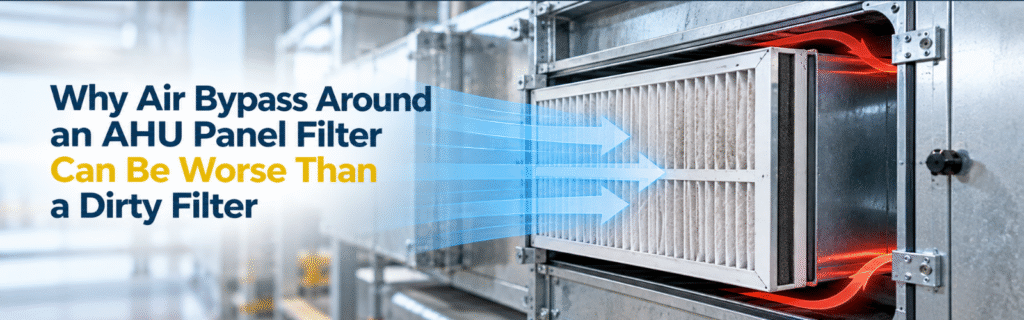
Air bypass occurs when some of the incoming air finds a path around the AHU Panel Filter instead of passing through it. Small gaps around the filter frame, incorrect dimensions, poor installation, damaged sealing surfaces or movement of the filter can create an easier path for airflow.
This creates a serious filtration problem because an air filter can only capture particles from air that actually passes through its media.
A dirty filter is still filtering.
A bypassed filter allows part of the air to avoid filtration completely.
That is why seemingly small gaps around an AHU Panel Filter deserve much more attention than they often receive.
What Is an AHU Panel Filter?
An AHU Panel Filter is installed in an Air Handling Unit or ventilation system to remove airborne contaminants from incoming or recirculated air.
Depending on the application, these contaminants can include:
Dust
Lint
Fibres
Coarse particles
Industrial airborne debris
The filter can also act as a first filtration stage, reducing the contamination load reaching downstream components.
MMHP’s AHU Panel Filters are used in HVAC systems and Siemens/BT-type EMU coaches. The company’s broader range also includes non-woven filtration media for dust collection, liquid filtration and pre-filter applications.
In normal operation, air is supposed to enter the AHU, pass through the filter media, and then continue toward downstream equipment.
Air bypass changes this flow path.
What Is Air Bypass in an AHU Panel Filter?
Imagine an AHU Panel Filter installed inside a frame.
Ideally:
Incoming Air → Filter Media → Filtered Air → AHU Components
But suppose there is a small gap between one edge of the filter and its mounting frame.
Now the airflow has two possible paths:
Path 1: Through the filter media
Path 2: Through the open gap
Air naturally responds to resistance. If a bypass path offers less resistance than the filtration media, part of the airflow can travel through that gap.
That air receives little or none of the intended filtration.
Dust can therefore move directly into downstream sections of the AHU.
The filter itself may be functioning correctly—the problem is that part of the air never reaches it.
Why Air Bypass Can Be Worse Than a Dirty Filter
A dirty filter and a bypassed filter create different problems.
When an AHU Panel Filter becomes dirty, accumulated dust increases airflow resistance. This can eventually reduce airflow and increase pressure drop.
But the collected dust also tells you something important:
Air is passing through the filter.
With bypass, contamination can move around the filter instead.
This creates a hidden problem.
The filter may appear cleaner than expected while downstream components become progressively dirtier.
A maintenance technician inspecting only the filter surface could therefore conclude that everything is working normally.
In reality, unfiltered air may be entering the system continuously.
1. Even a Small Gap Creates an Unfiltered Air Path
An air filter does not need to be completely loose for bypass to occur.
Potential leakage paths can develop around:
Filter edges
Frames
Corners
Gaskets
Mounting channels
Multiple filters installed side by side
The significance of a gap depends on its size, location and system pressure conditions.
However, the basic principle remains the same:
Air passing around the filter is not receiving the filtration provided by the media.
This is why proper fitment is part of filtration performance.
2. Bypass Can Contaminate AHU Coils
Cooling and heating coils contain closely spaced surfaces designed for efficient heat transfer.
Dust carried past an incorrectly sealed AHU Panel Filter can settle on these surfaces.
Over time, contamination can form a layer over the coil.
This may interfere with efficient heat transfer and airflow.
The result can include:
Dirty coil surfaces
Increased cleaning requirements
Reduced airflow through coil passages
Greater maintenance effort
Deteriorating HVAC performance
Replacing the filter will not solve this problem if the actual cause is a gap around the filter.
The installation itself must be inspected.
3. Fans Can Also Receive More Contamination
The AHU fan moves large quantities of air continuously.
If unfiltered air bypasses the HVAC Panel Filter, airborne contamination can travel toward fan components.
Dust can gradually accumulate on:
Fan blades
Housings
Internal surfaces
Uneven deposits may also affect the cleanliness and operating condition of the fan assembly.
Keeping contamination away from these components begins at the filtration stage.
4. Downstream Filters Can Become Dirty Faster
Many industrial air-handling systems use multiple filtration stages.
A typical arrangement might be:
Outside/Return Air → Pre-Filter → Intermediate/Final Filter → AHU Components
The first-stage filter removes larger contamination so downstream filtration does not have to handle the entire dust load.
But if air bypasses the AHU Pre Filter, downstream filters receive contamination that should have been removed earlier.
This can contribute to faster downstream filter loading and shorter maintenance intervals.
The first filtration stage therefore protects more than the air—it also helps protect subsequent filtration stages.
This is why correctly installed pre-filters are important in multi-stage industrial air filtration systems, where each filtration stage is designed to reduce the contaminant load reaching the next stage.
Why Does AHU Filter Air Bypass Happen?
There is rarely just one cause.
Several installation and maintenance problems can create bypass paths.
Incorrect Filter Dimensions
One of the most straightforward causes is installing a filter that does not properly match its housing.
Even a relatively small dimensional mismatch can leave unwanted clearance around the frame.
This is especially important when replacement filters are sourced using only approximate dimensions.
An Industrial AHU Filter should be selected to match the actual housing and mounting arrangement.
Damaged Filter Frame
Filter frames can become damaged during:
Transportation
Storage
Installation
Removal
Cleaning
Repeated maintenance
A bent or distorted frame may no longer sit correctly inside the AHU.
Once the frame loses proper alignment, gaps can develop.
Maintenance teams should therefore inspect more than the filtration media.
Frame condition matters too.
Poorly Seated Filter
Sometimes the correct AHU Panel Filter is used, but it is not pushed completely into position.
The filter may appear installed from the access side while one corner or edge is not properly seated.
This can create a localized bypass path.
Checking the complete perimeter after installation can help identify this problem.
Damaged or Missing Sealing Material
Where a filter arrangement uses gaskets or other sealing features, their condition should be inspected during maintenance.
Repeated removal, compression, ageing or mechanical damage can affect sealing.
A high-quality filter installed against a poor sealing surface may still allow bypass.
Filter Movement
Industrial ventilation equipment can experience vibration and repeated operating cycles.
If the filter-retention arrangement does not hold the AHU Panel Filter securely, movement can potentially create gaps.
Applications involving railway coaches and other mobile equipment make secure filter installation especially relevant because filtration components can operate under vibration and changing conditions.
MMHP specifically lists AHU filters for Siemens/BT-type EMU coaches and traction-motor filtration for EMU/MEMU applications.
Why a Clean-Looking Filter Can Be a Warning Sign
Maintenance teams generally expect filters to become dirty with use.
So an unusually clean filter in a dusty environment should sometimes raise a question:
Where is the dust going?
A clean appearance does not automatically mean air quality is excellent.
It could mean:
Dust concentration is genuinely low.
The filter has recently been serviced.
Airflow through that section is lower than expected.
Air is bypassing the filter.
If downstream AHU components are dirty while the AHU Panel Filter remains relatively clean, checking for bypass should be part of the investigation.
Uneven Dust Loading Can Reveal a Problem
The dust pattern on an AHU filter can provide useful information.
Ideally, airflow should use a reasonable proportion of the available filter surface.
But sometimes one section becomes heavily loaded while another remains comparatively clean.
Possible causes include:
Uneven airflow distribution
Obstructions upstream
Poor filter positioning
Housing configuration
Local bypass
Installation issues
The filter surface can therefore act as a visual clue to what is happening inside the AHU.
Instead of simply replacing a dirty filter, examine where the dirt has accumulated.
Dirty Filter vs. Air Bypass: What Is the Difference?
**Condition** | **Dirty AHU Panel Filter** | **Filter Air Bypass**
Dust on filter | Usually visible | May be less than expected
Air passes through media | Yes | Only partially
Pressure drop | Usually increases as loading rises | May not clearly reveal bypass
Downstream contamination | Controlled until performance deteriorates | Can occur continuously
Main problem | Restriction | Unfiltered airflow
Typical action | Service/replace filter | Find and eliminate leakage path
This is why pressure drop alone should not be the only indicator used to evaluate an AHU Panel Filter.
A filter can show acceptable resistance while some air is travelling around it.
Why Non-Woven Filter Media Still Needs Proper Installation
Modern Non-Woven Filter Media can provide an effective balance between contaminant capture and airflow when correctly selected for the application.
MMHP lists customizable non-woven filters for dust collection, liquid filtration and pre-filter applications. It also specifies synthetic non-woven polyester media in its traction-motor filter range.
However, media quality alone cannot prevent bypass.
Consider an excellent filter media capable of capturing the required particles.
If 100% of the air passes through it, the media can perform its intended function.
But if some air travels around the frame, that portion never interacts with the media.
This leads to an important filtration principle:
Filter performance depends on both the media and the integrity of the airflow path.
How Air Bypass Can Increase Maintenance Requirements
The effects of bypass may gradually appear throughout the AHU.
Maintenance teams may begin noticing:
Coils getting dirty sooner
More frequent internal AHU cleaning
Dust accumulation downstream
Faster loading of secondary filters
Increased cleaning of ventilation components
Individual symptoms may initially appear unrelated.
But they can sometimes be traced back to a common source—unfiltered air entering around the AHU Panel Filter.
Correcting the sealing or fitment issue can therefore help address more than one maintenance problem.
How to Prevent Air Bypass Around an AHU Panel Filter
Preventing bypass does not necessarily require complicated changes.
It begins with correct filter selection and installation.
Verify Exact Dimensions
Do not rely only on nominal filter size.
Check the actual dimensions required by the housing.
Inspect the Filter Frame
Before installation, look for:
Bent edges
Distortion
Loose sections
Physical damage
A damaged filter should not be forced into the housing.
Check the Mounting Surface
Inspect the AHU filter track or frame.
Dust deposits, damaged surfaces or foreign material can prevent the filter from sitting correctly.
Inspect Seals
Where sealing elements are used, check their condition.
Replace damaged components according to the AHU manufacturer’s requirements.
Confirm the Filter Is Fully Seated
After installation, inspect the perimeter.
The filter should sit correctly in its intended mounting position.
Inspect Dust Patterns During Maintenance
Do not immediately discard a used filter.
First look at the loading pattern.
Unusual clean areas or concentrated dust patches can provide valuable diagnostic information.
Filter Selection Should Consider More Than Filtration Efficiency
When selecting an AHU Panel Filter, filtration efficiency naturally matters.
But engineers should also consider:
Dimensions: Does the filter correctly match the housing?
Media: Is the filtration media appropriate for the contaminant and application?
Airflow: Can the required volume of air pass through the filter appropriately?
Construction: Is the frame suitable for the operating environment?
Sealing: Can the filter be installed without unwanted bypass paths?
Maintenance: Can it be inspected, removed and replaced correctly?
A filter that looks excellent on a specification sheet can still perform poorly if it does not fit the actual AHU correctly.
AHU Panel Filters in Railway Ventilation Applications
Air filtration requirements are not limited to stationary commercial HVAC systems.
MMHP lists AHU Panel Filters for Siemens/BT-type EMU coaches, using stainless-steel housing and aluminium-wire media. The company also manufactures traction-motor filters using M.S. sheet housings and synthetic non-woven polyester media for EMU/MEMU cooling applications.
In railway environments, ventilation and cooling filters may encounter dust along with vibration and repeated operating cycles.
Maintaining the correct filter fit and airflow path is therefore particularly important.
A filtration element cannot provide its intended protection if contaminated air can simply travel around it.
Why MMHP AHU Panel Filters & Non-Woven Fabric Filters?
MMHP manufactures AHU Panel Filters & Non-Woven Fabric Filters for HVAC, railway and industrial filtration applications.
Its product range includes AHU Panel Filters for HVAC systems and Siemens/BT-type EMU coaches, traction-motor filters for EMU/MEMU cooling, and customizable non-woven filters for dust collection, liquid filtration and pre-filtration.
For OEM and industrial requirements, filter selection should consider not only filtration media but also dimensions, housing construction, airflow requirements and the intended application.
Explore MMHP AHU Panel Filters & Non-Woven Fabric Filters
FAQs
What is air bypass in an AHU filter?
Air bypass occurs when part of the airflow travels around an AHU Panel Filter rather than through its filtration media. This can allow contaminants to enter downstream sections without being filtered.
Why does air bypass happen?
Common causes include incorrect filter dimensions, damaged frames, poor seating, damaged sealing surfaces and gaps between the filter and housing.
Can an AHU filter look clean even when the system is dusty?
Yes. If part of the airflow is bypassing the filter, the media may collect less dust than expected while downstream components become contaminated.
Can filter bypass affect cooling coils?
Unfiltered dust can reach coil surfaces and accumulate over time, potentially restricting airflow and interfering with effective heat transfer.
Does higher filtration efficiency prevent bypass?
No. Filtration efficiency describes the performance of air passing through the filter media. It cannot compensate for air that travels around the filter.
How can maintenance teams identify AHU filter bypass?
Check filter fit, frame condition, sealing surfaces, mounting tracks and dust-loading patterns. Downstream dust combined with an unusually clean filter can also justify further inspection.
What filters does MMHP manufacture for AHU and railway applications?
MMHP lists AHU Panel Filters for HVAC and Siemens/BT-type EMU applications, traction-motor filters for EMU/MEMU cooling and non-woven filters for dust collection, liquid filtration and pre-filter applications.
Conclusion
A dirty AHU Panel Filter is easy to notice.
Air bypass is not.
That makes bypass particularly important during routine inspection.
A dirty filter may gradually restrict airflow, but it is still forcing air through filtration media. With bypass, some contaminated air can avoid filtration completely and travel toward coils, fans, ducts and downstream filters.
The solution is therefore not simply to buy a higher-efficiency filter.
Correct sizing, proper seating, frame condition and effective sealing are all part of filtration performance.
For HVAC, railway ventilation and industrial filtration applications, MMHP offers AHU Panel Filters & Non-Woven Fabric Filters designed for different operating requirements. Selecting the correct filter—and ensuring that the air actually passes through it—is essential for effective contamination control.