1. Introduction: Why Air Filtration is Non-Negotiable in Modern Industry
What’s the one thing all industrial systems have in common — from a tiny valve to a massive turbine?
The answer: the air they breathe.
Whether you’re powering pneumatic tools, maintaining clean rooms, or running engines, air quality plays a silent but crucial role in system performance.
Unfortunately, unfiltered or poorly filtered air can lead to serious problems — equipment failure, downtime, contamination, and increased maintenance costs. Tiny particles, oil vapors, and moisture can quietly sabotage your operations.
That’s where industrial air filters come in. These often-overlooked components act as your first line of defense—protecting valuable equipment, enhancing product quality, and ensuring operational efficiency.
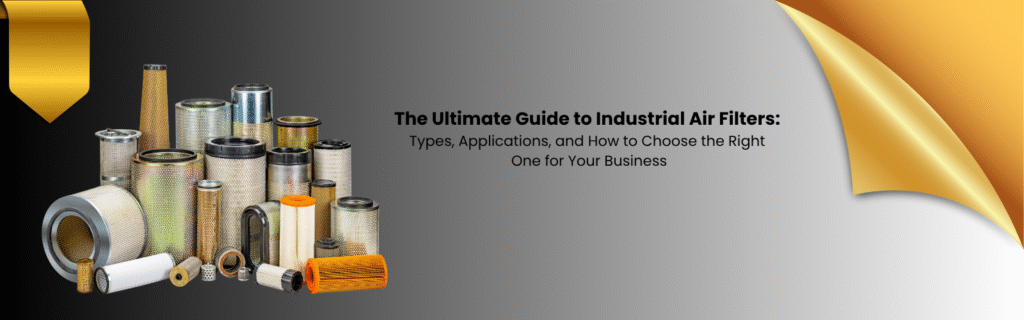
In this comprehensive guide, we’ll explore the types of industrial filters, their specific applications, and give you a clear roadmap to choose the right one for your business. Whether you’re in manufacturing, healthcare, automotive, or energy — this guide is for you.
2. The Fundamentals: How Industrial Air Filtration Works
The Filtration Process
Air filters work by trapping contaminants as air passes through them. The main filtration mechanisms include:
- Mechanical Filtration: Physical barriers that catch particles based on size.
- Impaction: Larger particles crash into filter fibers and stick.
- Diffusion: Tiny particles move randomly and collide with filter material.
- Adsorption: Used in some filters to remove gases and odors.
The goal is simple: remove harmful particles without restricting airflow.
The Importance of Micron Ratings
A micron (µm) is one-millionth of a meter. Air filters are rated by the size of particles they can trap.
- A 10-micron filter catches particles 10 microns or larger.
- A HEPA filter can capture particles as small as 0.3 microns.
Why it matters:
Choosing the wrong micron rating can either let contaminants through or clog your system too quickly. The right balance is key.
Understanding Filtration Stages
Most industrial systems use multi-stage filtration:
- Pre-Filters: Capture large particles like dust and lint.
- Intermediate Filters: Remove medium-sized particles.
- Final Filters (e.g., HEPA): Trap fine particles, bacteria, or other tiny contaminants.
This layered approach ensures longer filter life and more effective air cleaning.
3. Types of Industrial Air Filters: A Deep Dive
Compressed Air Filters
Function:
Used to clean compressed air before it powers tools, controls, or machines. They remove moisture, oil mist, dust, and rust particles.
MMHP Focus:
MMHP India offers a wide range of compressed air filters that ensure clean, dry air — crucial for the longevity and performance of pneumatic systems.
Applications:
- Pneumatic tools
- Process automation
- Food and beverage industries
- Paint shops
- Pharmaceuticals
AHU Panel Filters (HVAC & Ventilation)
Function:
Installed in Air Handling Units (AHUs), these filters are the first line of defense in any HVAC system. They protect the system and improve indoor air quality.
MMHP Focus:
MMHP India’s AHU filters range from basic pre-filters to fine filters. They help extend the life of expensive HEPA filters and ensure consistent airflow.
Applications:
- Hospitals
- Commercial buildings
- Clean rooms
- Manufacturing units
- Laboratories
Sintered Bronze Filters
Function:
Made from powdered bronze, these filters are durable, corrosion-resistant, and reusable. They’re ideal for high-pressure, high-temperature, or chemically aggressive environments.
MMHP Focus:
MMHP India’s sintered bronze filters also double as filter-mufflers, combining air filtration with noise reduction.
Applications:
- Pneumatic exhaust systems
- Chemical processing plants
- Harsh industrial environments
- High-temperature air/fluid lines
Engine Air Filters
Function:
Protects engines by preventing dust, sand, and debris from entering and damaging internal components.
MMHP Focus:
MMHP India manufactures engine filters tailored for automobiles, heavy equipment, and railways. They are trusted by major clients, including Indian Railways.
Applications:
- Automotive
- Earthmoving machinery
- Diesel generators
- Locomotives
High-Efficiency Particulate Air (HEPA) Filters
Function:
HEPA filters capture 99.97% of particles at 0.3 microns. They are essential for sterile or particle-sensitive environments.
MMHP Focus:
MMHP India’s HEPA filters serve as the final filtration stage, ensuring ultra-clean air where precision and safety are critical.
Applications:
- Pharmaceutical manufacturing
- Electronics and semiconductors
- Hospitals and surgical suites
- Food processing
- Aerospace
4. The Decision-Making Process: How to Choose the Right Filter
Assess Your Application
Start by answering this: What is the filter protecting?
Is it a pneumatic tool, an engine, a clean room, or a chemical system?
The environment and equipment type will determine what kind of filter you need.
Consider the Contaminant
Identify what you’re trying to filter out:
- Dust or dirt? → Use pre-filters or panel filters
- Oil mist or vapor? → Use compressed air filters
- Fine particles or bacteria? → Go for HEPA filters
- Corrosive fluids or gases? → Consider sintered bronze
Each filter is designed for specific types of contaminants.
Evaluate Environmental Conditions
Temperature, pressure, and chemical exposure can all affect filter performance.
For example:
- High temperatures or corrosive air? Use sintered bronze filters.
- Sterile environment? Use HEPA filters.
Choosing a filter that can withstand your conditions is essential for both safety and longevity.
Don’t Overlook Cost and Maintenance
There’s a trade-off between initial cost and long-term savings.
- Disposable filters are cheaper up front but require frequent replacement.
- Reusable filters (like sintered bronze) cost more initially but last longer.
Also, think about:
- Maintenance effort
- Downtime due to filter changes
- Availability of replacement parts
A slightly more expensive filter might actually save money over time.
5. Partnering with the Experts: Why MMHP India is Your Ultimate Resource
Decades of Expertise
With over 28 years of experience, MMHP India is a trusted name in industrial filtration. Our deep understanding of various applications allows us to recommend the best-fit solution, not just a product.
Customization is Key
No two businesses are exactly alike. That’s why MMHP India offers custom-built filters for unique challenges — whether it’s a special material requirement, a size constraint, or a highly corrosive environment.
Commitment to Quality
MMHP India holds ISO certifications, ensuring all filters meet global quality standards. Every product is tested for performance, durability, and efficiency — so you can trust that your operation is in good hands.
6. Conclusion: A Small Component with a Big Impact
Industrial air filters may be small, but their impact is massive.
From protecting sensitive equipment and ensuring clean air to maintaining product quality and reducing maintenance costs, the right filter can transform your operations.
To sum it up:
✅ Choose the right filter based on application, contaminant type, and environment.
✅ Don’t overlook maintenance and long-term cost savings.
✅ Work with experienced partners like MMHP India for reliable, customized solutions.
Ready to find the perfect filtration solution for your needs?
Contact the experts at MMHP India today for a free consultation. Discover how the right filter can make a world of difference to your operation — in performance, safety, and cost efficiency.
—————————————————————————————————–