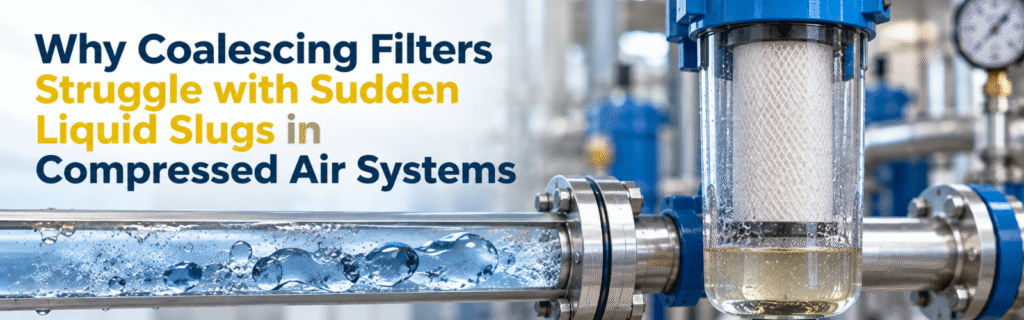
A Compressed Air Coalescing Filter is designed to remove fine liquid aerosols from compressed air.
Tiny oil and water droplets enter the filter element, combine into larger droplets and drain away from the airflow.
Under normal operating conditions, this process provides effective contamination control.
But there is an important difference between handling fine aerosols and receiving a sudden large quantity of liquid water or oil.
When bulk liquid suddenly enters the filter, the coalescing element can become overloaded. Instead of gradually capturing and draining microscopic droplets, the element is forced to handle much more liquid than expected.
The result can be:
- Rapid saturation
- Increased pressure drop
- Liquid carryover
- Reduced filtration performance
- Shortened filter-element life
- Downstream moisture problems
Understanding this difference helps maintenance teams avoid blaming the High Efficiency Coalescer when the real problem may be somewhere upstream in the compressed air system.
What Is a Compressed Air Coalescing Filter?
A Compressed Air Coalescing Filter removes very small liquid droplets and fine contaminants suspended in compressed air.
These contaminants may include:
- Water aerosols
- Oil aerosols
- Fine solid particles
- Compressor lubricant mist
- Condensed moisture
Unlike a simple particulate filter, a coalescing filter relies on specialized filtration media.
As compressed air moves through the element, tiny droplets interact with the filter fibers. The droplets combine—or coalesce—into larger droplets.
Once large enough, these droplets move through the media and drain toward the bottom of the filter housing.
This continuous capture-and-drain process is fundamental to proper coalescer operation.
Aerosols and Liquid Slugs Are Not the Same
This distinction is critical.
Aerosol
An aerosol consists of extremely small liquid droplets suspended throughout the compressed air.
A Coalescing Filter Element is specifically designed to capture these droplets.
Liquid Slug
A liquid slug is a much larger volume of liquid arriving suddenly through the compressed air line.
Instead of millions of microscopic droplets distributed through the airflow, the filter may suddenly receive a concentrated quantity of condensed water or oil.
That changes the loading condition dramatically.
Think of the difference between filtering humid air and pouring water directly onto filtration media.
Both involve water, but the physical challenge is completely different.
Where Do Liquid Slugs Come From?
Bulk liquid normally indicates that moisture management upstream of the Compressed Air Filter needs attention.
Several conditions can produce this problem.
1. Excessive Condensation in the Pipeline
Compressed air leaves the compressor at an elevated temperature.
As the air cools, its ability to retain water vapor decreases.
Water therefore condenses inside:
- Aftercoolers
- Receivers
- Distribution piping
- Low points
- Air treatment equipment
If this condensate is not removed effectively, it can accumulate.
A change in airflow can then push the accumulated water downstream as a liquid slug.
The coalescing filter suddenly receives a volume of water that should ideally have been separated and drained earlier.
2. Faulty Condensate Drains
Compressed air systems commonly use drains at:
- Air receivers
- Moisture separators
- Filter housings
- Air dryers
- Low points in piping
When a drain becomes blocked or fails, liquid begins accumulating.
Eventually that accumulated condensate can be carried downstream.
A maintenance team may notice that the Compressed Air Coalescing Filter is becoming saturated repeatedly and assume the filter is defective.
In reality, the root cause could be a failed upstream drain.
3. Poor Piping Layout
Compressed air piping should help control condensate movement.
Improper piping arrangements can create locations where water collects.
Problems can arise from:
- Poorly positioned low points
- Incorrect pipe slope
- Inadequate drain points
- Air take-offs positioned where condensate can enter them
- Long pipe runs without suitable moisture management
When accumulated condensate suddenly moves, downstream filtration equipment receives the impact.
4. Problems with the Aftercooler or Moisture Separator
The aftercooler reduces compressed-air temperature and causes a significant amount of water vapor to condense.
A moisture separator should then remove much of this bulk liquid.
If separation or drainage is ineffective, more liquid continues downstream.
That increases the burden placed on the High Efficiency Coalescer.
The coalescing filter is then being asked to compensate for an upstream moisture-separation problem.
5. High Ambient Humidity
During humid weather, a compressor can draw significantly more atmospheric moisture into the system.
Compression does not eliminate this water.
As the compressed air subsequently cools, moisture condenses.
This is one reason compressed-air systems can experience more condensate problems during periods of high humidity.
If the existing condensate-management system cannot handle the increased load, the coalescing filter may receive much more liquid than usual.
What Happens Inside a Coalescing Filter During a Liquid Slug?
Under normal conditions, fine droplets enter the filtration media gradually.
They are captured, combine into larger droplets and drain away.
During a liquid slug, the process changes.
A large amount of liquid reaches the element within a short period.
The media may become heavily wetted before the accumulated liquid can drain effectively.
This can create several consequences.
Rapid Filter Saturation
A Coalescing Filter Element has to drain collected liquid continuously.
If liquid arrives faster than it can be removed from the element, temporary saturation can occur.
This changes airflow through the media.
Areas that would normally provide effective filtration may become excessively wet.
The element may still be physically intact, but it is operating outside its intended loading condition.
Liquid Slugs Can Increase Pressure Drop
Pressure drop is one of the most important operating characteristics of any compressed air filter.
Air must pass through the filtration media.
As contamination or liquid loading increases, resistance can increase.
When a Compressed Air Coalescing Filter becomes heavily saturated, airflow through the element can become more difficult.
Higher pressure drop matters because the compressor must maintain sufficient pressure downstream.
Excessive filtration resistance can contribute to:
- Reduced pressure at equipment
- Poor pneumatic performance
- Increased compressor demand
- Higher energy consumption
- Reduced overall system efficiency
This is why an unexplained increase in differential pressure should not automatically result in replacing the element.
The underlying cause should also be investigated.
Why Liquid Carryover Can Occur
A coalescing filter is intended to remove liquid contamination.
So why would liquid sometimes appear downstream?
The answer is capacity and drainage.
If the element receives liquid faster than it can capture, coalesce and drain it, some liquid may remain in the airflow.
Heavy saturation can also disturb normal drainage behavior.
The result can be downstream moisture even though a coalescing filter is installed.
This does not necessarily mean that the filtration concept is ineffective.
It can indicate that the Compressed Air Filtration system is receiving an abnormal bulk-liquid load.
Drainage Is Just as Important as Filtration
Capturing droplets is only half the job.
Once liquid has been separated from the compressed air, it must leave the filter housing.
If condensate remains inside the housing, the collected liquid can accumulate.
Eventually the liquid level can approach the filtration element or airflow path.
This creates the possibility of re-entrainment, where previously separated liquid is picked up again by the moving compressed air.
Therefore, the condition of the filter drain should always be checked when investigating moisture downstream.
A high-performance filter combined with a malfunctioning drain can still produce poor results.
Why Replacing the Filter Element May Not Solve the Problem
Consider this situation:
A plant notices water downstream of a Compressed Air Coalescing Filter.
The filter element is replaced.
For a short time, everything appears normal.
Soon, water appears again.
The element is replaced once more.
The problem repeats.
In this case, repeatedly changing the coalescer may treat the symptom without correcting the cause.
Maintenance should instead inspect:
- Upstream moisture separator
- Receiver drains
- Filter drains
- Air dryer
- Aftercooler
- Pipeline low points
- Operating temperature
- Condensate loading
The filter should be part of the investigation—not automatically considered the source of the problem.
Coalescing Filters Are Not Bulk Water Separators
This is an important system-design principle.
A High Efficiency Coalescer and a bulk moisture separator perform related but different jobs.
A moisture separator is designed to remove larger quantities of condensed liquid.
A coalescing filter is intended to capture much finer aerosols that remain suspended after bulk separation.
A well-designed compressed-air treatment system may therefore follow a sequence such as:
Compressor → Aftercooler → Moisture Separation → Drainage → Filtration → Dryer → Final Air Treatment
The exact configuration depends on the application.
The important principle is that each component should perform the task for which it was designed.
Using a fine coalescing filter as the primary bulk-liquid separator can create unnecessary loading and pressure drop.
Why Filter Position Matters
The location of a Compressed Air Coalescing Filter can significantly affect what it receives.
For example, placing the filter where compressed air is still cooling rapidly can expose it to significant condensate formation.
Air temperature, dryer location, separator location and piping configuration should therefore be considered together.
Installing a high-efficiency filter in the wrong position does not guarantee high-quality compressed air.
System design matters as much as filter efficiency.
Liquid Loading Can Reduce Filter Element Life
Repeated exposure to abnormal liquid loading can increase stress on a Coalescing Filter Element.
Even when the media continues to function, heavy contamination and frequent saturation can lead to shorter practical service intervals.
The plant may experience:
- More frequent element replacement
- Increasing differential pressure
- Higher maintenance cost
- Greater risk of downstream contamination
- Unplanned servicing
Correcting the upstream moisture problem can therefore help improve the performance of the entire filtration system.
How to Identify a Liquid-Slug Problem
Several warning signs deserve investigation.
Filter Becomes Saturated Very Quickly
If a recently installed element becomes heavily wet much sooner than expected, check upstream condensate control.
Large Amounts of Water in the Filter Bowl
Some collected condensate is expected.
Unusually large volumes or rapid accumulation may indicate excessive bulk-liquid loading.
Water Appears Downstream Intermittently
Intermittent problems can indicate accumulated condensate suddenly moving through the pipeline.
Pressure Drop Changes Suddenly
Gradual contamination normally creates gradual changes.
A sudden change may indicate an unusual operating event, including heavy liquid loading.
Problem Is Worse During Humid Weather
Higher atmospheric moisture may expose limitations in condensate removal.
Replacing the Element Does Not Solve the Issue
Repeated premature failure strongly suggests that the filter itself may not be the root cause.
How to Protect a Compressed Air Coalescing Filter
Remove Bulk Water Before Fine Filtration
Where appropriate, use effective moisture separation before the coalescing stage.
The goal is to prevent large quantities of condensed water from reaching fine filtration media.
Inspect Automatic Drains
A small drain problem can create a large moisture problem.
Drains should be inspected and maintained according to the equipment manufacturer’s requirements.
Check Pipeline Low Points
Look for locations where condensate can collect.
These areas may require appropriate drainage arrangements.
Monitor Differential Pressure
Differential pressure provides useful information about filter condition.
Unexpected changes can help identify loading or restriction problems before downstream performance is seriously affected.
Consider Actual Operating Conditions
Filter selection should consider:
- Airflow
- Operating pressure
- Temperature
- Aerosol concentration
- Moisture loading
- Required downstream air quality
Selecting a filter only by connection size can overlook important operating requirements.
The Cost of Ignoring Bulk Liquid Carryover
Moisture downstream of compressed-air treatment equipment can affect much more than the filter itself.
Depending on the application, excessive water or oil can contribute to:
- Pneumatic valve problems
- Cylinder corrosion
- Instrument contamination
- Product-quality problems
- Pipeline corrosion
- Increased maintenance
- Premature component wear
For applications requiring cleaner compressed air, effective moisture control becomes particularly important.
The cost of correcting an upstream drainage problem can be much lower than repeatedly repairing downstream equipment.
Why MMHP High Efficiency Coalescers?
MMHP India provides High Efficiency Coalescers and industrial filtration solutions for compressed-air applications.
Effective compressed-air filtration requires more than installing a filter element. Airflow, contamination level, moisture load, drainage and system configuration all influence actual filter performance.
Choosing an appropriate Compressed Air Coalescing Filter for the operating conditions can help control fine oil and water aerosols while supporting cleaner downstream compressed air.
For applications experiencing abnormal moisture loading, the complete compressed-air treatment system should also be evaluated to identify the source of bulk liquid.
FAQs
1. Can a coalescing filter remove water from compressed air?
Yes. A coalescing filter is designed to remove fine water and oil aerosols suspended in compressed air. Bulk liquid should preferably be removed upstream using suitable separation and drainage.
2. What is a liquid slug in compressed air?
A liquid slug is a relatively large volume of condensed water or oil moving through a compressed-air line over a short period.
3. Why does my compressed air filter fill with water quickly?
Possible causes include excessive condensation, failed drains, inadequate moisture separation, high humidity, piping problems or air-treatment equipment issues.
4. Can excessive water increase coalescing-filter pressure drop?
Heavy liquid loading can increase resistance through the filtration media and may contribute to higher differential pressure.
5. Why is there water downstream even after installing a coalescing filter?
The filter may be receiving excessive bulk liquid, the drain may not be functioning correctly, or the overall moisture-removal system may need attention.
6. Should I replace the coalescing element whenever downstream water appears?
Not automatically. Inspect the element, but also investigate drains, separators, dryers, aftercoolers and piping for the root cause.
7. Is a coalescing filter the same as a moisture separator?
No. Bulk separators primarily remove larger quantities of condensed liquid, while coalescing filters are designed to capture much finer liquid aerosols.
Conclusion
A Compressed Air Coalescing Filter performs best when it is allowed to do the job it was designed for: capturing fine water and oil aerosols.
A sudden liquid slug creates a completely different operating condition.
When large volumes of condensate reach the filter, the element can become heavily saturated, differential pressure may rise, drainage can become overwhelmed, and liquid may appear downstream.
The solution is not always a new filter.
The better approach is to look upstream.
Separate bulk liquid first. Drain it effectively. Then allow the coalescing filter to handle the fine aerosols that remain.
For compressed-air applications requiring reliable contamination control, MMHP India High Efficiency Coalescers can be selected according to airflow, pressure and filtration requirements to support effective industrial compressed-air treatment.