Contamination Pathways in Compressed Air Systems: What Your Equipment Is Not Telling You
Compressed air is widely considered a “clean” power source for automation. It runs cylinders, solenoids, sprayers, robots, valves, AODD pumps, and high-speed packaging equipment. But what many plants fail to realize is that compressed air is often carrying a dangerous amount of contamination—dust, rust, oil aerosols, water droplets, carbon particles, and degraded rubber from aging pipelines.
Most of this contamination is invisible to the naked eye. But once inside a pneumatic system, it begins wearing out machines, degrading seals, blocking valves, and reducing performance long before a breakdown becomes visible.
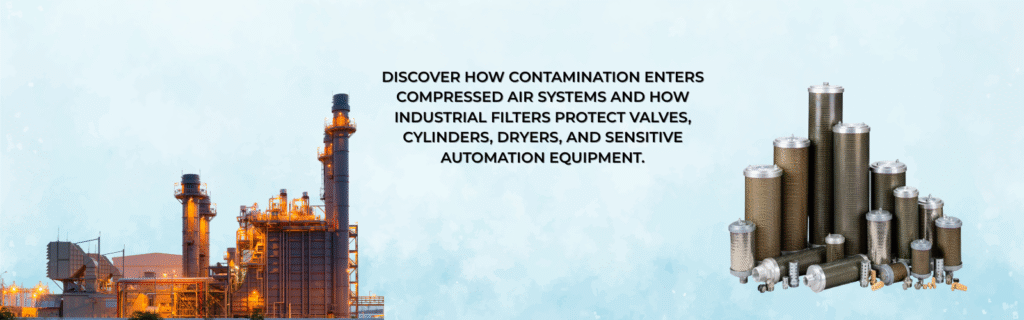
This is where a well-designed Compressed Air Contamination Filter becomes essential. It protects the entire network by stopping contaminants right at their source—before they reach high-value equipment.
This blog explains how contamination enters compressed air systems, why it is often overlooked, and what industries can do to protect their machinery with the right filtration strategy.
Why Compressed Air Is Often Dirtier Than Expected
Even when a compressor room looks clean, the air entering pneumatic equipment often carries three major contaminants:
- Water and moisture
- Oil aerosols from lubricated compressors
- Solid particles from pipes, valves, seals, and ambient air
These impurities exist in every facility—food plants, automotive lines, pharma cleanrooms, printing presses, and precision assembly operations. And they all impact machine health if not controlled properly through a Compressed Air Contamination Filter.
The Hidden Pathways Where Contamination Enters Your System
There are several points across the compressed air network where contaminants develop or enter the flow stream. Each pathway brings different risks.
1. Contamination at the Compressor Inlet
Compressors inhale ambient air that contains:
- dust
- pollen
- microscopic dirt
- humidity
- oil vapors
- welding fumes or chemical fumes (in some factories)
Once compressed, these particles become denser and more aggressive. Without a proper Compressed Air Contamination Filter, they move directly into the main air lines.
2. Oil Carryover from Lubricated Compressors
Oil-lubricated compressors always release a small amount of oil vapor into the air stream. Over time, this becomes:
- sticky aerosol
- fine oil mist
- carbonized residue
These oil traces coat the inside of pipelines, attracting dust and forming sludge. This sludge eventually breaks free and travels into valves, sensors, and actuators.
3. Rust & Scale Formation Inside Pipelines
As pipelines age, internal corrosion becomes unavoidable. Moisture inside compressed air lines accelerates this, leading to:
- rust flakes
- scale particles
- metal dust
These fragments cause major pneumatic failures, especially in high-speed or precision machines.
A robust Compressed Air Contamination Filter captures these particles before they reach critical equipment.
4. Moisture Carryover from Dryers and Aftercoolers
Even air dryers do not remove 100% of moisture. Temperature fluctuations in pipelines later cause:
- condensation
- microdroplets
- water pooling inside bends and low points
Water mixed with dust creates a sludge-like contaminant that can block valves and clog nozzles.
5. Rubber & Seal Degradation from Valves and Fittings
Every pneumatic valve, cylinder, and fitting contains:
- O-rings
- rubber seats
- elastomer seals
With time, these degrade and release microscopic rubber fragments into the airflow. These fragments are especially damaging for:
- proportional valves
- solenoids
- precision dosing actuators
- high-speed cylinders
A Compressed Air Contamination Filter prevents these particles from migrating downstream.
6. Oil & Carbon Backflow from Air Tools
Air tools, grinders, pneumatic drills, and torque tools often return small amounts of lubricant back into the air line. Over time, this contaminates the entire branch of the system.
How Contaminants Damage Pneumatic Equipment
Most contamination damage happens quietly and gradually until a breakdown finally becomes visible. Here is what typically occurs:
Valves:
Particles lodge between the spool and sleeve → sticking, leakage, or erratic shifting.
Cylinders:
Rust and dust scratch piston rods → seal failure → loss of force → air leakage.
Air Preparation Units:
Filters clog faster → higher pressure drop → higher compressor load.
Sensors:
Oil mist coats sensors → false readings → downtime.
Tools and Actuators:
Water removes lubrication → premature wear.
Robots & Precision Automation:
Even tiny contaminants cause drift, jerky movement, and loss of repeatability.
The cost of failure is often much higher than the cost of installing a reliable Compressed Air Contamination Filter.
Real Problem: Contamination Builds Up Quietly Over Months
Factories often assume their compressed air is clean because:
- they have an air dryer
- pressure looks normal
- machines appear to run fine
But contamination builds inside components long before failures occur.
By the time symptoms appear, damage is already done.
Symptoms include:
- sticking solenoid valves
- uneven cylinder movement
- unexpected pressure drops
- black/oily residue in pipelines
- frequent actuator seal changes
- inconsistent product finish (in paint lines)
- poor spray patterns
- tools losing power
These issues indicate contamination is already deep inside the system.
Where Filtration Plays the Most Important Role
A well-designed Compressed Air Contamination Filter removes contaminants at different stages:
- Coarse filtration: removes rust, dust, and solid particles
- Coalescing filtration: removes oil aerosols and fine mist
- Moisture separation: removes water droplets
- Fine micron filtration: ensures ultra-clean air for sensitive equipment
Different machines require different filtration levels:
- Packaging lines → 10–40 micron
- Food & pharma → 1–5 micron
- Robotics → 1 micron
- Paint & coating lines → oil-free, ultra-fine filtration
Why MMHP Filters Are Ideal for Contamination Control
MMHP designs filtration elements specifically for industrial conditions.
Their advantages include:
- stable micron accuracy
- sintered metal construction
- long service life
- high dirt-holding capacity
- low pressure drop
- compatibility with high-flow pneumatic systems
- resistant to oil, moisture, and corrosion
- customizable sizes for OEM equipment
MMHP filters are built to survive harsh production environments and prevent contamination from ever reaching valves or cylinders.
Case Example: A Packaging Plant Facing Random Machine Shutdowns
A food packaging plant saw:
- valves sticking mid-cycle
- sealing jaws failing intermittently
- inconsistent pneumatic flow
- sensors giving faulty signals
A contamination audit revealed heavy rust flakes and oil mist inside the main lines.
After installing MMHP Compressed Air Contamination Filters:
- breakdowns dropped by 70%
- cylinders ran smoother
- sealing quality improved
- energy consumption decreased
- filter replacement intervals increased
The entire line became more stable.
How to Know Which Filter You Need
Choosing the correct filtration design depends on:
- type of compressor
- distance between compressor and tools
- humidity levels
- sensitivity of equipment
- presence of oil
- application (robotics, packaging, paint, pharma, CNC)
General guidelines:
- Oil-heavy environments: use coalescing + sintered elements
- High moisture: use moisture separators + filters
- Precision robots: use fine micron filters
- General factory use: bronze or stainless-steel sintered filters
Conclusion
Contamination inside compressed air systems is one of the most underrated causes of pneumatic failure. It quietly travels through pipelines, coats equipment, blocks valves, and reduces machine life. Most plants never trace these failures back to the real root cause.
A well-sized Compressed Air Contamination Filter eliminates these hidden pathways and ensures clean, stable air reaches every machine.
Cleaner air means:
- fewer breakdowns
- better product quality
- lower maintenance costs
- longer equipment life
- more efficient compressed air usage
MMHP’s industrial filtration solutions are built to address these real-world challenges and give factories the reliability they expect from their pneumatic systems.