
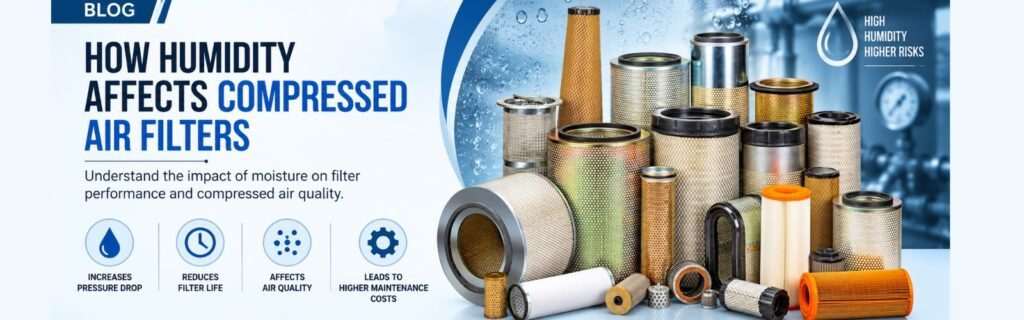
A compressed air system can appear perfectly normal during dry weather and suddenly begin experiencing filtration problems when humidity increases.
Filter elements require replacement sooner. Pressure drop increases. Water appears in downstream lines. Pneumatic equipment starts behaving inconsistently.
The compressor may be operating normally.
So what changed?
Often, the answer is simply moisture.
Atmospheric air always contains some amount of water vapour. When a compressor draws in humid air, that moisture enters the compressed air system. As air is compressed and subsequently cooled, part of the water vapour can condense into liquid water.
That creates a much more demanding environment for Compressed Air Filters.
Understanding how humidity affects filtration can help industries improve compressed air quality, extend filter life and prevent moisture-related equipment problems.
Why Does Compressed Air Contain Water?
A compressor does not manufacture moisture.
It draws moisture from the surrounding atmosphere.
Air entering a compressor contains:
- Oxygen
- Nitrogen
- Dust
- Oil aerosols from the environment
- Water vapour
- Other airborne contaminants
When atmospheric humidity is high, the incoming air contains more water vapour.
Compression raises the pressure and temperature of the air. As compressed air later cools in aftercoolers, receivers and pipelines, its ability to retain water vapour changes.
Moisture can then condense.
The result is liquid water entering parts of the compressed air network.
This is one reason Compressed Air Filters need to be selected as part of a complete air-treatment system rather than viewed as isolated components.
Why High Humidity Changes Filter Performance
During dry operating conditions, a filter may primarily deal with solid contamination and limited aerosol loading.
During humid conditions, the same filter may encounter:
- Increased liquid water
- Water aerosols
- Oil-water mixtures
- Wet particulate contamination
- Corrosion products
- Higher contaminant loading
This changes the operating conditions inside the filter.
A filter that previously provided a long service interval may therefore require attention sooner during periods of high humidity.
What Happens When Water Reaches the Filter Element?
The exact behaviour depends on the type of filter and media being used.
However, excessive moisture can affect Compressed Air Filters in several ways.
Increased Contaminant Loading
Water can combine with dirt, oil and other contaminants to create deposits on filtration media.
Instead of dry particles being captured individually, contaminants may form sticky deposits.
These deposits can restrict available airflow passages.
Higher Pressure Drop
As the available flow area becomes restricted, resistance increases.
The compressor then has to work against greater pressure loss to maintain the required downstream pressure.
Reduced Filter Life
A filter operating continuously under heavy liquid and contaminant loading may reach its service limit faster.
This means humidity can indirectly increase maintenance frequency.
Why Pressure Drop Matters
Pressure drop is one of the most important performance considerations in Compressed Air Filters.
Every filter creates some resistance.
However, as contamination accumulates, that resistance can increase.
A high pressure drop means the compressor may need to produce air at a higher pressure to deliver the required pressure at the point of use.
That requires additional energy.
Even relatively small unnecessary pressure losses across multiple air-treatment components can contribute to higher operating costs.
Maintaining filters in suitable condition therefore supports both air quality and energy efficiency.
Moisture Can Turn Dust Into a Bigger Problem
Dry dust is already undesirable in compressed air.
Add water and the situation can become worse.
Moisture can combine with fine particulate contamination and produce deposits inside:
- Filter housings
- Pipes
- Valves
- Regulators
- Pneumatic cylinders
- Instruments
These wet deposits may be more difficult to remove than dry contamination.
This means Compressed Air Filters are not only protecting downstream equipment from individual contaminants—they are helping prevent different contaminants from interacting.
Why Water Separators and Filters Are Different
A common misunderstanding is that one compressed air filter should remove every form of water.
That is not always the case.
Different air-treatment components perform different jobs.
A bulk water separator is designed primarily to remove larger quantities of liquid water from the compressed-air stream.
A coalescing filter is typically used to remove finer liquid aerosols and contaminants.
A dryer is used to reduce the moisture content of the compressed air further.
Therefore, a well-designed system may use several stages:
Compressor → Aftercooler → Water Separator → Compressed Air Filters → Dryer → Final Filtration
The actual configuration depends on the required air quality and application.
Why Drain Performance Becomes Critical
Removing moisture from compressed air is useful only if that collected liquid is actually discharged.
Filter housings and separators often include drain arrangements to remove accumulated condensate.
If a drain:
- Becomes blocked
- Fails to operate
- Is incorrectly installed
- Is not maintained
liquid may accumulate inside the housing.
Eventually, the collected water can be carried downstream again.
This can create the impression that the Compressed Air Filters are not working correctly even though the filtration media may not be the main problem.
Drain inspection should therefore be part of routine compressed-air maintenance.
High Humidity Can Increase Corrosion Risk
Water and metal are rarely a good combination in compressed-air networks.
If moisture remains in piping and equipment, corrosion can occur.
Corrosion creates another contaminant: rust particles.
These particles then enter the airflow and increase the contamination load on downstream Compressed Air Filters.
The system can therefore develop a cycle:
Moisture → Corrosion → Particles → Increased Filter Loading
Controlling moisture early helps reduce this secondary contamination.
How Humidity Affects Pneumatic Equipment
The effects of moisture extend far beyond filter life.
Poorly controlled water in compressed air can contribute to problems with:
Pneumatic Valves
Moisture and contamination may interfere with internal moving components.
Pneumatic Cylinders
Water can contribute to corrosion and affect lubrication conditions.
Instruments
Sensitive pneumatic instruments often require clean, dry compressed air.
Air Tools
Moisture can reduce reliability and contribute to internal corrosion.
Production Processes
In applications involving painting, electronics, food processing or precision manufacturing, water contamination may directly affect product quality.
Proper Compressed Air Filters are therefore part of broader process protection.
Seasonal Humidity Can Change Maintenance Requirements
Compressed air conditions are not necessarily constant throughout the year.
A plant may experience significantly different humidity during:
- Summer
- Monsoon
- Winter
- Dry seasons
For facilities in humid climates, seasonal changes can dramatically alter condensate generation.
A filter maintenance schedule based only on operating hours may therefore miss important environmental factors.
Maintenance teams should also monitor:
- Pressure drop
- Condensate levels
- Drain operation
- Downstream air quality
- Seasonal humidity
This provides a more realistic picture of filter condition.
Signs Humidity Is Affecting Your Compressed Air Filters
Look for several symptoms occurring together:
- More frequent filter replacement
- Increasing differential pressure
- Water downstream of filters
- Excessive condensate discharge
- Corrosion in compressed-air piping
- Wet contamination inside filter housings
- Pneumatic component problems
- Reduced air quality during humid months
If problems appear seasonally, humidity should be investigated as a potential contributor.
Should You Simply Install a Finer Filter?
Not necessarily.
Installing finer Compressed Air Filters does not automatically solve excessive moisture.
In fact, placing a fine filter in a system with uncontrolled bulk water can create unnecessary loading.
The better strategy is to understand what needs to be removed at each stage.
Bulk liquid water should be handled appropriately.
Fine aerosols require suitable coalescing filtration.
Water vapour requires drying technology when lower dew points are necessary.
Solid particles require appropriate particulate filtration.
Each component has a specific job.
Why Correct Filter Sizing Matters in Humid Conditions
Filter sizing is important under all operating conditions, but high moisture loading can make poor sizing more noticeable.
An undersized filter may experience:
- Higher air velocity
- Greater pressure drop
- Reduced contaminant capacity
- Shorter service intervals
Correctly sized Compressed Air Filters provide sufficient filtration area for the expected flow and operating conditions.
Engineers should consider actual maximum flow rather than only average consumption.
Don’t Forget Operating Pressure
Compressed air filtration performance is also related to system pressure and actual volumetric flow.
A filter should therefore be selected based on real system conditions, including:
- Maximum flow
- Operating pressure
- Temperature
- Contamination level
- Required air quality
- Moisture load
Selecting filters based only on connection size can result in poor performance.
A 1-inch connection, for example, does not automatically mean every 1-inch filter has the same flow capability.
How to Extend Compressed Air Filter Life
A few practical steps can make a significant difference.
Remove Bulk Water First
Avoid forcing fine filtration stages to handle contamination that should have been removed upstream.
Maintain Automatic Drains
Regularly verify that condensate is actually being discharged.
Monitor Differential Pressure
Do not rely only on fixed replacement intervals.
Maintain Aftercoolers
Effective cooling helps manage condensate in a controlled part of the system.
Use Appropriate Drying
Where low moisture levels are required, use a suitable compressed-air dryer.
Select the Correct Filter Grade
Match filtration performance to the actual air-quality requirement.
Size Filters Properly
Allow adequate flow capacity for maximum operating demand.
Together, these practices help Compressed Air Filters operate under more manageable conditions.
Filter Replacement: Time or Condition?
Fixed replacement schedules are useful for planning maintenance.
But filter condition also matters.
An element operating in a clean, dry environment may experience different loading than the same element operating in a hot and humid factory.
Maintenance decisions can consider:
- Operating hours
- Differential pressure
- Contamination levels
- Manufacturer recommendations
- Air-quality requirements
- Environmental conditions
Condition awareness can help avoid both premature replacement and excessive filter use.
Why Choose MMHP Compressed Air Filters?
MMHP India provides industrial filtration solutions for compressed-air applications.
Effective Compressed Air Filters must provide contaminant removal while maintaining suitable airflow and acceptable pressure drop.
MMHP filtration solutions can support different compressed-air requirements, including industrial applications where air quality directly influences machine reliability and process performance.
When selecting filtration, factors such as flow rate, operating pressure, contamination level, moisture conditions and required air quality should be considered together.
The objective is not simply to install a filter.
It is to create a filtration system that works reliably under actual plant conditions.
Frequently Asked Questions
Does humidity affect compressed air filter life?
Yes. Higher moisture loading can combine with oil and particulate contamination, potentially increasing deposits and filter restriction.
Can compressed air filters remove water?
Certain filtration stages can remove liquid aerosols, but bulk water separation and drying may require dedicated equipment.
Why does my compressed air system produce more water during humid weather?
Higher atmospheric humidity means the compressor draws in more water vapour. As compressed air cools, more condensate can form.
Why is water still present after the filter?
Possible causes include excessive moisture loading, unsuitable filtration, failed drains, inadequate drying or incorrect system design.
Can moisture increase pressure drop?
Moisture combined with contamination can contribute to deposits and filter loading, potentially increasing resistance across Compressed Air Filters.
Conclusion
Humidity is not just a weather condition.
For a compressed-air system, it is an operating variable.
When atmospheric humidity rises, the compressor draws in more water vapour. As that air is compressed and cooled, moisture can condense and place additional demand on separators, dryers and Compressed Air Filters.
If this moisture is not managed correctly, filters may load faster, pressure drop can increase and downstream equipment may be exposed to water, oil and particulate contamination.
The solution is not simply to keep installing finer filters.
Effective compressed-air treatment requires the right combination of water separation, filtration, drainage and drying.
By properly sizing Compressed Air Filters, maintaining condensate drains and considering seasonal humidity during maintenance planning, industries can achieve cleaner compressed air and more reliable equipment operation.