

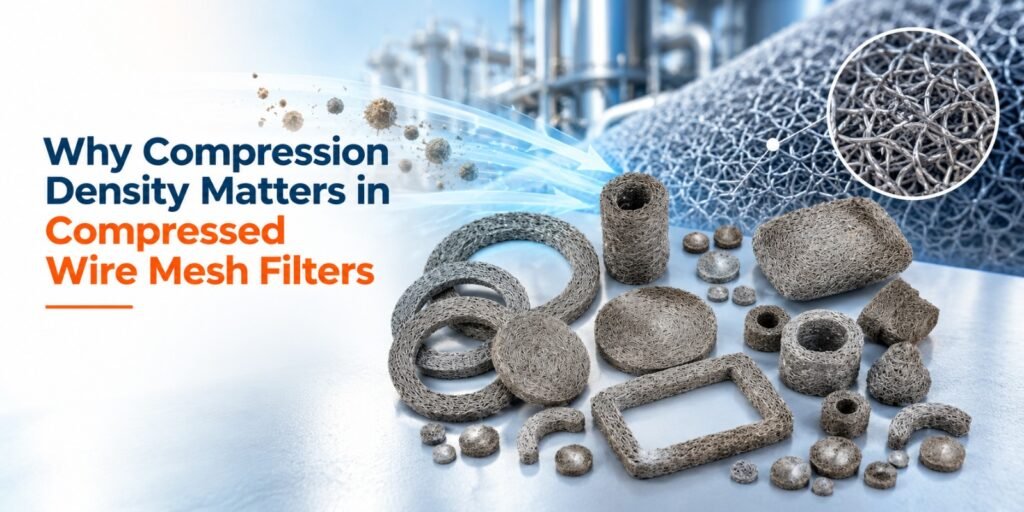
A Compressed Wire Mesh Filter is a durable industrial filtration component designed to retain contaminants while allowing air, gas or liquid to pass through its interconnected mesh structure.
Unlike conventional disposable filter media, compressed wire mesh elements are manufactured by shaping and compacting metallic wire mesh into a defined form. This construction makes them suitable for applications requiring mechanical strength, dimensional stability and filtration under demanding operating conditions.
However, the performance of a Compressed Wire Mesh Filter depends on more than its material or external dimensions.
One important factor is compression density.
Compression density determines how tightly the wire mesh is packed inside the finished element. It influences the available flow passages, contaminant retention, pressure drop and mechanical characteristics.
For industrial equipment manufacturers, understanding compression density helps ensure that the selected filter meets the actual operating requirements.
What Is a Compressed Wire Mesh Filter?
A Compressed Wire Mesh Filter is manufactured by compressing metallic wire mesh into a required shape and size.
The resulting element contains interconnected openings through which the process fluid can pass.
As the fluid travels through the mesh structure, suitable particles or droplets may be intercepted or retained, depending on the element design and operating conditions.
Compressed wire mesh elements can be produced in different geometries to suit equipment requirements.
Typical configurations include cylindrical elements, discs, rings and custom-shaped components.
MMHP India includes Compressed Wire Mesh Filters within its industrial filtration product range, making filter construction and selection relevant considerations for customers seeking metallic filtration elements.
What Is Compression Density in Wire Mesh Filters?
Compression density refers to the mass of wire mesh contained within a given volume of the finished filter element.
It can be expressed as:
BulkDensity=MassofCompressedMeshFinishedElementVolume
Consider two Compressed Wire Mesh Filters with identical dimensions.
One contains a relatively loose mesh structure, while the other contains more tightly packed wire mesh.
Although both filters look similar externally, their internal structures are different.
The loosely compressed element generally provides more open space for fluid flow.
The tightly compressed element generally contains narrower and more complex flow passages.
These differences affect how each filter performs.
Importantly, higher compression density does not automatically mean better filtration. The correct density depends on the intended application.
How Compression Density Affects Compressed Wire Mesh Filter Performance
1. Filtration Characteristics
Compression density influences the internal spaces between individual wires.
As the mesh is compressed, the available flow pathways change.
A denser structure may increase opportunities for contaminants to contact the wire surfaces, potentially improving retention of certain particles.
However, filtration performance also depends on wire diameter, mesh construction, filter thickness and contaminant characteristics.
Compression density alone cannot establish a filter’s micron rating or filtration efficiency.
For reliable selection, these parameters must be considered together.
2. Airflow and Pressure Drop
Every filter creates some resistance as air, gas or liquid passes through it.
In a Compressed Wire Mesh Filter, this resistance is influenced by the mesh structure and the available open spaces.
Higher compression density generally reduces the available flow area and can increase pressure drop.
Excessive pressure drop may restrict the flow required by downstream equipment.
On the other hand, selecting a very loosely compressed element purely to reduce resistance may compromise the required contaminant retention.
The objective is to achieve the right balance between filtration performance and acceptable flow resistance.
3. Mechanical Strength
One reason metallic mesh elements are used in industrial filtration is their robust construction.
Controlled compression helps create a consolidated element that can maintain its intended shape during handling and operation.
However, mechanical performance also depends on the wire material, diameter, element geometry and manufacturing process.
The correct compression density must therefore support both filtration requirements and structural stability.
4. Contaminant Accumulation
Contaminants captured by a wire mesh element accumulate within or around its internal passages.
The rate at which pressure drop increases depends on the contaminant concentration, particle characteristics and filter structure.
A densely compressed element may provide smaller flow passages, which can become restricted as deposits accumulate.
A more open structure may behave differently, but it may not deliver the same contaminant retention.
This is why density should be selected according to actual contamination conditions rather than a single standard assumption.
Why Correct Compression Density Matters in Industrial Applications
Different industrial systems have different filtration requirements.
For example, an application requiring relatively high fluid flow may need a more open mesh structure to maintain acceptable pressure drop.
Another application may require greater contaminant retention and therefore a different mesh configuration.
In both situations, the filter must be designed around the equipment’s operating conditions.
Industrial Air and Gas Systems
Compressed wire mesh elements may be used where a durable metallic filter structure is required.
The selected compression density should accommodate the intended flow rate while providing the required filtration characteristics.
Industrial Fluid Filtration
In compatible liquid-filtration applications, mesh construction affects contaminant retention and flow resistance.
Material compatibility, fluid viscosity and operating pressure must also be evaluated.
Custom Equipment Applications
Industrial equipment manufacturers may require filtration elements with particular dimensions, shapes or structural characteristics.
For such requirements, compression density becomes one of several design parameters considered alongside the filter’s geometry and material.
These are general engineering applications; suitability of a specific MMHP element should be confirmed against its product specifications.
Factors to Consider When Selecting a Compressed Wire Mesh Filter
Selecting a suitable Compressed Wire Mesh Filter requires evaluating the complete filtration requirement.
| Selection factor | Importance |
| Compression density | Influences open space and flow resistance |
| Wire mesh material | Determines compatibility with operating conditions |
| Filter dimensions | Ensures proper equipment fitment |
| Required flow rate | Helps establish flow capacity |
| Allowable pressure drop | Prevents excessive system restriction |
| Contaminant characteristics | Influences required filtration performance |
| Operating temperature | Helps determine material suitability |
These factors work together.
A filter with the correct dimensions but unsuitable density may not deliver the required performance.
Similarly, selecting the appropriate density without considering operating conditions can result in unnecessary restriction or inadequate filtration.
Common Mistakes When Selecting Compressed Wire Mesh Filters
Assuming Higher Density Always Means Better Filtration
Higher density may improve certain retention characteristics, but it can also increase pressure drop.
Selecting Filters Only by Dimensions
Two elements with identical external dimensions can have significantly different internal structures.
Ignoring Operating Conditions
Temperature, pressure, flow rate and contaminant characteristics all influence filter suitability.
Overlooking Material Compatibility
The selected metallic material must be compatible with the process fluid and operating environment.
Avoiding these mistakes helps ensure that the selected element is appropriate for the application.
Why Choose MMHP Compressed Wire Mesh Filters?
MMHP India manufactures industrial filtration products, including Compressed Wire Mesh Filters, for engineering and equipment applications.
When evaluating a compressed mesh element, customers should consider the required dimensions, mesh material, compression density and operating conditions.
These specifications help determine whether an element is suitable for the intended filtration requirement.
Explore MMHP’s industrial filtration product range and contact its team to discuss product specifications and application compatibility.
Frequently Asked Questions
1. What is compression density in a Compressed Wire Mesh Filter?
Compression density describes the mass of metallic wire mesh packed into a given volume of the finished filter element.
2. Does higher compression density improve filtration efficiency?
Not always. Higher density changes the internal flow passages, but filtration efficiency also depends on mesh construction, wire diameter and contaminant characteristics.
3. How does compression density affect pressure drop?
Increasing compression density generally reduces open space and can increase resistance to fluid flow.
4. Can compressed wire mesh filters be manufactured in different shapes?
Compressed wire mesh technology supports different geometries, including cylindrical, disc and custom-shaped elements. Specific configurations should be confirmed with the manufacturer.
5. What information is needed to select a Compressed Wire Mesh Filter?
Important details include operating fluid, flow rate, pressure, temperature, contaminant characteristics, required dimensions and filtration performance.
Conclusion
Compression density plays an important role in Compressed Wire Mesh Filter performance.
It affects the internal mesh structure, fluid-flow resistance, contaminant retention and mechanical characteristics of the finished element.
However, the highest compression density is not necessarily the best option.
A suitable filter must balance filtration requirements with acceptable pressure drop and structural stability.
For industrial equipment manufacturers, understanding these relationships supports better filter selection and more reliable operation.
Explore MMHP India’s Compressed Wire Mesh Filters and contact the team to discuss your specific filtration requirements.