

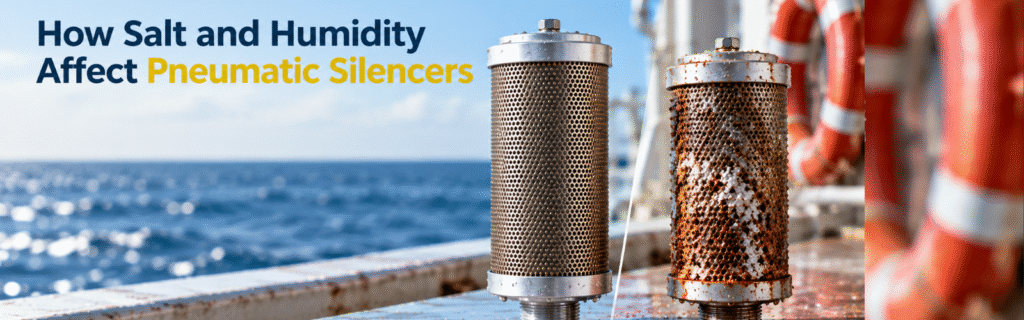
Pneumatic equipment used in marine environments operates under conditions very different from equipment installed inside a clean factory.
Ships, ports, offshore equipment and coastal industrial facilities are constantly exposed to high humidity, salt-laden air and moisture.
These conditions affect everything from electrical connections to metal components—and the Pneumatic Exhaust Silencer is no exception.
A Pneumuffler is installed on the exhaust side of pneumatic equipment to control the noise generated when compressed air is released. But for the silencer to work correctly, air must still be able to pass through its porous structure with minimal unwanted restriction.
In marine environments, salt deposits, moisture and corrosion can gradually interfere with these exhaust passages.
The process may begin with a small amount of surface contamination. Over time, however, deposits can accumulate, corrosion may develop on susceptible components, and the available exhaust area can decrease.
This can eventually lead to:
- Restricted exhaust airflow
- Increased backpressure
- Slower pneumatic actuators
- Inconsistent valve operation
- Higher maintenance requirements
- Premature silencer replacement
Understanding these effects helps engineers select and maintain pneumatic exhaust components more effectively in demanding marine conditions.
Why Marine Environments Are Different
Industrial pneumatic equipment installed inside a controlled production facility may operate in relatively stable environmental conditions.
Marine equipment does not have that advantage.
Depending on its location, pneumatic equipment may encounter:
High humidity: Moisture is continuously present in the surrounding atmosphere.
Salt-laden air: Fine salt particles and sea spray can settle on exposed components.
Condensation: Temperature changes can cause water to form on equipment surfaces.
Direct water exposure: Equipment installed on decks or exposed areas may encounter spray and rain.
Temperature variations: Day/night cycles and changing weather conditions can encourage condensation.
When these conditions occur together, the environment can become highly demanding for pneumatic components.
What Does a Pneumatic Exhaust Silencer Do?
When a pneumatic valve or actuator operates, compressed air must eventually be released into the atmosphere.
Without exhaust control, rapidly expanding compressed air can produce a sharp and repetitive noise.
A Pneumatic Exhaust Silencer, also called a Pneumuffler or pneumatic exhaust muffler, is installed at the exhaust port.
Its porous structure allows exhaust air to disperse through many small passages.
Instead of leaving through one concentrated opening, the exhaust is diffused.
This helps control noise.
However, the exhaust passages must remain sufficiently open.
When salt, corrosion products or other contaminants begin obstructing them, the silencer can become increasingly restrictive.
How Salt Reaches Pneumatic Silencers
Salt contamination does not necessarily come from inside the compressed-air system.
In marine environments, it can reach the silencer externally.
Tiny salt-containing droplets and particles can travel through the surrounding air.
They may settle onto exposed equipment, including:
- Pneumatic valves
- Cylinders
- Fittings
- Tubing
- Exhaust ports
- Pneumufflers
When water evaporates, salt deposits can remain behind.
One exposure may leave only a small amount.
Repeated exposure creates the real problem.
The cycle becomes:
Salt-laden moisture → Surface deposition → Water evaporates → Salt remains → More moisture arrives → Deposits accumulate
Eventually, these deposits can begin affecting the open surface area of the Pneumatic Exhaust Silencer.
Why Humidity Makes Salt Contamination More Difficult
Salt and humidity can create a persistent contamination cycle.
In a dry environment, deposited particles may remain relatively stable.
In humid conditions, moisture can repeatedly wet contaminated surfaces.
This creates an environment where salt residue, dust and other contaminants can remain attached to the silencer instead of being easily removed.
A Pneumuffler installed close to sea spray can therefore experience much more aggressive contamination than an identical component installed indoors.
Corrosion Is Another Concern
Salt contamination is not only an airflow issue.
Marine atmospheres are well known for accelerating corrosion of susceptible metallic materials.
The exact corrosion behavior depends on factors including:
- Material
- Surface condition
- Salt concentration
- Humidity
- Temperature
- Exposure duration
- Protective treatment
A Pneumatic Exhaust Silencer may include multiple components, such as porous media, threaded connections, housings and fasteners.
Each part must therefore be considered when evaluating suitability for a marine environment.
How Corrosion Can Affect a Pneumatic Exhaust Silencer
Corrosion can affect more than appearance.
As a metallic surface deteriorates, corrosion products can form.
These deposits may accumulate around the silencer or its exhaust passages.
When combined with:
- Salt
- Dust
- Oil mist
- Moisture
they can create increasingly complex contamination.
Over time, airflow through the silencer may become less uniform.
This is why a Pneumuffler should not be judged only by whether its outer surface still looks acceptable.
Exhaust performance matters more than appearance alone.
1. Salt Deposits Can Restrict the Porous Surface
A Pneumatic Exhaust Silencer depends on open passages.
If salt deposits gradually cover part of its porous surface, the effective exhaust area can decrease.
Initially, the remaining open passages may still handle the exhaust.
But continued accumulation can increase airflow resistance.
The exhaust air then has fewer available paths through which to escape.
This can increase pressure on the exhaust side of the pneumatic circuit.
2. Moisture Can Trap Other Contaminants
Marine installations rarely deal with salt alone.
Equipment can also be exposed to:
- Dust
- Oil
- Grease
- Rust particles
- Process contamination
Moisture can help these contaminants adhere to the Pneumuffler surface.
This creates a deposit that may be more restrictive than dry salt or dust alone.
The combination can look like:
Salt + Moisture + Dust + Oil → Surface Deposits → Reduced Open Area → Exhaust Restriction
3. Corrosion Products Can Add to Blockage
Where corrosion occurs, loose particles and deposits may contribute further contamination.
This means the silencer can potentially experience contamination from both directions:
From outside
Salt, humidity, water spray and environmental dust.
From inside
Oil mist, moisture, pipe contamination and particles carried by compressed air.
When both occur together, blockage can develop faster.
What Happens When Exhaust Flow Becomes Restricted?
A Pneumuffler does not operate independently from the pneumatic system.
Consider a pneumatic cylinder.
When compressed air enters one side of the cylinder, air from the opposite side must escape.
The path may be:
Cylinder → Control Valve → Exhaust Port → Pneumatic Exhaust Silencer → Atmosphere
If the silencer becomes restrictive, exhaust air cannot leave as freely.
Pressure remains on the exhaust side.
This creates backpressure.
MMHP’s existing technical articles explain how restricted pneumatic exhaust can contribute to slower cylinder movement, inconsistent actuator response and increased machine cycle times. MM Hydro Pneumatics Pvt Ltd
Backpressure Can Affect Actuator Speed
Suppose compressed air pushes the piston in one direction.
At the same time, air on the opposite side must leave.
If that air encounters excessive resistance at the Pneumatic Exhaust Silencer, it opposes piston movement.
The cylinder may:
- Extend more slowly
- Retract more slowly
- Respond inconsistently
- Require longer to complete its stroke
In a marine pneumatic system controlling repetitive operations, these changes can become operationally important.
Where Marine Pneumatic Silencers May Be Used
Pneumatic systems can be found across marine and coastal applications.
Depending on the vessel or installation, compressed air may support equipment such as:
- Pneumatic valves
- Actuators
- Control systems
- Air-operated tools
- Material-handling equipment
- Pneumatic hoists
- Process equipment
MMHP currently identifies marine pneumatic systems among the applications for its pneumatic exhaust mufflers. MM Hydro Pneumatics Pvt Ltd
The exact operating environment, however, can vary considerably between a protected machinery space and equipment exposed to outdoor marine air.
Protected Installation vs Exposed Installation
Two identical Pneumufflers on the same vessel may have completely different service conditions.
Protected Location
A silencer inside a relatively dry equipment enclosure may experience limited direct salt exposure.
Exposed Location
A silencer installed close to open air, spray or weather can experience repeated wetting and salt deposition.
Therefore, maintenance intervals should not automatically be identical.
Inspection frequency should reflect actual exposure conditions.
Warning Signs of Marine Pneumuffler Problems
Maintenance personnel can watch for several indicators.
Visible Salt Deposits
White or crust-like deposits around the silencer can indicate repeated salt exposure.
Surface Corrosion
Changes in metallic surfaces should prompt closer inspection.
Slower Pneumatic Movement
A gradual reduction in actuator speed can indicate exhaust restriction.
Changed Exhaust Sound
A noticeable change in the normal exhaust sound can justify checking the silencer.
Moisture Around the Exhaust
Repeated wetting can contribute to contamination and should not be ignored.
Frequent Silencer Replacement
If Pneumufflers in one location require replacement much more frequently than those elsewhere, environmental exposure may be the reason.
Don’t Confuse Corrosion With the Root Cause
Suppose maintenance finds a badly contaminated Pneumuffler.
Replacing it restores normal actuator performance.
Problem solved?
Not necessarily.
If the new component is installed under exactly the same conditions, contamination may return.
The better questions are:
Why did the silencer deteriorate?
Is it directly exposed to sea spray?
Is water entering from the compressed-air system?
Is the material appropriate for the environment?
Can the installation provide better environmental protection without restricting exhaust?
Finding the root cause helps prevent repeated replacement.
Internal Moisture Still Matters in Marine Applications
External salt exposure receives most of the attention, but moisture can also originate inside the compressed-air system.
Atmospheric air entering a compressor contains water vapor.
As compressed air cools, moisture can condense.
If moisture separation, drainage or air drying is inadequate, water can travel downstream.
It may eventually reach pneumatic valves and exhaust silencers.
Therefore, a marine Pneumuffler may face:
external humidity and salt + internal compressed-air moisture.
This makes moisture management particularly important.
How to Reduce Premature Pneumuffler Problems in Marine Systems
Choose Materials for the Environment
Material compatibility should be evaluated according to actual exposure conditions rather than simply selecting a silencer by thread size.
Inspect Exposed Silencers Regularly
Look for salt accumulation, contamination, corrosion and physical damage.
Maintain Compressed-Air Treatment
Air dryers, filters, moisture separators and drains help reduce contamination coming from inside the system.
Check Exhaust Performance
Do not inspect only appearance. Changes in actuator speed or exhaust behavior may indicate developing restriction.
Consider Installation Position
Where system design permits, avoid unnecessary direct exposure to water spray or heavy contamination.
Investigate Repeat Failures
Frequent blockage or corrosion usually indicates an environmental, air-quality or selection issue that deserves further investigation.
Why Material Selection Matters
A Marine Pneumatic Silencer must operate in an environment where moisture and salt exposure may be unavoidable.
Selecting the appropriate construction therefore becomes important.
Engineers should consider:
- Corrosion resistance
- Operating temperature
- Pressure
- Exhaust volume
- Thread compatibility
- Environmental exposure
- Maintenance requirements
The correct solution for an indoor packaging machine may not necessarily be the best choice for exposed marine equipment.
Don’t Select a Marine Pneumuffler by Thread Size Alone
A silencer can fit the exhaust port perfectly and still be unsuitable for the application.
Thread size confirms mechanical compatibility.
It does not by itself tell you whether the silencer can handle:
- Required exhaust flow
- Operating pressure
- Temperature
- Repeated cycling
- Salt exposure
- Humidity
- Contamination
A complete selection process needs to consider both the pneumatic requirement and operating environment.
Why MMHP PNEUMUFFLER®?
MMHP India manufactures PNEUMUFFLER® pneumatic exhaust silencers for a variety of industrial applications, including marine pneumatic systems. Its published range includes multiple configurations intended for different operating requirements, while its broader Pneumuffler guidance emphasizes correct airflow and exhaust management rather than treating a silencer only as a noise-control accessory. MM Hydro Pneumatics Pvt Ltd
For marine applications, selection should consider the required exhaust flow together with pressure, temperature, connection type, moisture exposure and environmental contamination.
FAQs
Can salt water damage a Pneumatic Exhaust Silencer?
Salt-containing moisture can leave deposits on exposed components and can accelerate corrosion of susceptible materials. The effect depends on the silencer construction and severity of exposure.
Can salt deposits clog a Pneumuffler?
Accumulated deposits can reduce the available open area of porous exhaust media and contribute to increased airflow resistance.
Can a corroded Pneumuffler slow a pneumatic cylinder?
If corrosion or associated contamination restricts exhaust flow, backpressure can increase and actuator movement may become slower or inconsistent. MMHP’s existing exhaust guidance describes the relationship between exhaust restriction and cylinder performance. MM Hydro Pneumatics Pvt Ltd
Why are marine Pneumufflers exposed to more moisture?
Marine environments typically have high humidity and may expose equipment to sea spray, condensation and changing temperatures.
Should marine Pneumufflers be inspected more frequently?
Inspection frequency should be based on actual environmental exposure and operating conditions. A component exposed to sea spray may require closer attention than one installed in a protected enclosure.
What should be considered when selecting a marine pneumatic silencer?
Consider exhaust flow, pressure, temperature, connection size/type, corrosion resistance, moisture exposure, contamination and maintenance accessibility.
Is replacing a corroded Pneumuffler enough?
Replacement may restore exhaust flow, but repeated corrosion or blockage should trigger investigation of the environment, installation position, compressed-air quality and component suitability.
Conclusion
Marine pneumatic systems present a combination of conditions that ordinary factory equipment may never experience.
Salt, humidity, condensation and corrosion can gradually affect a Pneumatic Exhaust Silencer, particularly when the component is directly exposed to marine air or water spray.
As contamination accumulates:
Salt and moisture exposure → deposits/corrosion → reduced exhaust area → increased backpressure → slower pneumatic operation.
That is why a Pneumuffler in a marine application should not be treated as a simple fit-and-forget accessory.
Correct material selection, proper compressed-air treatment, suitable installation and regular inspection all contribute to maintaining reliable exhaust performance.
For marine pneumatic equipment, the objective remains the same: reduce exhaust noise while allowing compressed air to leave the system efficiently—even when the surrounding environment is demanding.