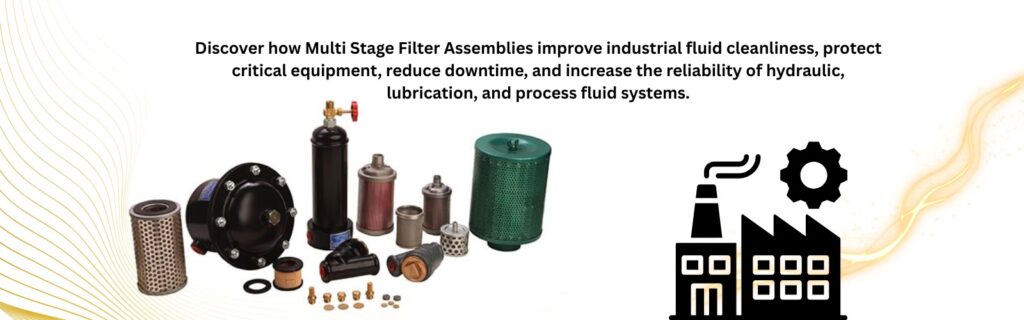
Industrial fluid systems are designed to deliver consistent performance under demanding operating conditions. Whether they circulate hydraulic oil, lubricants, coolants, chemicals, process liquids, or other industrial fluids, these systems depend on one essential factor for reliable operation—clean fluid.
Contaminated fluids are one of the leading causes of equipment wear and unexpected machine failures. Tiny particles such as metal shavings, rust, dust, welding residue, carbon deposits, and process contaminants continuously circulate through industrial systems. Over time, these contaminants damage pumps, valves, bearings, seals, heat exchangers, and other precision components.
Many systems rely on a single filter to remove contaminants. While this may be sufficient for basic applications, demanding industrial environments often require a more comprehensive filtration strategy.
This is where Multi Stage Filter Assemblies provide a significant advantage.
Instead of relying on one filtration element to remove every type of contaminant, Multi Stage Filter Assemblies divide the filtration process into multiple stages. Each stage is designed to remove different sizes and types of particles, providing more effective contamination control while improving system reliability.
For industries where equipment uptime, product quality, and maintenance costs directly affect profitability, Multi Stage Filter Assemblies offer a practical solution for improving long-term operational performance.
Why Industrial Fluid Systems Need Better Filtration
Modern industrial equipment has become increasingly sophisticated.
Hydraulic systems operate at higher pressures.
Automation systems demand greater precision.
Manufacturing equipment runs continuously for extended periods.
As technology advances, equipment tolerances become smaller.
This means even microscopic contamination can create significant problems.
Common industrial systems include:
- Hydraulic power units
- Lubrication systems
- Cooling circuits
- Chemical dosing systems
- Process fluid systems
- Industrial cleaning systems
All these applications depend on clean fluids to function efficiently.
Without effective filtration, contaminants gradually accumulate inside the system.
This leads to:
- Reduced efficiency
- Increased wear
- Equipment breakdowns
- Higher maintenance costs
- Unplanned production stoppages
Installing Multi Stage Filter Assemblies helps maintain fluid cleanliness throughout the operating cycle.
The Hidden Cost of Fluid Contamination
Many companies focus on repairing equipment after failures occur rather than preventing contamination from entering the system.
However, contamination often creates hidden costs long before visible failures appear.
These include:
- Reduced pump efficiency
- Increased energy consumption
- Valve sticking
- Internal leakage
- Seal damage
- Higher oil replacement costs
- Reduced machine accuracy
These issues gradually increase operating expenses while reducing production efficiency.
Properly designed Multi Stage Filter Assemblies help minimize these problems by continuously removing contaminants before they damage expensive equipment.
What Are Multi Stage Filter Assemblies?
Multi Stage Filter Assemblies are integrated filtration systems that use two or more filtration stages arranged in sequence.
Rather than asking one filter to remove every contaminant, each stage performs a specific filtration task.
Typically, the filtration process begins by removing larger particles before progressing to finer filtration.
This staged approach improves both filtration efficiency and filter service life.
Although the exact configuration varies depending on the application, Multi Stage Filter Assemblies are commonly designed to handle a wide range of contaminant sizes while maintaining consistent fluid flow.
Why Sequential Filtration Works Better
Imagine trying to remove large stones and fine sand using only one screen.
The screen would either clog quickly or allow smaller particles to pass through.
The same principle applies to industrial filtration.
A single filter that captures extremely fine particles may become loaded rapidly when large contaminants are present.
By comparison, Multi Stage Filter Assemblies divide the workload.
The first stage removes larger contaminants.
Subsequent stages progressively remove finer particles.
This improves overall filtration efficiency while extending filter life.
Why Single-Stage Filtration Is Not Always Enough
Single-stage filtration systems perform well in many applications.
However, industrial environments often generate contaminants of widely varying sizes.
These may include:
- Welding debris
- Rust flakes
- Pipe scale
- Metal wear particles
- Dust
- Process residues
- Carbon deposits
A single filtration stage must attempt to capture all these contaminants simultaneously.
This creates several challenges.
Faster Filter Loading
Large particles quickly occupy the available filtration area.
As contamination accumulates, pressure drop increases and flow decreases.
Reduced Service Life
When one filter handles every contaminant, replacement intervals become shorter.
This increases maintenance costs and production interruptions.
Reduced Filtration Efficiency
A filter selected for coarse particles may allow fine contaminants to circulate.
Conversely, an extremely fine filter may become blocked quickly when exposed to larger debris.
Multi Stage Filter Assemblies solve these problems by allowing each filtration stage to perform a dedicated function.
How Multi Stage Filter Assemblies Work
The operation of Multi Stage Filter Assemblies follows a logical sequence designed to maximize filtration efficiency.
Stage One – Primary Filtration
The first stage captures larger contaminants such as:
- Rust flakes
- Pipe scale
- Metal chips
- Sand
- Process debris
Removing these particles protects the downstream filtration stages from excessive contamination.
Stage Two – Intermediate Filtration
After coarse particles have been removed, the fluid passes through a second filtration stage.
This stage captures medium-sized contaminants that could damage pumps and valves.
Stage Three – Fine Filtration (Where Applicable)
In applications requiring higher fluid cleanliness, a final filtration stage removes fine particles before the fluid returns to the hydraulic system or process equipment.
This staged filtration approach helps Multi Stage Filter Assemblies achieve superior contamination control while maintaining stable flow characteristics.
Benefits of Multi Stage Filter Assemblies
Industrial users increasingly prefer Multi Stage Filter Assemblies because they offer advantages beyond simple particle removal.
Some of the key benefits include:
Better Contamination Control
Different filtration stages remove different particle sizes more effectively than a single filter.
Longer Filter Service Life
The first filtration stage protects downstream filters, extending their operating life.
Reduced Pressure Drop
Distributing filtration across multiple stages helps maintain efficient fluid flow.
Lower Maintenance Costs
Longer filter life means fewer replacements and reduced labour costs.
Improved Equipment Reliability
Cleaner fluid protects pumps, valves, actuators, bearings, and other critical components.
Increased System Efficiency
Maintaining clean fluids allows equipment to operate more consistently while reducing energy losses.
Industries That Benefit from Multi Stage Filter Assemblies
Because contamination affects virtually every industrial fluid system, Multi Stage Filter Assemblies are widely used across multiple sectors.
These include:
Hydraulic Power Units
Protect pumps, valves, and cylinders from abrasive wear.
Manufacturing Equipment
Improve fluid cleanliness for continuous production machinery.
Chemical Processing
Support cleaner process fluids while protecting sensitive equipment.
Lubrication Systems
Remove contaminants before they damage bearings and rotating equipment.
Industrial Cooling Systems
Prevent debris from reducing heat exchanger performance.
OEM Machinery
Machine builders increasingly integrate Multi Stage Filter Assemblies to improve equipment reliability while simplifying maintenance.
Advanced Benefits of Multi Stage Filter Assemblies
While the primary objective of Multi Stage Filter Assemblies is to improve fluid cleanliness, their advantages extend well beyond filtration. By dividing contamination removal into multiple stages, they help industrial systems operate more efficiently, reliably, and economically.
Let’s look at these benefits in detail.
1. Improved Contamination Control
Industrial fluids often contain particles of different sizes.
These may include:
- Rust flakes
- Pipe scale
- Sand
- Metal wear particles
- Fine process contaminants
- Carbon residue
A single filtration stage may struggle to remove all of these efficiently.
Multi Stage Filter Assemblies progressively remove contaminants by allowing each filter stage to target a specific particle size range.
This results in cleaner operating fluids throughout the system.
2. Longer Filter Service Life
One of the biggest advantages of Multi Stage Filter Assemblies is that they distribute the filtration workload.
The primary filter removes larger contaminants before they reach the finer filtration stages.
This helps:
- Reduce filter loading
- Extend element life
- Lower replacement frequency
- Improve maintenance planning
Longer service intervals reduce both maintenance costs and production interruptions.
3. Better Protection for Critical Components
Modern industrial equipment contains precision-engineered components that operate with extremely tight tolerances.
These include:
- Hydraulic pumps
- Servo valves
- Proportional valves
- Bearings
- Heat exchangers
- Flow control valves
Even microscopic contamination can accelerate wear.
Multi Stage Filter Assemblies provide more comprehensive contamination control, helping protect these expensive components.
4. Stable Fluid Flow
As filters become contaminated, pressure drop increases.
If filtration relies on a single element, clogging may occur more rapidly.
By distributing contamination across multiple stages, Multi Stage Filter Assemblies maintain smoother fluid flow for longer periods.
This supports:
- Stable operating pressure
- Improved system efficiency
- Reduced pump loading
5. Lower Maintenance Costs
Every filter replacement involves:
- Labour
- Downtime
- Spare parts
- Production losses
Because Multi Stage Filter Assemblies generally provide longer operating life, maintenance requirements are reduced.
This lowers the overall cost of ownership.
6. Improved Equipment Reliability
Reliable machinery depends on consistent fluid cleanliness.
Cleaner fluids reduce wear throughout the system while minimizing contamination-related failures.
Industries using Multi Stage Filter Assemblies often experience:
- Fewer breakdowns
- Longer equipment life
- Improved production consistency
- Better machine availability
Design Considerations for Multi Stage Filter Assemblies
Not every filtration system requires the same configuration.
Several engineering factors influence the design of Multi Stage Filter Assemblies.
Fluid Type
Different fluids contain different contaminants.
Applications may involve:
- Hydraulic oil
- Lubricating oil
- Coolants
- Process liquids
- Industrial chemicals
The filtration stages should be selected according to the fluid characteristics.
Flow Rate
Every filtration assembly must accommodate the required flow.
Undersized Multi Stage Filter Assemblies may increase pressure drop.
Oversized assemblies may increase installation costs unnecessarily.
Matching filtration capacity to system flow is essential.
Contamination Level
Highly contaminated systems may require additional filtration stages.
Systems operating with relatively clean fluids may require fewer stages.
Understanding contamination levels helps optimize filter selection.
Operating Pressure
Hydraulic and industrial fluid systems often operate under varying pressures.
The selected Multi Stage Filter Assemblies should safely withstand operating conditions while maintaining filtration efficiency.
Maintenance Accessibility
Filters require periodic servicing.
Well-designed Multi Stage Filter Assemblies provide convenient access for:
- Filter replacement
- Inspection
- Cleaning
- Routine maintenance
Easy servicing reduces maintenance time and minimizes production interruptions.
Why OEMs Prefer Multi Stage Filter Assemblies
Original Equipment Manufacturers are continuously looking for ways to improve machine reliability while simplifying maintenance.
Multi Stage Filter Assemblies support these objectives in several ways.
Improved Machine Reliability
Cleaner fluids reduce wear throughout the hydraulic or process system.
This improves customer satisfaction while reducing warranty claims.
Compact System Design
Instead of installing multiple independent filtration units throughout the machine, Multi Stage Filter Assemblies integrate filtration into one organized system.
This simplifies equipment layout.
Faster Machine Assembly
Integrated filtration systems reduce:
- Pipe connections
- Installation time
- Assembly complexity
This helps improve manufacturing efficiency.
Easier Servicing
Customers increasingly prefer equipment that is simple to maintain.
Compact Multi Stage Filter Assemblies improve accessibility during routine servicing.
Better Overall Equipment Value
Reliable filtration contributes to:
- Longer machine life
- Lower maintenance costs
- Improved operational efficiency
These benefits increase the overall value of OEM equipment.
Real Industrial Example
A manufacturer of hydraulic power units supplied equipment to multiple production facilities.
Although the hydraulic systems performed well initially, customers reported increasing maintenance costs after extended operation.
The primary cause was contamination entering the system during routine maintenance and normal component wear.
The manufacturer upgraded the design by incorporating Multi Stage Filter Assemblies.
The first filtration stage removed larger contamination, while subsequent stages captured finer wear particles before they circulated through the hydraulic system.
After implementation, customers experienced:
- Cleaner hydraulic oil
- Longer pump life
- Reduced valve failures
- Lower filter replacement frequency
- Improved machine reliability
- Reduced maintenance costs
The upgraded filtration system significantly improved overall equipment performance without increasing operational complexity.
Common Mistakes When Selecting Multi Stage Filter Assemblies
Although Multi Stage Filter Assemblies offer significant advantages, selecting the wrong configuration can reduce system performance.
Some common mistakes include:
Choosing Only Based on Initial Cost
Selecting the least expensive assembly often ignores long-term operating costs.
Lower-quality filtration may increase:
- Equipment wear
- Maintenance frequency
- Downtime
- Energy consumption
The total cost of ownership should always be considered.
Ignoring Maintenance Requirements
A filtration system that is difficult to access may discourage regular servicing.
Proper installation should allow technicians to replace filter elements quickly and safely.
Incorrect Stage Selection
Not every application requires identical filtration stages.
Choosing the wrong sequence may reduce filtration efficiency or create unnecessary pressure drop.
Overlooking Future Expansion
Some industrial systems are expanded over time.
Selecting adaptable Multi Stage Filter Assemblies allows future upgrades without complete redesign.
Best Practices for Maintaining Multi Stage Filter Assemblies
To maximize filtration performance and equipment life, maintenance teams should:
- Inspect filter elements regularly.
- Replace filters according to operating conditions.
- Monitor pressure drop across each stage.
- Check seals and connections for leakage.
- Maintain clean servicing practices.
- Record maintenance history.
- Inspect housings for damage or corrosion.
Preventive maintenance ensures Multi Stage Filter Assemblies continue providing effective contamination control throughout their service life.
How to Choose the Right Multi Stage Filter Assemblies
Selecting the right Multi Stage Filter Assemblies is essential for achieving maximum filtration efficiency, reducing maintenance costs, and protecting expensive industrial equipment. While every application has unique requirements, considering a few critical factors can help ensure the filtration system delivers reliable long-term performance.
1. Understand the Type of Fluid
The first step is identifying the fluid being filtered.
Industrial applications commonly involve:
- Hydraulic oil
- Lubricating oil
- Coolants
- Process fluids
- Industrial chemicals
- Water-based fluids
Each fluid carries different types of contaminants.
Selecting Multi Stage Filter Assemblies specifically designed for the operating fluid helps achieve better contamination control and longer service life.
2. Identify the Expected Contaminants
Not every system experiences the same contamination levels.
Some systems primarily encounter:
- Rust particles
- Pipe scale
- Sand
- Dust
Others may generate:
- Metal wear particles
- Carbon deposits
- Process residues
- Fine abrasive contaminants
Understanding the contamination profile helps determine the number of filtration stages and the type of filter media required in Multi Stage Filter Assemblies.
3. Match the Flow Rate
Industrial systems require continuous fluid circulation.
The selected Multi Stage Filter Assemblies should support the required flow rate without causing excessive pressure drop.
Proper flow capacity ensures:
- Stable operating pressure
- Efficient fluid circulation
- Lower pump loading
- Consistent equipment performance
4. Consider Operating Pressure
Hydraulic and industrial fluid systems often operate under demanding pressure conditions.
The selected assembly should be suitable for:
- Continuous operating pressure
- Pressure fluctuations
- System safety requirements
Choosing properly rated Multi Stage Filter Assemblies improves long-term reliability and operating safety.
5. Plan for Easy Maintenance
Filtration systems require routine servicing throughout their operational life.
Well-designed Multi Stage Filter Assemblies should provide:
- Easy filter replacement
- Convenient inspection access
- Simple maintenance procedures
- Minimal production interruption
Reducing servicing time improves machine availability and lowers maintenance costs.
Best Maintenance Practices
Even the best filtration system requires routine maintenance to deliver consistent performance.
Following these best practices helps maximize the effectiveness of Multi Stage Filter Assemblies.
Monitor Pressure Drop
Pressure differential across the filtration stages provides valuable information about filter loading.
An increasing pressure drop generally indicates that filter elements should be inspected or replaced.
Replace Filter Elements on Schedule
Waiting until filters become completely blocked can affect system performance.
Replacing filter elements at recommended intervals maintains efficient contamination control.
Inspect Seals and Connections
During maintenance, technicians should inspect:
- O-rings
- Gaskets
- Threaded connections
- Mounting hardware
Proper sealing prevents contamination bypass and leakage.
Maintain Clean Servicing Practices
Contamination introduced during maintenance can reduce filtration effectiveness.
Always clean filter housings before opening the assembly and handle replacement elements carefully.
Keep Maintenance Records
Recording:
- Filter replacement intervals
- Pressure differential readings
- Equipment operating hours
- Maintenance observations
helps optimize future servicing schedules and improves overall reliability.
Why MMHP Filter Assemblies?
At MMHP India, we understand that every industrial fluid system has unique filtration requirements. Whether the application involves hydraulic oil, lubricants, coolants, or process fluids, effective contamination control is essential for maintaining equipment performance and minimizing downtime.
Our Filter Assemblies are engineered to deliver:
- Reliable contamination control
- Efficient fluid flow
- Durable construction
- Easy maintenance
- Compact installation
- Long service life
- Consistent filtration performance
Designed for demanding industrial environments, MMHP Filter Assemblies help protect pumps, valves, cylinders, bearings, and other critical system components from contamination-related wear.
Whether you are designing OEM machinery or maintaining existing industrial equipment, MMHP provides dependable filtration solutions tailored to your operational needs.
Why Choose MMHP?
Industrial filtration is more than just removing contaminants—it is about protecting valuable equipment, improving productivity, and reducing long-term operating costs.
MMHP India has built its reputation by supplying high-quality industrial filtration solutions that support efficient and reliable machine operation.
Customers choose MMHP because our products offer:
✔ Efficient contamination control
✔ Reliable filtration performance
✔ Durable construction for industrial applications
✔ Easy installation and maintenance
✔ Long service life
✔ Solutions suitable for hydraulic, lubrication, and industrial fluid systems
With a focus on quality, engineering, and customer satisfaction, MMHP continues to be a trusted partner for industries seeking dependable filtration solutions.
Conclusion
As industrial machinery becomes more advanced, maintaining clean operating fluids is more important than ever. A single filtration stage may not always provide sufficient protection in systems exposed to a wide range of contaminants.
Multi Stage Filter Assemblies offer a smarter approach by dividing the filtration process into multiple stages. This allows each filter element to perform a dedicated role, resulting in better contamination control, longer filter life, improved fluid cleanliness, and enhanced equipment reliability.
The benefits include:
- Better particle removal
- Reduced pressure drop
- Longer maintenance intervals
- Lower operating costs
- Improved machine reliability
- Extended component life
Whether used in hydraulic systems, lubrication circuits, process plants, or OEM machinery, Multi Stage Filter Assemblies help industries improve productivity while reducing maintenance-related downtime.
MMHP India offers robust Filter Assemblies designed to meet the demanding requirements of modern industrial applications. By investing in reliable filtration today, businesses can protect valuable equipment, improve operational efficiency, and reduce long-term maintenance costs.
Frequently Asked Questions (FAQs)
1. What are Multi Stage Filter Assemblies?
Multi Stage Filter Assemblies are integrated filtration systems that use multiple filtration stages to remove different sizes of contaminants, improving fluid cleanliness and protecting industrial equipment.
2. Where are Multi Stage Filter Assemblies commonly used?
They are widely used in:
- Hydraulic systems
- Lubrication systems
- Industrial process plants
- Cooling circuits
- Chemical processing
- Manufacturing equipment
- OEM machinery
3. What are the benefits of Multi Stage Filter Assemblies?
Key benefits include:
- Improved contamination control
- Longer filter life
- Better equipment protection
- Reduced maintenance costs
- Lower pressure drop
- Increased system reliability
4. How often should Multi Stage Filter Assemblies be serviced?
Service intervals depend on operating conditions, contamination levels, and pressure differential readings. Regular inspection and timely filter replacement help maintain optimum performance.
5. Why are Multi Stage Filter Assemblies better than single-stage filters?
Unlike single-stage systems, Multi Stage Filter Assemblies progressively remove contaminants through multiple filtration stages. This improves filtration efficiency, extends filter life, and provides better protection for sensitive industrial components.