

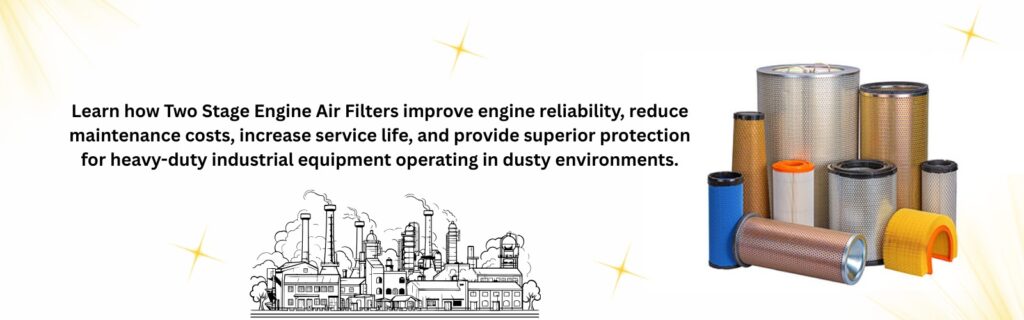
Heavy equipment is designed to perform in some of the harshest operating environments imaginable. From construction sites and mining operations to agriculture, infrastructure projects, and material handling applications, these machines are constantly exposed to dust, dirt, sand, and other airborne contaminants.
Every day, engines powering excavators, loaders, dump trucks, compressors, generators, and tractors inhale thousands of cubic meters of air. While this air is essential for combustion, it also carries fine particles that can gradually damage critical engine components.
Even microscopic contaminants entering the combustion chamber can cause premature wear of pistons, cylinder liners, valves, and turbochargers. Over time, this reduces engine performance, increases fuel consumption, and shortens equipment life.
This is why modern heavy-duty machines increasingly rely on Two Stage Engine Air Filters.
Unlike conventional filtration systems, Two Stage Engine Air Filters use two levels of filtration to remove both coarse and fine contaminants before clean air reaches the engine.
The result is superior engine protection, longer filter life, improved fuel efficiency, and greater equipment reliability.
In this article, we’ll explore how Two Stage Engine Air Filters work, why they are becoming the preferred choice for heavy equipment, and how they help industries reduce maintenance costs while maximizing machine uptime.
Why Heavy Equipment Operates in Challenging Conditions
Industrial equipment rarely operates in clean environments.
Instead, machines continuously work in locations where airborne contamination is unavoidable.
Typical environments include:
- Construction sites
- Mining operations
- Cement plants
- Quarries
- Agricultural fields
- Road construction projects
- Waste management facilities
- Industrial manufacturing plants
These environments contain large amounts of:
- Dust
- Sand
- Cement particles
- Metal particles
- Soil
- Crop residue
- Fine abrasive materials
Without effective filtration, these contaminants enter the engine and gradually reduce its efficiency.
This is why Two Stage Engine Air Filters are particularly valuable in heavy-duty applications.
Why Clean Air Is as Important as Clean Fuel
Many equipment owners focus heavily on fuel quality.
However, air is equally important.
A diesel engine consumes far more air than fuel during combustion.
In fact, for every litre of fuel burned, the engine requires a much larger volume of clean air to produce efficient combustion.
If contaminated air enters the engine, it can lead to:
- Reduced combustion efficiency
- Increased engine wear
- Higher fuel consumption
- More frequent maintenance
- Reduced engine life
This makes Two Stage Engine Air Filters an essential component for protecting modern diesel engines.
The Hidden Cost of Airborne Contamination
Airborne contamination rarely causes immediate engine failure.
Instead, damage develops gradually.
Tiny particles act like abrasive materials inside the engine.
Over thousands of operating hours, they wear critical components such as:
- Pistons
- Cylinder liners
- Intake valves
- Turbocharger compressor wheels
- Bearings
The consequences include:
- Lower engine power
- Increased fuel costs
- Higher oil consumption
- Reduced productivity
- Costly engine overhauls
Installing high-quality Two Stage Engine Air Filters significantly reduces the amount of harmful contamination reaching these components.
What Are Two Stage Engine Air Filters?
Two Stage Engine Air Filters are advanced air filtration systems designed to provide enhanced protection by filtering incoming air in two separate stages.
Instead of relying on a single filter element, the filtration process is divided into:
Primary Filtration Stage
The first stage captures larger airborne particles such as:
- Dust
- Sand
- Leaves
- Insects
- Large debris
Removing these larger contaminants prevents premature loading of the second filter stage.
Secondary Filtration Stage
After passing through the primary filter, the air enters the secondary element.
This stage captures much finer particles that could otherwise enter the engine.
These include:
- Fine dust
- Microscopic abrasive particles
- Industrial contaminants
- Airborne pollutants
Together, both stages provide significantly better engine protection than a conventional single-stage filter.
How Two Stage Engine Air Filters Work
The operation of Two Stage Engine Air Filters is simple yet highly effective.
Step 1 – Air Intake
Ambient air enters the engine air intake system carrying dust and airborne contaminants.
Step 2 – Primary Filter Removes Large Particles
The primary filter traps larger contaminants before they reach the secondary filter.
This extends the life of the overall filtration system.
Step 3 – Secondary Filter Removes Fine Contaminants
The partially cleaned air then flows through the secondary filter.
This filter removes extremely fine particles that can cause long-term engine wear.
Step 4 – Clean Air Reaches the Engine
Only clean, filtered air enters the combustion chamber.
This improves combustion while protecting internal engine components.
Why Single-Stage Filtration Is Sometimes Not Enough
Traditional air filters perform well under moderate operating conditions.
However, heavy-duty equipment often works in environments where contamination levels are exceptionally high.
Examples include:
- Mining operations
- Cement manufacturing
- Quarrying
- Earthmoving
- Agricultural harvesting
In these conditions, single-stage filters may load more quickly, reducing service intervals and increasing maintenance frequency.
Two Stage Engine Air Filters provide an additional level of protection by dividing filtration into two stages.
This approach offers several advantages:
- Better contaminant removal
- Longer filter life
- Improved airflow stability
- Reduced maintenance frequency
Benefits of Two Stage Engine Air Filters
Superior Engine Protection
By removing both coarse and fine contaminants, Two Stage Engine Air Filters help protect expensive engine components from abrasive wear.
Longer Service Life
Since the primary filter captures larger particles first, the secondary filter remains cleaner for longer.
This extends the overall service life of the filtration system.
Improved Fuel Efficiency
Clean air supports more efficient combustion.
This allows engines to maintain optimum fuel efficiency throughout their operating life.
Reduced Maintenance Costs
Longer service intervals mean:
- Fewer filter replacements
- Lower labour costs
- Reduced downtime
- Lower maintenance expenses
Consistent Engine Performance
A clean air supply allows engines to maintain:
- Stable power output
- Reliable combustion
- Better throttle response
- Improved productivity
Industries That Benefit Most
Because of their superior filtration performance, Two Stage Engine Air Filters are widely used in demanding industries.
These include:
Construction
Protect excavators, loaders, bulldozers, and road-building equipment from heavy dust exposure.
Mining
Handle fine abrasive particles commonly found in mining operations.
Agriculture
Protect tractors, harvesters, and irrigation equipment operating in dusty fields.
Material Handling
Improve engine reliability in forklifts and heavy lifting equipment used outdoors.
Power Generation
Support cleaner engine operation in diesel generator applications.
Industrial Manufacturing
Maintain reliable engine performance for equipment operating continuously in dusty industrial environments.
Additional Benefits of Two Stage Engine Air Filters
While the primary purpose of Two Stage Engine Air Filters is to protect the engine from harmful contaminants, their benefits extend far beyond filtration. A properly designed two-stage filtration system contributes to better machine performance, lower operating costs, and increased equipment reliability throughout its service life.
Let’s explore these benefits in detail.
1. Better Dust-Holding Capacity
Heavy equipment often operates continuously in dusty environments where air filters are exposed to large amounts of airborne contamination.
A single-stage filter may become clogged quickly under such conditions.
Two Stage Engine Air Filters divide the filtration process into two separate stages.
The primary element captures larger particles, allowing the secondary element to focus on finer contaminants.
This improves the overall dust-holding capacity of the filtration system and extends filter service intervals.
2. Longer Engine Life
Engine wear caused by dust contamination is gradual but expensive.
Fine abrasive particles entering the combustion chamber can damage:
- Cylinder liners
- Pistons
- Piston rings
- Intake valves
- Turbochargers
By providing superior contamination control, Two Stage Engine Air Filters help extend the life of these critical engine components.
This reduces overhaul frequency and improves long-term equipment reliability.
3. Improved Fuel Economy
Efficient combustion depends on a consistent supply of clean air.
When filters become overloaded, airflow decreases and combustion efficiency is affected.
Because Two Stage Engine Air Filters maintain cleaner airflow for longer periods, engines can continue operating closer to their optimum efficiency.
The result is:
- Better fuel economy
- Stable engine performance
- Lower operating costs
4. Reduced Maintenance Frequency
Replacing filters too frequently increases maintenance costs.
Since Two Stage Engine Air Filters distribute contamination across two filtration stages, they generally provide longer service life than conventional single-stage filters operating under similar conditions.
This helps reduce:
- Maintenance labour
- Filter replacement frequency
- Equipment downtime
5. Improved Equipment Availability
Downtime directly affects productivity.
When machines spend less time undergoing filter replacement and contamination-related repairs, they spend more time performing productive work.
For fleet operators and contractors, improved equipment availability translates directly into higher profitability.
Common Causes of Air Filter Failure
Even high-quality Two Stage Engine Air Filters cannot provide effective protection if they are improperly maintained or incorrectly installed.
Understanding common causes of failure helps improve maintenance planning.
Incorrect Installation
Improper installation is one of the most common causes of air filtration problems.
Poor sealing around the filter housing may allow unfiltered air to bypass the filter entirely.
Even the best Two Stage Engine Air Filters cannot protect an engine if contaminants enter through air leaks.
Always inspect:
- Housing condition
- Sealing surfaces
- Gaskets
- Clamps
- Intake ducts
during every filter replacement.
Delayed Filter Replacement
Many operators continue using heavily loaded filters because the machine still appears to operate normally.
However, excessive restriction can result in:
- Reduced airflow
- Lower engine power
- Higher fuel consumption
- Increased exhaust temperatures
Following recommended maintenance schedules helps maintain the performance of Two Stage Engine Air Filters.
Poor Intake System Maintenance
The air filter is only one part of the intake system.
Other components also require regular inspection.
These include:
- Air cleaner housing
- Intake hoses
- Clamps
- Dust ejectors
- Restriction indicators
Neglecting these components may reduce the effectiveness of Two Stage Engine Air Filters.
Operating in Extremely Dusty Conditions Without Inspection
Construction sites, mines, and agricultural fields expose filters to varying contamination levels.
Instead of relying solely on fixed replacement intervals, maintenance personnel should regularly inspect filtration systems to determine actual operating conditions.
Why Heavy Equipment Manufacturers Prefer Two-Stage Filtration
Leading equipment manufacturers increasingly specify Two Stage Engine Air Filters because they provide better protection in demanding environments.
Their advantages include:
Improved Engine Reliability
Cleaner intake air reduces wear on expensive engine components.
Longer Service Intervals
Higher dust-holding capacity reduces the frequency of filter replacements.
Lower Warranty Claims
Better engine protection reduces contamination-related failures.
Improved Customer Satisfaction
Customers appreciate machines that require less maintenance and deliver consistent performance.
Better Performance in Harsh Environments
Whether operating in quarries, mining sites, or agricultural fields, Two Stage Engine Air Filters provide dependable protection against heavy airborne contamination.
Applications That Demand Two Stage Engine Air Filters
Although they are valuable in many industries, Two Stage Engine Air Filters are particularly beneficial in applications exposed to continuous dust.
Construction Equipment
Machines such as:
- Excavators
- Wheel loaders
- Bulldozers
- Backhoe loaders
- Motor graders
operate continuously in dusty conditions.
Two-stage filtration helps maintain reliable engine performance.
Mining Equipment
Mining operations generate extremely fine abrasive particles.
These contaminants accelerate engine wear if not effectively removed.
Two Stage Engine Air Filters provide enhanced protection for heavy mining machinery.
Agricultural Machinery
Harvesters, tractors, and sprayers frequently operate in fields where dust levels change throughout the day.
Improved filtration supports longer engine life.
Quarry Equipment
Stone crushing and aggregate processing generate large amounts of airborne dust.
Reliable filtration is essential for protecting diesel engines in these environments.
Diesel Generator Sets
Generators operating in industrial plants and remote project sites often experience dusty operating conditions.
Using Two Stage Engine Air Filters helps maintain cleaner intake air and more reliable engine operation.
Real Industrial Example
A road construction company operating multiple excavators noticed that engine air filters required replacement far more frequently than expected.
The machines were working in areas with heavy dust generated by earthmoving and aggregate handling.
Frequent filter replacement increased maintenance costs and reduced equipment availability.
After upgrading to Two Stage Engine Air Filters, the company observed:
- Longer filter service intervals
- Reduced dust reaching the engine
- Improved fuel efficiency
- Lower maintenance costs
- Increased equipment uptime
The additional filtration stage significantly improved engine protection while reducing the overall cost of ownership.
Best Practices for Maintaining Two Stage Engine Air Filters
To maximize the performance of Two Stage Engine Air Filters, maintenance teams should follow a structured preventive maintenance program.
Inspect Filters Regularly
Check filters according to operating conditions rather than waiting for visible performance issues.
Replace Primary Elements at the Recommended Interval
The primary element handles most of the contamination load.
Replacing it on time helps maintain airflow.
Protect the Secondary Element
The secondary filter should only be removed when necessary.
Avoid exposing it to unnecessary contamination during servicing.
Keep the Air Cleaner Housing Clean
Before installing new filters, remove dust and debris from the housing to prevent contaminants from entering the engine.
Monitor Restriction Indicators
Restriction indicators provide valuable information about filter loading and help determine the ideal replacement time.
How to Choose the Right Two Stage Engine Air Filters
Selecting the right Two Stage Engine Air Filters is essential for maximizing engine performance, reducing maintenance costs, and ensuring reliable operation in demanding environments. While filter size is important, several other factors should also be considered to achieve the best results.
1. Understand the Operating Environment
The first step is understanding where the equipment operates.
Machines working in:
- Construction sites
- Mining operations
- Cement plants
- Quarrying
- Agriculture
- Waste handling
are exposed to much higher dust concentrations than machines operating indoors.
Choosing Two Stage Engine Air Filters designed for dusty environments ensures better protection and longer service intervals.
2. Select the Correct Filtration Capacity
Every engine has different airflow requirements depending on:
- Engine displacement
- Horsepower
- Operating load
- Air consumption
The selected Two Stage Engine Air Filters should provide sufficient airflow while maintaining high filtration efficiency.
An undersized filter may restrict airflow, while an oversized filter may not fit correctly within the air cleaner housing.
3. Consider Dust-Holding Capacity
Not all air filters have the same contaminant-holding capability.
Machines operating continuously in dusty environments require filters capable of storing large amounts of dust without causing excessive restriction.
High dust-holding capacity allows Two Stage Engine Air Filters to:
- Extend maintenance intervals
- Maintain stable airflow
- Improve engine protection
- Reduce operating costs
4. Ensure Proper Fitment
Even the highest-quality filter cannot perform effectively if it is not properly sealed.
Always verify:
- Correct dimensions
- Proper gasket seating
- Housing compatibility
- Secure installation
A properly fitted Two Stage Engine Air Filter prevents contaminated air from bypassing the filtration system.
5. Follow the Manufacturer’s Maintenance Schedule
Air filters should be replaced according to:
- Operating conditions
- Restriction indicators
- Equipment manufacturer’s recommendations
Replacing filters too early increases maintenance costs, while replacing them too late reduces engine performance.
How Two Stage Engine Air Filters Support Preventive Maintenance
Preventive maintenance is the most effective way to maximize equipment reliability.
Rather than waiting for engine problems to occur, regular inspection of Two Stage Engine Air Filters helps detect contamination before it affects performance.
A preventive maintenance program should include:
- Inspecting the primary filter element.
- Checking the secondary safety element.
- Cleaning the air cleaner housing.
- Inspecting intake ducts and clamps.
- Monitoring restriction indicators.
- Recording replacement intervals.
These simple practices help extend engine life while reducing unexpected breakdowns.
Why MMHP Engine Air Filters?
At MMHP India, we understand that industrial engines operate under challenging conditions where clean air is essential for reliable performance.
Our Engine Air Filters are designed to provide dependable filtration for a wide range of industrial and heavy-duty applications.
MMHP focuses on delivering filtration solutions that help industries achieve:
- Superior contaminant removal
- Consistent airflow
- Reliable engine protection
- Longer filter service life
- Reduced maintenance costs
- Improved equipment reliability
Whether your equipment operates in construction, mining, agriculture, manufacturing, power generation, or material handling, MMHP Engine Air Filters are designed to support demanding industrial environments.
Why Choose MMHP?
Choosing the right filtration partner is just as important as choosing the right filter.
MMHP India combines industrial filtration expertise with a commitment to delivering reliable products for modern machinery.
Customers choose MMHP because our filtration solutions offer:
✔ Excellent filtration efficiency
✔ High dust-holding capacity
✔ Consistent airflow performance
✔ Durable construction
✔ Reliable protection for industrial diesel engines
✔ Long service life under demanding operating conditions
Our products are designed to help customers improve machine reliability while lowering maintenance and operating costs.
Conclusion
Heavy equipment works in environments where airborne contamination is unavoidable.
Dust, sand, cement particles, and other fine contaminants constantly challenge engine reliability.
Without effective filtration, these particles gradually damage internal engine components, increasing fuel consumption, reducing performance, and shortening engine life.
Two Stage Engine Air Filters provide a highly effective solution by filtering incoming air in two stages.
The primary stage removes larger contaminants, while the secondary stage captures fine particles before they enter the engine.
This two-stage approach delivers:
- Better engine protection
- Longer filter service life
- Reduced maintenance costs
- Improved fuel efficiency
- Greater equipment reliability
For industries where machine uptime directly impacts productivity and profitability, investing in high-quality Two Stage Engine Air Filters is a practical and cost-effective decision.
MMHP India offers Engine Air Filters designed to perform reliably in demanding industrial environments, helping businesses protect their equipment while improving long-term operational efficiency.
Frequently Asked Questions (FAQs)
1. What are Two Stage Engine Air Filters?
Two Stage Engine Air Filters use two filtration elements to remove both coarse and fine airborne contaminants before clean air reaches the engine, providing enhanced protection in dusty environments.
2. Why are Two Stage Engine Air Filters better than single-stage filters?
They divide the filtration process into two stages, allowing the primary filter to capture larger particles while the secondary filter removes finer contaminants. This improves filtration efficiency and extends filter life.
3. Which industries benefit most from Two Stage Engine Air Filters?
They are widely used in:
- Construction
- Mining
- Agriculture
- Quarrying
- Material handling
- Power generation
- Heavy industrial equipment
4. How often should Two Stage Engine Air Filters be replaced?
Replacement depends on operating conditions, dust levels, and restriction indicator readings. Always follow the equipment manufacturer’s maintenance recommendations and inspect filters regularly.
5. Can Two Stage Engine Air Filters improve fuel efficiency?
Yes. By maintaining clean airflow to the engine, Two Stage Engine Air Filters help support efficient combustion, stable engine performance, and better fuel economy.