Spray painting systems depend on compressed air for much more than atomizing paint.
Pneumatic cylinders, control valves, actuators and other air-operated components may work continuously around the spray booth or coating line. Every time these components operate, compressed air must also be exhausted.
A Pneumatic Exhaust Silencer helps control the sharp noise created when this compressed air is released.
But spray-painting environments introduce a challenge that ordinary pneumatic applications may not face to the same extent:
paint mist and overspray.
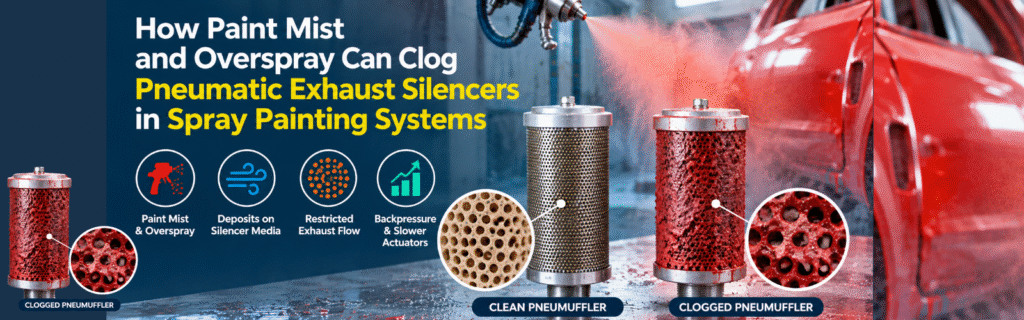
Fine airborne paint particles can settle on equipment around the spraying area. If this contamination reaches a pneumatic silencer, it can gradually collect on or within the porous exhaust media.
At first, the change may be difficult to notice.
As contamination builds, however, the available exhaust passages can become restricted. Exhaust backpressure may increase, pneumatic equipment may respond more slowly, and the silencer may require replacement sooner than expected.
This means a silencer that appears to be a small accessory can become an important maintenance point in spray-painting equipment.
Understanding the relationship between paint overspray, Pneumuffler contamination and exhaust airflow can help maintenance teams identify problems before they begin affecting machine performance.
Why Pneumatic Equipment Is Used in Spray Painting Systems
Industrial spray-painting and coating operations frequently use pneumatic equipment because compressed air provides fast and controllable movement.
Depending on the equipment, pneumatic components may operate:
- Spray-gun positioning mechanisms
- Reciprocators
- Paint-booth doors
- Clamping systems
- Material-handling equipment
- Control valves
- Pneumatic cylinders
- Automated positioning equipment
Every pneumatic movement involves air entering and leaving the system.
For example, when a double-acting cylinder extends, compressed air enters one side while air from the opposite chamber exhausts through the valve.
When the cylinder retracts, the process reverses.
This exhaust air may leave the control valve rapidly, producing a sharp noise.
A Pneumatic Exhaust Silencer fitted to the exhaust port diffuses the escaping air and reduces the noise.
But it must allow sufficient exhaust flow while doing so.
What Is Paint Overspray?
Not every paint droplet leaving a spray gun reaches the intended surface.
Some of the sprayed material remains suspended in the surrounding air as fine droplets or particles.
This is generally referred to as overspray.
Spray booths are designed with ventilation and filtration systems to control this contamination, but airborne material can still settle on nearby components and surfaces.
Depending on the coating process, the surrounding environment may contain:
- Fine paint droplets
- Pigment particles
- Coating residue
- Dust
- Solvent-related contaminants
- General industrial airborne particles
A Pneumuffler operating in this environment can therefore experience very different contamination from one installed in a comparatively clean automation cabinet.
How a Pneumatic Exhaust Silencer Works
A Pneumatic Exhaust Silencer typically contains porous media through which exhaust air passes.
Instead of compressed air leaving a valve through one unrestricted opening at high velocity, the silencer distributes the airflow through many small passages.
This helps reduce the intensity of the exhaust noise.
However, these small passages also mean contamination matters.
The silencer needs enough open flow paths to handle the required exhaust volume.
When those passages gradually become contaminated, airflow resistance can increase.
That is where paint mist becomes a concern.
How Paint Mist Reaches a Pneumuffler
Paint contamination does not necessarily need to enter through the compressed-air supply.
It can come from the external environment.
Consider a pneumatic valve located close to a spraying operation.
During operation, airborne overspray moves throughout the surrounding area. Some particles eventually settle onto nearby surfaces.
If the exposed surface of the Pneumatic Silencer is within that environment, paint can begin depositing on its porous structure.
Repeated exposure creates layer after layer of contamination.
The effect may be gradual:
Clean Silencer → Light Overspray → Partial Surface Coverage → Restricted Pores → Higher Exhaust Resistance
Because this happens progressively, operators may not immediately associate slower pneumatic operation with the exhaust silencer.
Why Paint Contamination Can Be Different From Ordinary Dust
Ordinary dry dust can certainly restrict a pneumatic silencer.
Paint overspray can present an additional problem because some coating materials can deposit in a wet or tacky condition before drying.
Fine particles may adhere to the surface rather than simply resting loosely on it.
Additional contamination can then attach to this layer.
After the material cures, the resulting deposit may become harder to remove.
The contamination can therefore gradually reduce the available open area of the Pneumatic Exhaust Muffler.
The exact behavior will depend on the coating material, operating environment and silencer construction, but the maintenance principle remains important:
A silencer exposed to coating overspray should be inspected for restriction—not just physical damage.
What Happens When the Silencer Begins to Clog?
The effect starts at the exhaust side of the pneumatic system.
Imagine a pneumatic cylinder connected to a directional control valve.
During cylinder movement, air must leave the opposite side:
Cylinder → Control Valve → Exhaust Port → Pneumatic Exhaust Silencer → Atmosphere
If the silencer is clean, exhaust air can leave with relatively low restriction.
If paint contamination progressively blocks the silencer, exhaust air encounters greater resistance.
Pressure can remain on the exhaust side for longer.
This is known as backpressure.
MMHP’s existing technical content similarly explains that restricted or incorrectly sized exhaust silencers can create backpressure that interferes with pneumatic cylinder and valve operation. (MM Hydro Pneumatics Pvt Ltd)
1. Cylinder Movement May Become Slower
Pneumatic cylinders rely on a pressure difference to produce movement.
Compressed air pushes the piston from one side while air from the other chamber must escape.
If exhaust air cannot leave freely, residual pressure opposes piston movement.
The result may be:
- Slower extension
- Slower retraction
- Delayed response
- Longer cycle time
This can be particularly noticeable in automated painting equipment where movements are repeated continuously.
A maintenance team may initially check supply pressure or cylinder condition without considering the small silencer attached to the exhaust port.
2. Machine Timing Can Become Inconsistent
Automated spray-painting processes depend on repeatable movement.
A pneumatic actuator may need to position equipment at a specific point within a specific time.
If exhaust restriction develops gradually, cylinder speed may no longer remain consistent.
That can potentially interfere with machine sequencing.
The problem may appear intermittent at first because the silencer is only partially restricted.
As more overspray accumulates, the effect can become increasingly noticeable.
3. Exhaust Backpressure Can Increase
The purpose of a Pneumuffler is to reduce exhaust noise without creating excessive restriction.
When its porous structure becomes blocked, that balance changes.
The component may still reduce noise, but airflow capacity can deteriorate.
This is an important distinction.
A quiet exhaust does not automatically mean a healthy exhaust.
In fact, an unusually weak exhaust sound combined with slower cylinder movement can sometimes justify inspecting the silencer for contamination.
MMHP already notes in its cylinder-focused guidance that contaminated silencers can accumulate dust, oil mist and particles and restrict exhaust flow. (MM Hydro Pneumatics Pvt Ltd)
4. Cycle Time Can Gradually Increase
In high-cycle industrial operations, even a small delay can become significant.
Suppose a pneumatic actuator performs hundreds or thousands of movements during a production shift.
A small increase in each movement time may eventually reduce overall machine throughput.
Because silencer contamination occurs gradually, operators may adapt to the slower machine without immediately recognizing the change.
This is one reason preventive inspection is preferable to waiting for complete blockage.
5. Pneumatic Components May Be Unnecessarily Replaced
Restricted exhaust can sometimes imitate other pneumatic problems.
When a cylinder becomes slow, maintenance teams may suspect:
- Low supply pressure
- Cylinder seal wear
- Valve malfunction
- Flow-control problems
- Air leakage
These possibilities should certainly be investigated.
But if the exhaust silencer is ignored, a simple restriction can remain undetected.
A useful troubleshooting approach is therefore to examine both sides of the pneumatic circuit:
Supply side AND exhaust side.
Why Spray Painting Environments Need Different Maintenance Attention
A Pneumuffler installed inside a protected machine enclosure may remain relatively clean for a long period.
The same component installed close to a coating process can face a much more aggressive environment.
This means maintenance intervals should not automatically be identical across every machine.
Inspection frequency should consider actual exposure to:
- Paint overspray
- Dust
- Oil mist
- Moisture
- Process residue
- Ambient contamination
The environment should influence the maintenance strategy.
Positioning the Pneumatic Silencer Matters
Sometimes contamination can be reduced by reviewing where the exhaust component is located.
If the Pneumatic Exhaust Silencer sits directly within an overspray zone, it may experience heavier contamination than necessary.
Where machine design permits, engineers can consider whether pneumatic valves and exhaust components can be positioned away from direct coating exposure.
However, relocation should not be improvised.
Exhaust piping, valve performance, flow capacity and equipment-manufacturer requirements must still be considered.
The objective is not simply to hide the silencer from paint.
It is to maintain correct pneumatic performance while minimizing unnecessary contamination exposure.
External Contamination vs Internal Contamination
Not every clogged Pneumuffler in a paint facility is blocked by overspray from outside.
Contamination can reach the silencer from two directions.
External contamination
This includes:
- Paint mist
- Overspray
- Dust
- Booth contamination
These contaminants settle onto the exposed silencer surface.
Internal contamination
Compressed-air systems may also carry:
- Oil mist
- Moisture
- Fine particles
- Compressor-related contaminants
These reach the silencer from inside the pneumatic circuit.
In some environments, both mechanisms can occur simultaneously.
A silencer could therefore be exposed to oily internal contamination while paint residue accumulates externally.
This combination can accelerate restriction.
How to Identify a Paint-Clogged Pneumatic Silencer
Maintenance teams can watch for several warning signs.
Visible Paint Deposits
Inspect the external porous surface.
Heavy coating residue is an obvious reason for closer examination.
Slower Cylinder Operation
If a pneumatic cylinder gradually becomes slower while supply pressure remains normal, inspect exhaust restriction.
Uneven Machine Cycles
Changes in actuator response can indicate that exhaust flow is no longer consistent.
Reduced Exhaust Flow
A noticeably weaker exhaust discharge may indicate restriction.
Frequent Pneumatic Problems Near the Spray Zone
If components located near painting equipment experience problems more frequently than identical equipment elsewhere, environmental contamination should be investigated.
Should a Paint-Clogged Pneumuffler Be Cleaned?
The answer depends on the silencer construction, contamination and manufacturer’s instructions.
Some industrial silencer constructions may allow appropriate cleaning, while others are better replaced once significantly contaminated.
The key point is:
Do not damage the porous media while trying to clean it.
Aggressive mechanical cleaning can alter the structure or damage the element.
Likewise, using an incompatible chemical cleaner may affect materials within the component.
Follow the manufacturer’s recommended maintenance procedure.
If paint has hardened deeply within the porous structure and normal cleaning cannot restore airflow, replacement may be the safer maintenance decision.
Don’t Judge a Pneumuffler Only by Noise
This is especially important in spray-painting applications.
Maintenance teams often think:
Silencer = noise-control device.
Therefore, if exhaust noise remains acceptable, they assume the silencer is working.
But airflow is equally important.
The better question is:
Is the Pneumuffler reducing noise while still allowing the required exhaust flow?
MMHP’s existing Pneumuffler guidance repeatedly emphasizes the relationship between exhaust restriction, backpressure and pneumatic performance. (MM Hydro Pneumatics Pvt Ltd)
Preventive Maintenance for Spray Painting Pneumufflers
A practical inspection routine can include:
Visual inspection: Look for dried paint, coating deposits and general contamination.
Operational observation: Watch for changes in actuator speed or cycle consistency.
Exhaust check: Investigate unusual changes in exhaust behavior.
Environment check: Identify silencers directly exposed to heavy overspray.
Replacement history: If the same silencer location repeatedly clogs, investigate the environment or installation rather than treating each failure independently.
This turns silencer maintenance from reactive replacement into preventive maintenance.
Choosing a Pneumatic Exhaust Silencer for Spray Painting Equipment
The correct silencer should not be selected on thread size alone.
Engineers should consider:
Exhaust Flow Requirement
The silencer must handle the volume of air generated by the valve or actuator.
Operating Pressure
Confirm compatibility with system operating conditions.
Thread Type and Size
Correct BSP/NPT or other specified connection compatibility is necessary for proper installation.
Environmental Contamination
Consider exposure to paint mist, dust, moisture and oil.
Operating Temperature
Temperature can influence material selection.
Maintenance Accessibility
A silencer in a contamination-prone environment should be accessible for routine inspection.
Backpressure
Noise reduction should not come at the expense of excessive exhaust restriction.
MMHP’s current and existing Pneumuffler material emphasizes that flow capacity, operating conditions and application requirements need to be considered alongside connection size. (MM Hydro Pneumatics Pvt Ltd)
Why This Matters in Automated Spray Painting Lines
Modern coating lines are increasingly automated.
Pneumatic actuators may perform repetitive movements throughout the production shift.
Consistency matters.
If a contaminated Pneumatic Exhaust Silencer causes an actuator to respond even slightly differently, the impact can extend beyond the pneumatic component itself.
Depending on the machine design, inconsistent movement may affect:
- Process timing
- Equipment positioning
- Production cycle consistency
- Maintenance frequency
- Overall equipment availability
A small exhaust component therefore deserves attention as part of the complete pneumatic system.
Why MMHP Pneumufflers?
MMHP India manufactures Pneumufflers® and pneumatic exhaust silencers for industrial pneumatic applications.
Its existing product and technical content emphasizes the need to combine effective noise reduction with adequate exhaust airflow and low restriction. MMHP also provides different Pneumuffler configurations for varying industrial operating requirements. (MM Hydro Pneumatics Pvt Ltd)
For spray-painting equipment, selection should consider not only the exhaust port connection but also airflow, pressure, environmental contamination and maintenance conditions.
This helps ensure that the Pneumatic Exhaust Silencer continues performing its primary functions without becoming an overlooked restriction in the pneumatic circuit.
FAQs
1. Can paint overspray clog a pneumatic exhaust silencer?
Yes. If a Pneumuffler is exposed to airborne paint mist or overspray, deposits can accumulate on its porous surface and potentially restrict exhaust airflow.
2. What happens when a Pneumuffler becomes clogged?
Exhaust resistance can increase, potentially creating backpressure and contributing to slower or inconsistent pneumatic actuator operation.
3. Why are Pneumufflers vulnerable in spray booths?
Fine airborne coating material can settle on exposed components. A porous exhaust silencer located near the spraying area can gradually collect this contamination.
4. Can a clogged pneumatic silencer slow a cylinder?
Yes. Restricted exhaust airflow can leave residual pressure on the exhaust side of a pneumatic cylinder and oppose piston movement. MMHP’s existing cylinder guidance discusses this relationship between contaminated silencers, backpressure and slower movement. (MM Hydro Pneumatics Pvt Ltd)
5. Should Pneumufflers near spray-painting equipment be inspected more frequently?
Inspection frequency should reflect actual operating conditions. Components exposed to heavy overspray or other contamination may require closer attention than those operating in clean environments.
6. Can a paint-clogged Pneumuffler be cleaned?
It depends on the silencer material, severity of contamination and manufacturer’s maintenance recommendations. If hardened contamination cannot be safely removed or airflow cannot be restored, replacement may be required.
7. What should be considered when selecting a Pneumuffler?
Consider exhaust flow, pressure, connection/thread, operating temperature, contamination exposure, acceptable backpressure and maintenance requirements—not simply port size.
Conclusion
In spray-painting systems, paint mist does not only affect walls, booths and ventilation filters.
It can also reach small pneumatic components.
When overspray gradually covers a Pneumatic Exhaust Silencer, its open exhaust passages can become restricted. This can increase backpressure, slow pneumatic movement and create machine-performance problems that may initially look like cylinder or valve faults.
The key is to treat the Pneumuffler as a functional part of the pneumatic exhaust system, not simply as a noise-control accessory.
Inspect where it is installed. Look for overspray. Watch for changes in actuator speed. And investigate exhaust restriction before replacing more expensive pneumatic components.
For industrial spray-painting and other contamination-prone pneumatic applications, MMHP Pneumufflers® can be selected according to exhaust flow, connection, pressure and operating environment to support quieter, reliable pneumatic exhaust performance.