

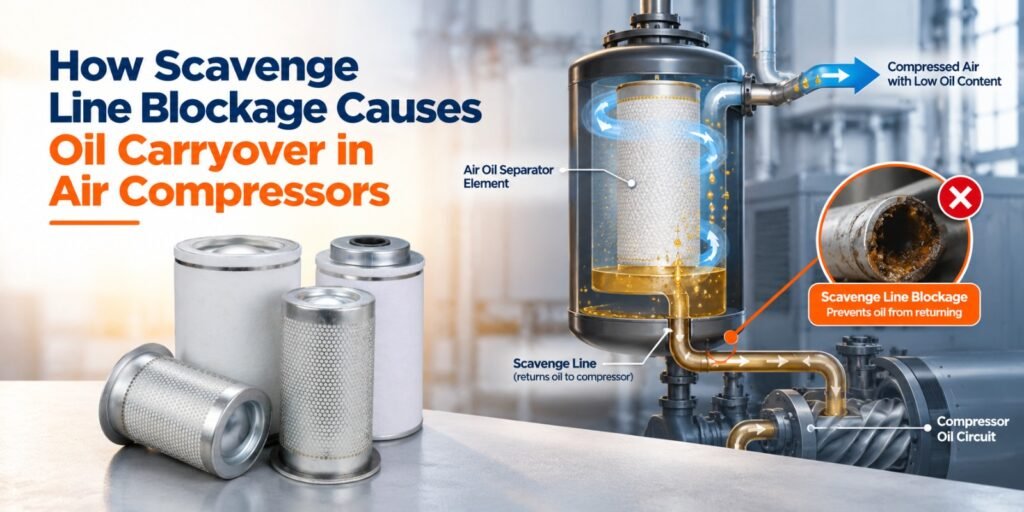
An Air Oil Separator is an essential component in oil-injected rotary screw air compressors. It separates lubricating oil from compressed air, helping maintain air quality while allowing recovered oil to return to the compressor’s lubrication circuit.
However, even when the Air Oil Separator element is functioning correctly, excessive oil may still enter the compressed air system.
One possible cause is a blocked scavenge line.
The scavenge line removes collected oil from the separator and returns it to the compressor’s oil circuit. When this line becomes restricted or blocked, oil can accumulate inside the separator assembly instead of being recovered.
This can increase oil carryover, affect downstream equipment and lead to unnecessary separator replacements.
Understanding how the scavenge system works helps maintenance teams identify the actual cause of oil carryover and maintain reliable compressor operation.
What Is an Air Oil Separator?
An Air Oil Separator is designed to separate lubricating oil from compressed air in oil-injected compressor systems.
During compression, oil is introduced to provide lubrication, cooling and sealing.
As a result, the discharged air contains oil droplets that must be separated before the air enters the downstream compressed air system.
Oil separation generally occurs in two stages.
Primary Oil Separation
Larger oil droplets are removed through mechanical separation within the separator vessel.
Fine Oil Separation
The remaining oil mist passes through the Air Oil Separator element, where fine droplets combine into larger droplets through coalescence.
The collected oil then drains to a collection area and is returned to the compressor through the scavenge system.
This recovery process is important for maintaining effective separation.
What Is a Scavenge Line in an Air Compressor?
A scavenge line, also called an oil return line, is a small passage or tube that returns collected oil from the separator element to the compressor’s oil circuit.
In many oil-injected rotary screw compressor designs, the line operates using a pressure difference between the separator vessel and the oil-return connection.
The arrangement may include a pickup tube, restrictor or orifice, and a check valve, depending on the compressor design.
Simplified oil recovery process
Air Oil Separator Element
Fine oil droplets collect and coalesce
Collected Oil
Oil gathers at the recovery point
Scavenge Line
Returns oil through the designed recovery path
Compressor Oil Circuit
Recovered oil re-enters the lubrication system
Conceptual process; the exact scavenge arrangement varies by compressor model.
When this return path works correctly, collected oil is continuously recovered rather than accumulating inside the separator.
How Scavenge Line Blockage Causes Oil Carryover
A blocked scavenge line interrupts the normal oil recovery process.
1. Oil Collects Inside the Separator
As compressed air passes through the separator element, oil droplets continue to coalesce.
Normally, this collected oil is removed through the scavenge line.
When the line is blocked, the recovered oil cannot drain at the required rate.
2. Oil Accumulation Increases
Oil begins accumulating in the collection area of the separator element.
As the oil level increases, it may interfere with the normal separation process.
3. Oil Can Be Re-Entrained into Compressed Air
Under certain operating conditions, accumulated oil can be picked up again by the moving compressed air.
This process is called oil re-entrainment.
Instead of remaining separated, some oil is carried into the compressed air outlet.
4. Downstream Oil Carryover Increases
The result may be excessive oil contamination in downstream compressed air equipment.
This can happen even when the separator media itself is not damaged.
Consequently, replacing the Air Oil Separator without checking the scavenge line may not solve the underlying problem.
What Causes Scavenge Line Blockage?
Several conditions can restrict the oil-return path.
Oil Deposits and Sludge
Degraded lubricating oil can form deposits that obstruct small passages and orifices.
Contamination
Particles or other contaminants circulating in the lubrication system may accumulate in the return line.
Blocked Orifice
The small orifice used in some scavenge arrangements can become restricted by deposits.
Damaged or Incorrectly Positioned Pickup Tube
A damaged, displaced or incorrectly installed pickup tube may prevent proper oil recovery.
Check Valve Problems
Where fitted, a malfunctioning check valve can interfere with the intended direction of oil flow.
These issues should be diagnosed according to the compressor manufacturer’s service procedure.
Warning Signs of Scavenge Line Blockage
Scavenge line problems can develop gradually, making early detection important.
Common warning signs include:
- Increased oil carryover: More oil appears in downstream compressed air equipment.
- Higher oil consumption: The compressor requires more frequent oil top-ups.
- Oil contamination: Oil deposits appear in compressed air piping, filters or condensate.
- Recurring carryover after separator replacement: Oil contamination continues despite installing a new separator element.
These symptoms do not confirm scavenge line blockage on their own. Excessive oil level, incorrect separator installation, unsuitable lubricant or other compressor faults can produce similar symptoms.
How Scavenge Line Blockage Affects Compressor Performance
Increased Oil Consumption
When separated oil is not recovered effectively, more lubricant may leave the compressor with the compressed air.
Downstream Filter Contamination
Excessive oil carryover can overload downstream coalescing filters and increase maintenance requirements.
Reduced Compressed Air Quality
Oil contamination may affect pneumatic equipment and processes requiring cleaner compressed air.
Unnecessary Maintenance Costs
Replacing an Air Oil Separator without diagnosing the oil-return system can result in repeated failures and avoidable expenses.
How to Prevent Scavenge Line Blockage
Preventive maintenance should cover the complete oil separation and recovery system.
Inspect the Scavenge Line
Check the return line, pickup tube and associated components according to the compressor manufacturer’s maintenance procedure.
Maintain Lubricant Quality
Use the specified compressor lubricant and follow the recommended oil-change intervals to reduce deposit formation.
Check Oil Levels
Maintain the correct compressor oil level. Overfilling can also contribute to excessive oil carryover.
Examine the Separator Element
Inspect the Air Oil Separator for damage, incorrect fitment or other conditions affecting separation.
Investigate Carryover Before Replacement
When excessive oil appears downstream, evaluate the separator element and scavenge system together.
Safety note: Compressor vessels can retain dangerous pressure. Inspection or maintenance must only be performed by qualified personnel after the equipment has been isolated, depressurised and made safe according to the manufacturer’s instructions.
Why Choose MMHP Air Oil Separators?
MMHP India offers Air Oil Separators as part of its industrial filtration product range.
Selecting a suitable separator element involves considering compressor compatibility, dimensions, operating conditions and required separation performance.
However, an effective Air Oil Separator also depends on proper installation and a functioning oil-return system.
For separator replacement requirements, explore MMHP India’s industrial filtration solutions and contact the team with your compressor model and technical specifications.
Frequently Asked Questions
1. What is the purpose of a scavenge line in an air compressor?
It returns oil collected by the Air Oil Separator to the compressor’s oil circuit.
2. Can a blocked scavenge line cause oil carryover?
Yes. Restricted oil recovery can cause oil accumulation inside the separator and increase the risk of oil re-entrainment.
3. Will replacing the Air Oil Separator solve oil carryover?
Not necessarily. If the scavenge line is blocked, replacing the separator element alone may not correct the problem.
4. What causes excessive oil carryover in air compressors?
Possible causes include scavenge line blockage, incorrect oil level, damaged separator elements, unsuitable operating conditions and installation problems.
5. How can scavenge line blockage be prevented?
Follow the manufacturer’s maintenance procedures, maintain lubricant quality and inspect the oil-return components when diagnosing carryover.
Conclusion
An Air Oil Separator plays an important role in removing lubricating oil from compressed air in oil-injected compressors.
However, effective separation requires more than a properly functioning filter element.
The scavenge line must also recover collected oil and return it to the compressor’s lubrication circuit.
When this line becomes blocked, oil can accumulate inside the separator, increasing the risk of re-entrainment and downstream oil carryover.
By inspecting the scavenge system alongside the separator element, maintenance teams can identify the underlying problem, reduce unnecessary replacements and improve compressor reliability.
For Air Oil Separator requirements, contact MMHP India to discuss suitable filtration elements for your compressor application.
Internal linking recommendation: Link the first relevant mention of Air Oil Separator to MMHP’s dedicated Air Oil Separator product page after confirming its current URL. Add a contextual link to MMHP’s coalescing filtration page in the downstream contamination section, where relevant.