A High Efficiency Coalescer plays an important role in removing fine liquid aerosols from compressed air and gas systems.
Compressed air can contain small droplets of water and lubricating oil. These contaminants may affect pneumatic equipment, control valves and industrial processes if they are not adequately removed.
Coalescing filters are designed to capture fine droplets and combine them into larger liquid droplets that can be separated from the airflow.
However, capturing liquid is only one part of effective coalescing filtration.
The collected liquid must also be removed from the filter housing.
If drainage is inadequate, liquid can accumulate inside the housing, increasing the risk of re-entrainment, pressure drop and reduced filtration performance.
Understanding how drainage design affects a High Efficiency Coalescer helps engineers maintain effective liquid separation and reliable compressed air quality.
What Is a High Efficiency Coalescer?
A High Efficiency Coalescer is a filtration component designed to separate fine liquid aerosols from a flowing gas stream.
Unlike conventional particulate filters that primarily retain solid contaminants, coalescing filters are designed to capture small liquid droplets.
As contaminated compressed air passes through the coalescing media, droplets contact the filter fibres and combine into larger droplets.
These larger droplets then move towards the drainage region, where they can collect and be removed.
How Coalescing Filtration Works
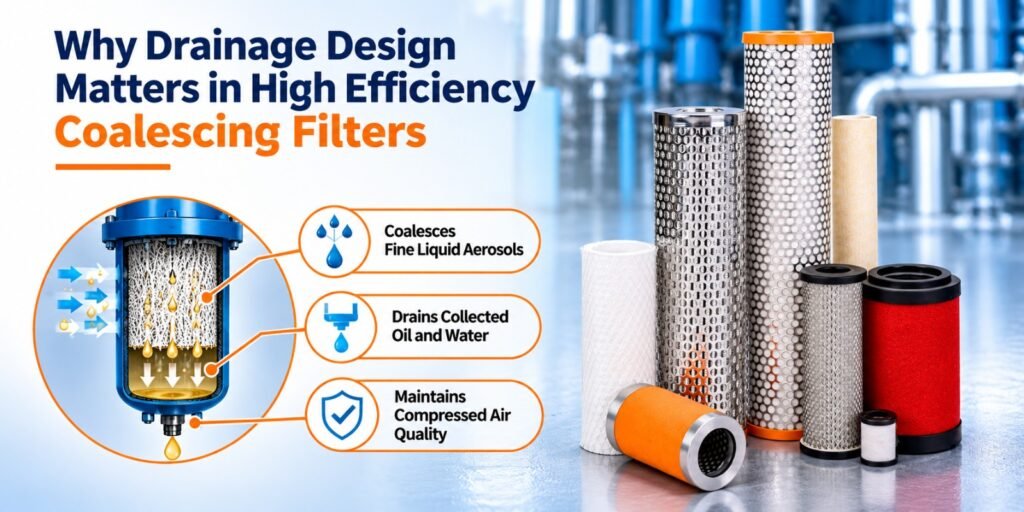
The process generally involves three stages:
- Droplet capture: Fine liquid aerosols are intercepted by the filter media.
- Coalescence: Captured droplets combine into larger liquid droplets.
- Liquid drainage: Separated liquid moves away from the media and is discharged through the housing’s drainage arrangement.
The exact flow path and drainage mechanism depend on the coalescer design.
MMHP India includes High Efficiency Coalescers in its industrial filtration product range.
Why Drainage Is Important in Coalescing Filters
A coalescing element can capture liquid effectively, but the system must also provide a suitable path for the separated liquid to leave the housing.
Without proper drainage, collected oil or water may remain inside the filter assembly.
This creates several operating problems.
1. Liquid Accumulation
When separated liquid is not removed at the required rate, it can collect in the filter housing.
As the liquid level rises, it may interfere with the normal separation process.
2. Increased Pressure Drop
Excessive liquid accumulation can obstruct available flow passages.
This may increase resistance to airflow and affect the performance of downstream compressed air equipment.
3. Liquid Re-entrainment
Under certain conditions, accumulated liquid can be picked up again by the moving air.
This process is known as re-entrainment.
Instead of remaining separated, some liquid may travel downstream with the compressed air.
4. Reduced Compressed Air Quality
Poor drainage can allow oil or water contamination to reach equipment that requires cleaner compressed air.
This can increase maintenance requirements and affect process reliability.
How Drainage Design Affects High Efficiency Coalescer Performance
Drain Location
The drain must be positioned where separated liquid can collect and be removed effectively.
For gravity-assisted designs, the collection area is typically located near the bottom of the housing.
An unsuitable drainage arrangement can allow liquid to remain inside the assembly.
Drain Capacity
The drainage system must be capable of removing the liquid collected during normal operation.
If the amount of liquid entering the coalescer exceeds the drain’s removal capacity, accumulation can occur.
Drain Operation
Depending on the filter assembly, liquid may be discharged using manual, float-operated or electronically controlled drains.
Each arrangement has different operating and maintenance requirements.
Housing Orientation
Some coalescing filter assemblies rely on a specified installation orientation to support liquid collection and drainage.
Incorrect installation may interfere with the intended liquid-removal path.
The manufacturer’s installation instructions should always be followed.
Common Drainage Problems in Coalescing Filters
Even a correctly selected High Efficiency Coalescer can experience performance problems when its drainage system is not maintained properly.
Blocked Drain Outlet
Oil deposits, sludge or particulate contamination can restrict the drain outlet, preventing collected liquid from leaving the housing.
Malfunctioning Automatic Drain
A faulty float mechanism or electronic drain may fail to discharge liquid at the required time.
Incorrect Drain Installation
Improper piping connections, unsuitable discharge arrangements or incorrect housing orientation can interfere with drainage.
Excessive Liquid Loading
A coalescer receiving more liquid than its design capacity may experience accumulation even when the drain is functioning.
In such cases, upstream bulk liquid separation may be necessary.
How to Maintain Effective Coalescer Drainage
Proper maintenance helps the coalescer continue separating liquid contaminants effectively.
- Inspect drain operation: Confirm that collected liquid is being discharged correctly.
- Check for blockages: Examine drain outlets and associated connections during scheduled maintenance.
- Monitor differential pressure: Unexpected increases may indicate element loading or other restrictions.
- Inspect the filter element: Replace elements according to manufacturer specifications and operating conditions.
- Check upstream equipment: Ensure water separators, aftercoolers and other air-treatment components are functioning correctly.
Maintenance must be performed only after the equipment has been safely isolated and depressurised.
How to Select the Right High Efficiency Coalescer
Selecting a suitable coalescer requires evaluating both filtration performance and liquid-removal requirements.
| Selection factor | Why it matters |
| Airflow capacity | Ensures adequate flow through the element |
| Operating pressure | Determines housing compatibility |
| Liquid contamination | Influences separation and drainage requirements |
| Filtration efficiency | Determines aerosol-removal performance |
| Drainage arrangement | Supports removal of collected liquid |
| Installation orientation | Helps maintain the intended drainage path |
| Maintenance accessibility | Simplifies inspection and servicing |
A properly selected coalescer must provide the required aerosol separation while allowing collected liquid to drain effectively.
Why Choose MMHP High Efficiency Coalescers?
MMHP India offers High Efficiency Coalescers as part of its industrial filtration product range.
For compressed air and compatible industrial gas applications, coalescer selection should consider airflow, operating pressure, liquid contamination and required separation performance.
Drainage requirements must also be evaluated as part of the complete filter assembly.
Customers can explore MMHP India’s industrial filtration solutions and contact the MMHP team with their application requirements.
The suitability of a particular MMHP coalescer and its drainage arrangement should be confirmed against its product specifications.
Frequently Asked Questions
1. Why is drainage important in a High Efficiency Coalescer?
Drainage removes collected liquid from the filter housing, helping prevent accumulation and re-entrainment.
2. What happens when a coalescer drain becomes blocked?
Liquid may accumulate inside the housing, increasing the risk of pressure drop and downstream contamination.
3. Can a coalescing filter remove both oil and water aerosols?
Suitable coalescing filters can separate oil and water aerosols, depending on their design and operating conditions.
4. Does every coalescer require an automatic drain?
Not necessarily. Drain selection depends on the filter assembly, liquid loading and application requirements.
5. Can poor drainage affect compressed air quality?
Yes. Inadequate liquid removal can increase the risk of collected contaminants being carried downstream.
Conclusion
A High Efficiency Coalescer must do more than capture fine liquid droplets. It must also allow separated liquid to leave the filtration system effectively.
Drainage design influences liquid accumulation, pressure drop, re-entrainment and overall compressed air quality.
Correct drain selection, proper installation and regular maintenance help support reliable coalescing filtration.
For High Efficiency Coalescer requirements, contact MMHP India to discuss suitable filtration solutions for your industrial application.