Hydraulic systems are widely used in construction equipment, manufacturing machinery, industrial presses and material-handling equipment. These systems depend on clean hydraulic oil to operate pumps, valves, cylinders and other components efficiently.
However, contamination can enter hydraulic systems through maintenance activities, component wear, seals and external operating conditions.
A Hydraulic Filter helps remove solid contaminants from hydraulic oil, reducing the risk of damage to sensitive components.
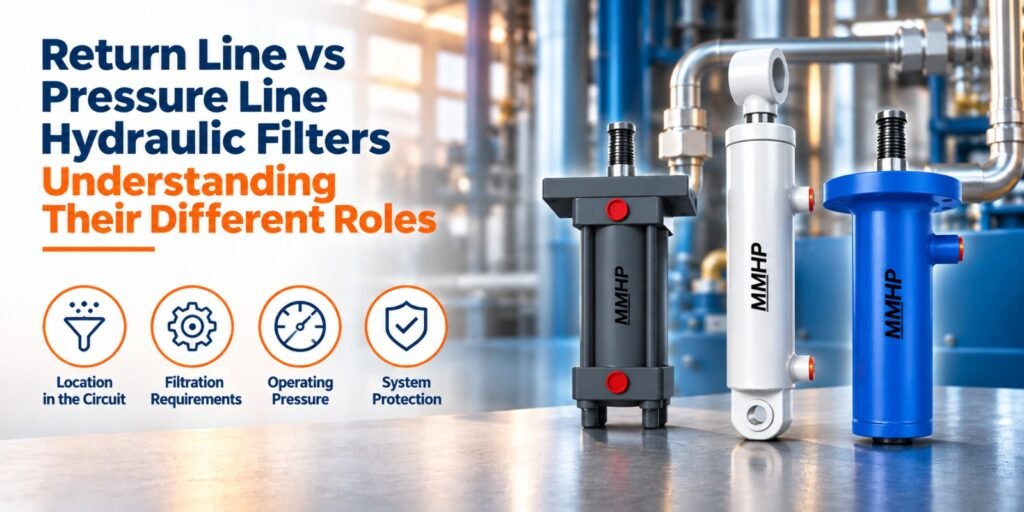
Two commonly used filtration locations are the return line and the pressure line.
Although both filters help control contamination, they perform different functions and operate under different pressure conditions.
Understanding these differences helps engineers select suitable filtration elements and maintain reliable hydraulic system performance.
What Is a Hydraulic Filter?
A Hydraulic Filter is a filtration component designed to capture solid particles circulating in hydraulic fluid.
Hydraulic systems contain precision components that can be affected by particles entering small clearances and control passages.
Contamination may contribute to:
- Premature wear of pumps and valves.
- Reduced performance of hydraulic cylinders.
- Blockage of small hydraulic passages.
- Increased maintenance requirements.
- Unplanned equipment downtime.
Hydraulic filters are installed at selected locations within a system to help maintain the required fluid cleanliness.
The appropriate filter depends on operating pressure, flow rate, contamination levels and the sensitivity of the equipment being protected.
What Is a Hydraulic Return Line Filter?
A Hydraulic Return Line Filter is installed in the line carrying hydraulic oil back towards the reservoir.
After oil passes through hydraulic actuators and control components, it returns to the tank.
The return line filter captures contaminants before the oil re-enters the reservoir.
How Does a Return Line Filter Work?
As hydraulic oil flows back towards the tank, it passes through the filter element.
Solid particles are retained by the filtration media, while filtered oil continues into the reservoir.
This helps reduce the accumulation of circulating contaminants in the hydraulic oil supply.
Key Characteristics
Return line filters generally operate at lower pressures than main pressure line filters, although return pressure can vary significantly with system design and operating conditions.
They are commonly used to help maintain overall system cleanliness.
What Is a Hydraulic Pressure Line Filter?
A Hydraulic Pressure Line Filter is installed in the pressurised hydraulic circuit, typically downstream of the pump and upstream of components requiring protection.
Its purpose is to capture contaminants before they reach sensitive hydraulic components.
How Does a Pressure Line Filter Work?
Hydraulic oil discharged from the pump passes through the pressure line filter before reaching downstream equipment.
The filter captures particles that could otherwise enter control valves, actuators or other components.
Key Characteristics
Pressure line filters must be designed to withstand the operating pressures and pressure fluctuations of their installation location.
Their housings and elements therefore require suitable pressure ratings and structural strength.
These filters are particularly important where downstream components have strict fluid cleanliness requirements.
Hydraulic Return Line vs Pressure Line Filters: Key Differences
| Feature | Return Line Filter | Pressure Line Filter |
| Installation | Oil return path to reservoir | Pressurised hydraulic circuit |
| Main function | Capture contaminants before oil returns to tank | Protect downstream hydraulic components |
| Operating pressure | Generally lower | Often substantially higher |
| Housing requirements | Rated for return-line conditions | Rated for full applicable line pressure |
| Filtration objective | Support overall system cleanliness | Provide targeted component protection |
| Selection considerations | Return flow, restriction, contamination | Pressure rating, flow, efficiency, differential pressure |
Both filter types contribute to contamination control, but they are not automatically interchangeable.
Why Hydraulic Filter Location Matters
1. Protection of Sensitive Components
Pressure line filters can protect downstream components from particles generated upstream, including contamination originating from the pump.
Return line filters capture particles after oil has circulated through the system.
Consequently, the location determines which components receive direct filtration protection.
2. Operating Pressure Requirements
A pressure line filter must tolerate the system’s operating pressure and applicable pressure surges.
A return line filter is selected for its own operating conditions.
Installing a filter assembly at a location beyond its rated pressure can create serious safety and reliability risks.
3. Flow Rate Requirements
Hydraulic flow changes depending on pump capacity, actuator movement and system configuration.
Return flow may differ from pump delivery flow in certain circuits.
The filter must accommodate the actual maximum flow expected at its installation point.
4. Contamination Control
Different locations remove contaminants at different stages of fluid circulation.
A properly designed hydraulic filtration system may use more than one filter to achieve the required cleanliness level.
How to Select the Right Hydraulic Filter
Choosing the correct filter involves more than matching its dimensions.
Filtration Efficiency
The filter should provide the particle-removal performance required to achieve the system’s target fluid cleanliness.
Pressure Rating
The housing and element must be suitable for the maximum operating pressure and pressure fluctuations at the installation point.
Flow Capacity
The filter must handle the required hydraulic oil flow without creating excessive restriction.
Differential Pressure and Bypass
The filter’s allowable differential pressure and bypass arrangement, where provided, must be compatible with the hydraulic circuit.
Fluid Compatibility
Filter media, seals and housing materials must be suitable for the hydraulic fluid and operating temperature.
Common Hydraulic Filter Selection Mistakes
One common mistake is assuming that a return line filter can replace a pressure line filter simply because both have similar connection sizes.
Another is selecting an element based only on its nominal micron rating without considering filtration efficiency and operating conditions.
Ignoring maximum flow, pressure surges or cold-start oil viscosity can also create problems.
Correct filtration requires selecting the entire filter assembly and element for the specific hydraulic circuit.
Why Choose MMHP Hydraulic Filters?
MMHP India offers Oil/Hydraulic Filters and Filter Assemblies as part of its industrial filtration range.
For hydraulic filtration requirements, customers should identify the installation location, operating pressure, flow rate, fluid type and required filtration performance.
These details help determine suitable replacement elements or filtration assemblies for industrial equipment.
Explore MMHP India’s filtration products and contact the team with your equipment specifications.
Frequently Asked Questions
1. What is the main difference between a return line and pressure line hydraulic filter?
A return line filter captures contaminants before oil returns to the reservoir, while a pressure line filter protects downstream components in the pressurised circuit.
2. Can a return line filter be used in a pressure line?
Not unless the complete filter assembly is specifically rated and approved for that pressure line application.
3. Which hydraulic filter is more important?
Both serve different purposes. The required arrangement depends on the system design and the cleanliness needs of its components.
4. Does a pressure line filter operate at higher pressure?
Generally, yes. Pressure line filters often operate at substantially higher pressures than return line filters.
5. Can hydraulic systems use both filter types?
Yes. Some systems use multiple filtration locations to provide both overall contamination control and targeted component protection.
Conclusion
Hydraulic Return Line Filters and Pressure Line Filters perform different but complementary functions.
Return line filters help remove contaminants before hydraulic oil re-enters the reservoir. Pressure line filters provide targeted protection to components downstream of the pump.
Their operating pressures, installation locations and design requirements differ.
Selecting the appropriate Hydraulic Filter requires understanding the hydraulic circuit, contamination requirements, flow rate and pressure conditions.
For industrial Oil/Hydraulic Filter requirements, contact MMHP India to discuss suitable filtration elements and assemblies for your equipment.