

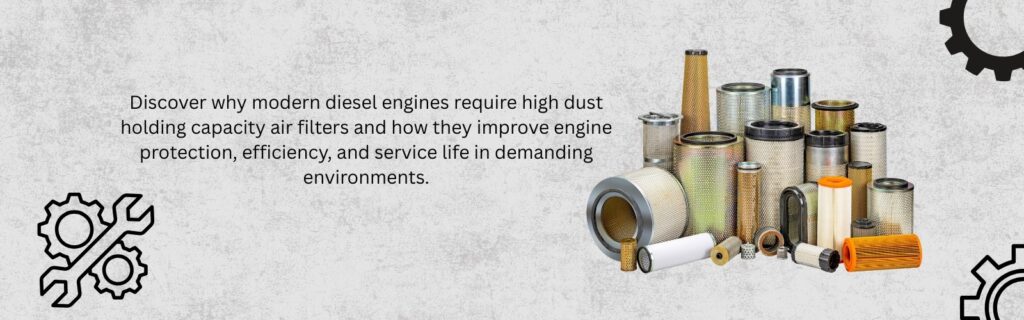
Modern diesel engines are more powerful, fuel-efficient, and environmentally compliant than ever before. Whether used in construction equipment, mining machinery, agricultural vehicles, diesel generators, material handling equipment, or industrial engines, today’s diesel engines are designed to deliver maximum performance while meeting increasingly strict emission standards.
However, these advancements have also made engines more sensitive to contamination.
While fuel quality and lubrication receive significant attention, one of the most important factors affecting engine life is often overlooked—air filtration.
Every diesel engine consumes thousands of liters of air for combustion. If that air contains dust, dirt, sand, or airborne contaminants, engine components begin to wear rapidly.
This is why High Dust Holding Capacity Air Filters have become essential for modern diesel engines operating in challenging industrial environments.
MMHP India provides engine air filtration solutions designed to handle demanding operating conditions while protecting engines from harmful contamination.
The Air Requirement of Modern Diesel Engines
A diesel engine consumes significantly more air than fuel during operation.
For efficient combustion, the engine continuously draws air through the intake system.
In ideal conditions, this air would be completely clean.
However, most industrial environments contain:
- Dust
- Sand particles
- Construction debris
- Cement dust
- Agricultural residue
- Mining contaminants
- Industrial airborne particles
Without proper filtration, these contaminants enter the engine and cause serious damage.
This is where High Dust Holding Capacity Air Filters become critical.
Why Modern Engines Are More Sensitive Than Older Engines
Many operators assume that newer engines are more durable than older models.
While modern engines are technologically advanced, they often operate with:
- Tighter tolerances
- Higher fuel injection pressures
- Advanced turbochargers
- Precision combustion systems
- Emission control equipment
These features improve efficiency but also make engines more vulnerable to contamination.
Even small amounts of dust can negatively impact performance.
As a result, modern engines depend heavily on High Dust Holding Capacity Air Filters.
Understanding Dust Holding Capacity
Dust holding capacity refers to the amount of dust a filter can capture before airflow becomes significantly restricted.
A filter with higher dust holding capacity can:
- Retain more contamination
- Maintain airflow longer
- Extend service intervals
- Improve engine protection
This characteristic is particularly important in dusty industrial environments.
The better the dust holding capacity, the longer the filter can continue protecting the engine effectively.
Why Dust Is Dangerous for Diesel Engines
Dust may seem harmless, but inside an engine it acts like abrasive material.
When contaminants enter the combustion system, they can damage:
- Cylinder liners
- Piston rings
- Turbochargers
- Intake valves
- Bearings
Over time, dust contamination leads to:
- Increased wear
- Reduced power
- Higher fuel consumption
- Reduced engine life
This is why High Dust Holding Capacity Air Filters are a critical investment.
The Role of Air Filters in Engine Protection
Engine air filters serve as the first line of defense against airborne contamination.
Their primary responsibilities include:
- Capturing dust particles
- Maintaining airflow
- Protecting internal engine components
- Supporting efficient combustion
However, not all filters perform equally.
Filters with limited dust holding capacity may clog quickly, reducing airflow and increasing maintenance requirements.
How Dust Affects Combustion Efficiency
Clean air is essential for proper combustion.
When airflow becomes restricted:
- Fuel combustion becomes less efficient
- Engine power decreases
- Fuel consumption increases
- Emissions rise
Modern diesel engines rely on precise air-fuel ratios.
Maintaining adequate airflow is one reason why High Dust Holding Capacity Air Filters are preferred in industrial applications.
Why Construction Equipment Requires Better Filtration
Construction sites are among the harshest environments for engine air filters.
Equipment often operates in:
- Dry soil
- Cement dust
- Sand
- Demolition debris
Machines such as:
- Excavators
- Loaders
- Bulldozers
- Backhoe loaders
- Cranes
are exposed to continuous contamination.
Standard filters may become overloaded quickly.
This is why High Dust Holding Capacity Air Filters are particularly important in construction applications.
Mining Applications Demand Maximum Dust Protection
Mining operations generate extreme dust concentrations.
Contaminants can include:
- Fine mineral particles
- Silica dust
- Rock dust
- Processing debris
These particles are highly abrasive.
Without effective filtration, engine wear increases dramatically.
High-capacity filtration helps protect expensive equipment operating in these environments.
The Impact on Turbochargers
Modern diesel engines often use turbochargers to improve performance and efficiency.
Turbochargers operate at extremely high speeds.
Dust entering the turbocharger can:
- Damage compressor blades
- Reduce efficiency
- Create imbalance
- Shorten service life
Effective filtration helps protect turbochargers from contamination-related damage.
Why Frequent Filter Changes Increase Costs
Some facilities attempt to compensate for poor filtration by changing filters more often.
However, frequent replacement increases:
- Maintenance labor
- Spare parts costs
- Equipment downtime
A better solution is selecting High Dust Holding Capacity Air Filters capable of handling larger contamination loads.
This extends service intervals and improves overall efficiency.
Real Example: Quarry Equipment Performance
A quarry operator experienced recurring engine issues in wheel loaders.
Problems included:
- Reduced power
- Increased fuel consumption
- Frequent filter replacement
Investigation revealed extremely high dust loading conditions.
After switching to higher-capacity filtration:
- Filter life increased
- Engine performance improved
- Maintenance costs decreased
- Equipment availability improved
The improvement came from better contamination management.
Why Airflow Stability Matters
An engine requires a consistent supply of air.
When filters clog rapidly:
- Intake restriction increases
- Combustion efficiency decreases
- Engine performance suffers
High dust holding capacity helps maintain stable airflow for longer periods.
This improves overall engine reliability.
How OEMs Address Dust Challenges
Equipment manufacturers understand the impact of contamination on engine performance.
As a result, many OEMs specify filtration systems capable of handling severe operating environments.
The goal is to:
- Protect engines
- Reduce warranty claims
- Improve customer satisfaction
- Extend service intervals
This trend continues to drive demand for High Dust Holding Capacity Air Filters.
Why MMHP Engine Air Filters Support Modern Diesel Engines
MMHP India provides engine air filtration solutions designed for industrial environments where contamination control is critical.
Their filters help:
- Capture airborne contaminants
- Maintain airflow
- Support engine efficiency
- Improve equipment reliability
- Reduce maintenance frequency
These benefits make them suitable for demanding diesel engine applications.
Signs Your Air Filter May Be Inadequate
Watch for:
- Frequent filter replacement
- Reduced engine power
- Increased fuel consumption
- Excessive intake restriction
- Premature engine wear
These symptoms may indicate that the existing filtration system lacks sufficient dust holding capacity.
Best Practices for Air Filtration Management
To maximize engine protection:
Inspect Filters Regularly
Monitor contamination levels and restriction indicators.
Replace Filters When Required
Avoid both premature and delayed replacement.
Maintain Proper Sealing
Air leaks bypass filtration and allow contaminants into the engine.
Use Quality Filtration Products
High-performance filtration improves long-term reliability.
Match Filters to Operating Conditions
Dusty environments require higher-capacity solutions.
Why MMHP Is the Best Choice
MMHP India understands the challenges modern diesel engines face in industrial environments.
Their engine air filtration solutions are designed to:
- Handle demanding dust conditions
- Support efficient airflow
- Improve engine protection
- Extend service life
- Reduce maintenance requirements
For businesses operating in construction, mining, agriculture, power generation, and industrial applications, MMHP provides practical filtration solutions designed for real-world performance.
Final Conclusion
Modern diesel engines are more advanced and efficient than ever, but they are also more sensitive to contamination.
Dust entering the engine can accelerate wear, reduce performance, increase fuel consumption, and shorten equipment life.
This is why High Dust Holding Capacity Air Filters are essential.
By capturing more contamination while maintaining airflow, they help protect critical engine components and improve operational reliability.
MMHP India Engine Air Filters provide the contamination control modern diesel engines need to perform efficiently in demanding industrial environments.
When it comes to engine protection, the ability to hold more dust often means longer life, lower costs, and better performance.