In modern industrial automation, speed and precision are everything. Machines operate at high cycle rates, valves switch within milliseconds, and even small delays can impact production output. While engineers focus on actuators, controllers, and valves, one critical component often goes unnoticed — the exhaust system.
More specifically, the role of Pneumufflers in controlling exhaust airflow.
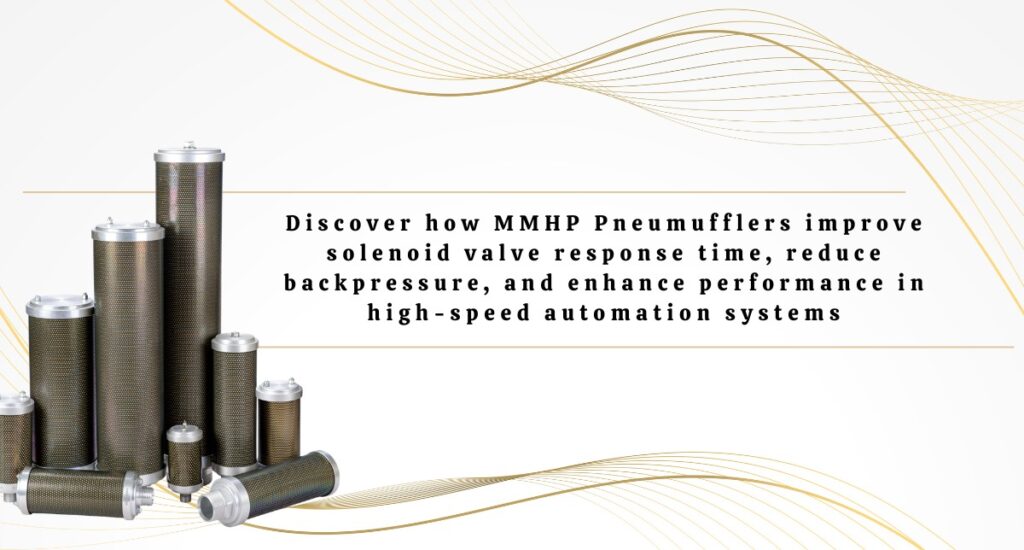
Most industries install Pneumufflers to reduce noise. But their impact goes far beyond that. In high-speed automation systems, properly selected MMHP Pneumufflers directly influence valve response time, airflow stability, and overall system efficiency.
Let’s understand how.
The Hidden Role of Exhaust in Pneumatic Systems
Every pneumatic system operates in a simple cycle:
- Compressed air enters the valve
- The valve directs airflow to actuators
- Air is exhausted after the stroke
While supply air is carefully controlled, exhaust air is often ignored.
Uncontrolled exhaust leads to:
- Sudden pressure release
- High turbulence
- Noise spikes
- Flow instability
In high-speed systems, this instability affects how quickly a valve can reset and perform the next cycle.
This is where Pneumufflers become critical.
How Pneumufflers Influence Valve Response Time
Valve response time is the time taken for a valve to shift and reset.
For consistent operation, exhaust air must leave the system smoothly.
Without Pneumufflers:
- Air escapes instantly
- Turbulence forms at the exhaust
- Pressure fluctuations occur
- Valve resetting becomes inconsistent
With properly designed MMHP Pneumufflers:
- Exhaust is diffused evenly
- Flow stabilizes
- Pressure transitions become smoother
- Valve cycles become more consistent
This directly improves response time.
Why High-Speed Automation Needs Pneumufflers
Applications such as:
- Packaging lines
- Pick-and-place robotics
- Textile machinery
- Bottling plants
- Pharmaceutical automation
operate at high cycle frequencies.
In these systems:
- Even milliseconds matter
- Repetition must be consistent
- Flow stability is critical
Pneumufflers ensure that each exhaust cycle behaves identically.
This consistency improves:
- production accuracy
- cycle repeatability
- system reliability
The Problem with Uncontrolled Exhaust
When Pneumufflers are not used, or incorrectly sized:
- Exhaust velocity becomes too high
- Pressure drops occur suddenly
- Airflow becomes unstable
- Valve spool movement becomes inconsistent
This leads to:
- delayed actuation
- incomplete cylinder strokes
- irregular motion
- increased air consumption
Over time, this affects overall machine performance.
How MMHP Pneumufflers Solve This
MMHP Pneumufflers are designed using sintered bronze technology that:
- diffuses exhaust air uniformly
- maintains low backpressure
- ensures stable airflow
- reduces turbulence
- supports high cycle operations
Unlike simple silencers, they are engineered for performance.
Backpressure vs Performance — The Balance
One common concern is backpressure.
Too much backpressure:
- slows down valves
- affects cylinder speed
Too little control:
- creates turbulence
- destabilizes flow
MMHP Pneumufflers are designed to maintain:
✔ Low backpressure
✔ Controlled diffusion
✔ High flow capacity
This balance ensures optimal system performance.
Real Industrial Example
A packaging line running at high speed experienced:
- inconsistent sealing
- irregular actuator timing
- excessive exhaust noise
Investigation showed:
- no proper Pneumufflers installed
- uncontrolled exhaust flow
After installing MMHP Pneumufflers:
- cycle timing stabilized
- noise reduced significantly
- air consumption improved
- machine output increased
The improvement came from exhaust control — not valve replacement.
Why Sintered Bronze Pneumufflers Perform Better
MMHP uses sintered bronze because it offers:
- uniform pore structure
- consistent airflow diffusion
- high durability
- resistance to clogging
- long service life
This ensures stable performance even in dusty environments.
Applications Where Pneumufflers Are Critical
Pneumufflers are essential in:
- solenoid valve exhaust
- AODD pumps
- air cylinders
- compressed air systems
- automation lines
- vacuum systems
In each case, exhaust control improves performance.
Signs You Need Better Pneumufflers
Watch for:
- inconsistent actuator speed
- high exhaust noise
- vibration near valves
- irregular cycle timing
- increased air usage
These indicate poor exhaust control.
Commercial Benefits of Using MMHP Pneumufflers
- Improved automation accuracy
- Reduced downtime
- Lower energy consumption
- Extended valve life
- Better workplace conditions
- Increased production efficiency
For OEMs and industrial buyers, Pneumufflers are not optional — they are performance components.
Conclusion
In high-speed automation systems, exhaust control is as important as supply control.
MMHP Pneumufflers ensure:
- stable airflow
- consistent valve response
- reduced noise
- improved system efficiency
By controlling exhaust behavior, Pneumufflers improve the performance of the entire pneumatic system.
Small component. Major impact.