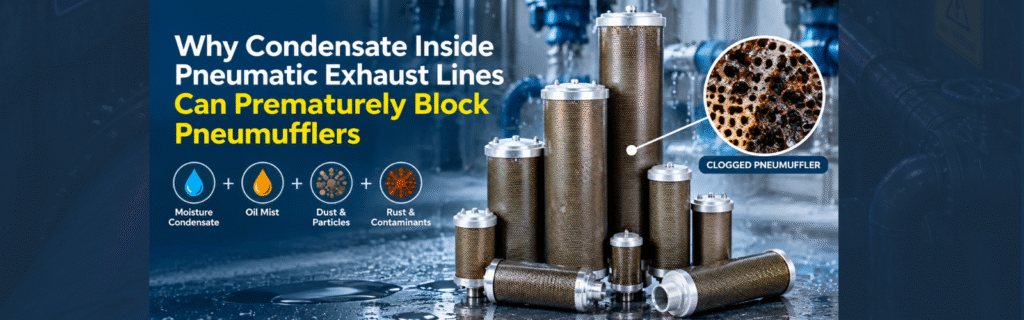
A Pneumuffler may look like a simple component fitted to a pneumatic valve exhaust port, but its operating condition can directly influence how efficiently compressed air leaves the system.
Most maintenance teams know that dust, oil and other contaminants can eventually clog a pneumatic silencer.
Moisture is often overlooked.
Compressed air naturally contains water vapor. As compressed air cools, some of this moisture can condense into liquid water. If the air-treatment and drainage system does not remove it effectively, condensate can travel through pneumatic lines and eventually reach valves and exhaust components.
The problem becomes more serious when this moisture combines with:
- Compressor oil
- Dust
- Pipe contamination
- Rust particles
- Process debris
Instead of remaining as separate contaminants, they can form a sticky deposit that gradually blocks the porous passages of a Pneumuffler.
The result may be increased exhaust resistance, slower actuator movement, longer machine cycles and premature silencer replacement.
The silencer may appear to be the problem.
But the real cause may have started much further upstream.
Why Is There Water in a Compressed Air System?
Atmospheric air always contains some amount of water vapor.
When a compressor takes in atmospheric air, it also takes in this moisture.
Compression raises the air temperature. As the compressed air subsequently travels through an aftercooler, receiver, dryer and distribution piping, it begins to cool.
Cooler air cannot retain the same amount of water vapor.
Some moisture therefore changes into liquid condensate.
This is normal behavior in compressed-air systems.
The challenge is removing the condensed water before it reaches pneumatic equipment.
Where Should Condensate Normally Be Removed?
A properly designed compressed-air system can use several stages to manage moisture.
Depending on the installation, these may include:
Aftercooler → Moisture Separator → Air Receiver → Filters → Air Dryer → Distribution System
Condensate drains may also be installed at appropriate locations.
Each component performs a different function.
The objective is to prevent large quantities of liquid water from travelling into valves, cylinders and pneumatic tools.
However, problems with drainage, air treatment or piping can allow moisture to move farther downstream than intended.
Eventually, some of it may reach the Pneumatic Exhaust Silencer.
How Does Moisture Reach a Pneumuffler?
A Pneumuffler is normally fitted to the exhaust port of a pneumatic valve or another air-operated component.
During operation, compressed air enters the actuator.
When the valve switches, that air must leave:
Cylinder → Valve → Exhaust Port → Pneumuffler → Atmosphere
Any moisture, oil mist or contamination carried in the exhausted air can therefore pass through the silencer.
A small amount may not immediately create a problem.
But repeated exposure over thousands of pneumatic cycles can gradually change the condition of the porous silencer media.
Why Water Alone Is Not the Only Problem
Pure water passing through a Pneumatic Exhaust Silencer is one issue.
Water mixed with contamination is more concerning.
Industrial compressed air can contain varying amounts of:
- Oil aerosols
- Dust
- Rust
- Pipe scale
- Compressor contaminants
- Fine solid particles
Moisture can help these contaminants adhere to surfaces.
Instead of dry particles passing through or remaining loosely deposited, the combination can create a damp residue.
As the moisture evaporates, solids can remain behind.
Repeated cycles can produce:
Moisture + Oil + Dust → Sticky Deposit → Dry Residue → Restricted Pores
Over time, the available exhaust area of the Pneumuffler can decrease.
How Condensate Prematurely Blocks a Pneumuffler
The internal structure of a pneumatic silencer contains many small passages.
These passages allow exhaust air to expand and disperse instead of leaving the valve as a concentrated high-velocity jet.
This is how a Pneumuffler helps reduce pneumatic exhaust noise.
However, the same porous structure can accumulate contamination.
Imagine that only a small portion of the available passages becomes restricted.
Initially, the difference may be difficult to notice.
As more passages become blocked, the remaining open area must handle a larger share of the exhaust flow.
Resistance increases progressively.
Eventually, the Pneumuffler can become restrictive enough to affect pneumatic operation.
1. Condensate Can Trap Dust Inside the Silencer
Dry dust and moisture can behave very differently.
A dry particle may move with the airflow.
When surfaces are wet or oily, particles are more likely to remain attached.
Moisture reaching the Pneumatic Silencer can therefore increase the tendency for fine contamination to collect.
Additional particles then deposit onto the existing layer.
This creates progressive fouling.
A Pneumuffler operating in a dusty manufacturing environment may experience this faster than the same silencer operating in clean conditions.
2. Oil and Water Can Create More Persistent Deposits
Many pneumatic systems contain some level of oil contamination, whether from compressor carryover, lubrication or process conditions.
When oil, water and fine solids reach the exhaust together, deposits can become more difficult to remove.
A silencer may look dark, oily or dirty externally.
But the more important contamination may be inside the porous structure where it cannot be easily seen.
This is why visual appearance alone does not always reveal the true condition of a Pneumatic Exhaust Muffler.
3. Moisture Can Carry Pipe Contamination Downstream
Condensate can collect at low points in compressed-air piping.
If drainage is inadequate, accumulated water can pick up:
- Rust
- Pipe scale
- Dirt
- Installation debris
Changes in airflow can then push this contaminated liquid downstream.
Instead of receiving a small amount of water vapor, pneumatic equipment may suddenly receive a larger quantity of contaminated condensate.
This can accelerate fouling of valves as well as exhaust silencers.
What Happens When a Pneumuffler Becomes Restricted?
The immediate problem is not simply that the silencer becomes dirty.
The important issue is exhaust flow.
Pneumatic cylinders require air to leave one chamber while compressed air enters the other.
Consider cylinder extension:
Compressed Air → Cylinder Side A
At the same time:
Cylinder Side B → Valve → Pneumuffler → Atmosphere
If the Pneumuffler is restricted, air from Side B cannot escape as freely.
Residual pressure remains inside the chamber.
This pressure opposes movement of the piston.
The result is pneumatic exhaust backpressure.
Backpressure Can Slow Pneumatic Cylinders
A cylinder may receive perfectly adequate supply pressure and still move slowly.
Why?
Because supply pressure is only one side of the equation.
The exhaust side also needs to release air efficiently.
A moisture-clogged Pneumuffler can restrict this release.
Operators may notice:
- Slow cylinder extension
- Slow cylinder retraction
- Delayed response
- Inconsistent movement
- Longer cycle times
The natural reaction may be to increase supply pressure.
That does not correct the blocked exhaust path.
Why This Problem Is Often Misdiagnosed
A slow pneumatic actuator can have many possible causes.
Maintenance teams may inspect:
- Cylinder seals
- Solenoid valves
- Regulators
- Flow-control valves
- Supply pressure
- Air leaks
All of these are reasonable checks.
But the Pneumuffler is easy to overlook because it is small and inexpensive compared with the cylinder or valve.
A restricted silencer can therefore result in unnecessary troubleshooting or component replacement.
A useful rule is:
When investigating slow pneumatic movement, check both supply airflow and exhaust airflow.
Condensate Can Cause Intermittent Problems
Moisture-related Pneumuffler problems may not always appear consistently.
For example, the system may operate normally when:
- Ambient humidity is low
- The compressor has recently started
- Drainage is functioning correctly
Problems may become more noticeable when:
- Humidity increases
- Compressed air cools significantly
- Condensate drains fail
- Production runs continuously
- Water accumulates overnight
- The system experiences temperature changes
This can make troubleshooting difficult.
A machine may run correctly during one shift and develop slower pneumatic movement during another.
Why Humid Weather Can Make the Problem Worse
Atmospheric humidity affects how much moisture enters the compressor.
During humid conditions, more water vapor enters with the intake air.
If the compressed-air treatment system is already operating near its moisture-handling capacity, additional humidity can increase downstream condensate.
Plants may therefore notice moisture-related pneumatic problems becoming more frequent during rainy or humid seasons.
In such situations, repeatedly replacing a Pneumatic Exhaust Silencer without examining moisture control may provide only temporary relief.
The Role of Compressed Air Dryers
An air dryer reduces moisture in compressed air before it reaches downstream equipment.
Different industrial systems use different dryer technologies depending on required air quality and operating conditions.
However, even a properly selected dryer requires:
- Correct operating conditions
- Suitable maintenance
- Effective drainage
- Appropriate filtration
If dryer performance deteriorates, more moisture can enter the distribution system.
A clogged Pneumuffler may therefore sometimes be a downstream symptom of an upstream air-treatment problem.
Drain Failure Can Lead to Pneumuffler Problems
Condensate drains are relatively small components, but their job is critical.
They remove accumulated water from equipment such as:
- Moisture separators
- Air receivers
- Filters
- Dryers
- Pipeline low points
If a drain becomes blocked or stops functioning correctly, liquid continues accumulating.
Eventually, airflow can carry that water downstream.
This is why a maintenance team investigating repeated Pneumuffler blockage should inspect more than the silencer.
Check the condensate-management system too.
Piping Layout Can Influence Moisture Movement
Compressed-air distribution design also affects condensate behavior.
Water naturally moves toward low points.
If the piping system contains locations where condensate collects without suitable drainage, accumulated liquid can remain there until airflow pushes it downstream.
Correct piping design can help minimize this problem.
Factors may include:
- Pipe slope
- Drain locations
- Branch connections
- Low points
- Air velocity
- System temperature
A Pneumuffler cannot compensate for poor condensate management upstream.
Warning Signs of Moisture-Related Pneumuffler Blockage
Maintenance teams should look for a combination of symptoms.
Visible Water at the Exhaust
Repeated droplets or unusually wet exhaust can indicate excessive moisture reaching the valve.
Oily or Sticky Silencer Surface
This may indicate a combination of moisture, oil and contamination.
Pneumuffler Clogs Soon After Replacement
Frequent blockage suggests that the environment or compressed-air quality needs investigation.
Cylinder Becomes Progressively Slower
Increasing exhaust restriction can gradually change actuator speed.
Problems Increase During Humid Conditions
This can indicate insufficient moisture removal.
Water Appears at Multiple Pneumatic Components
If several locations show moisture, the root cause is likely upstream rather than an individual silencer.
Don’t Automatically Replace the Pneumuffler
Suppose a plant experiences a blocked silencer every few weeks.
Maintenance replaces it.
The new Pneumuffler works correctly.
Several weeks later, the same problem returns.
Replacing it again may restore operation—but it does not explain why the component is clogging so quickly.
Repeated premature blockage should trigger a root-cause investigation.
Check:
- Is excessive moisture reaching the machine?
- Are condensate drains functioning?
- Is the air dryer operating correctly?
- Is oil carryover excessive?
- Is the distribution piping collecting water?
- Is the Pneumuffler exposed to external contamination?
- Is the silencer correctly sized for the exhaust flow?
This approach can reduce repeated component replacement.
Condensate Problems Can Affect More Than the Pneumuffler
If enough moisture is reaching the exhaust silencer to cause repeated problems, other pneumatic components may also be exposed.
Excessive moisture can potentially contribute to contamination or corrosion within:
- Solenoid valves
- Pneumatic cylinders
- Regulators
- Flow-control valves
- Pneumatic tools
- Instrumentation
The clogged Pneumuffler may therefore be an early warning sign of a wider compressed-air quality issue.
Preventing Moisture-Related Pneumuffler Blockage
Maintain Effective Moisture Separation
Bulk condensate should be removed before compressed air reaches sensitive pneumatic equipment.
Inspect Condensate Drains
Do not assume an automatic drain is working simply because one is installed.
Inspect and maintain it according to manufacturer recommendations.
Monitor Air Dryer Performance
Unexpected downstream moisture should trigger an inspection of the dryer and associated air-treatment equipment.
Check Compressed-Air Filters
Filtration upstream can help control solid and liquid contamination before it reaches pneumatic components.
Inspect Pipeline Low Points
Identify locations where water can accumulate.
Monitor the Pneumuffler
Look for changes in exhaust behavior, contamination and actuator speed.
Investigate Repeated Failures
If Pneumufflers require unusually frequent replacement, find the upstream cause rather than treating repeated clogging as normal.
Pneumuffler Selection Still Matters
Moisture control is important, but the silencer itself must also be appropriate for the application.
Selection should consider:
- Exhaust flow rate
- Operating pressure
- Port/thread size
- BSP/NPT requirement
- Temperature
- Environmental contamination
- Exhaust frequency
- Acceptable backpressure
MMHP’s PNEUMUFFLER® range includes different constructions for industrial requirements, including Metal, Relief Valve, Standard, Porous Plastic, High Pressure and High Temperature series. MMHP also specifies BSP/NPT thread compatibility and customized options on its current product page.
A silencer should therefore be selected according to the operating application—not merely because its thread fits the valve.
Why MMHP PNEUMUFFLER®?
MMHP India manufactures PNEUMUFFLER® pneumatic exhaust silencers for a wide variety of pneumatic applications.
The product range is designed around the important balance between noise reduction and unrestricted exhaust flow, with different configurations available according to pressure, temperature, connection and operating requirements.
For systems experiencing premature silencer blockage, engineers should consider both the Pneumuffler and the condition of the compressed-air supply.
Correct silencer selection combined with effective moisture and contamination control can help maintain reliable exhaust flow and pneumatic equipment performance.
FAQs
Can water clog a Pneumuffler?
Moisture can contribute to blockage, particularly when it combines with oil, dust, rust or other contamination that deposits within the porous silencer structure.
Why is water coming from my pneumatic exhaust?
Possible causes include excessive condensate in compressed-air piping, ineffective moisture separation, failed drains, dryer problems or condensation occurring downstream.
Can a clogged Pneumuffler slow a pneumatic cylinder?
Yes. Restriction at the exhaust can create backpressure that opposes cylinder movement and may increase extension or retraction time.
Why does my Pneumuffler keep clogging?
Repeated clogging can result from moisture, oil mist, dust, external contamination, inadequate compressed-air treatment or incorrect silencer sizing.
Should I increase air pressure if the cylinder becomes slow?
Not automatically. Check supply pressure, but also inspect the exhaust path. Increasing pressure will not correct a blocked exhaust silencer.
Does humid weather affect compressed-air moisture?
Yes. Higher atmospheric humidity means more water vapor can enter the compressor, potentially increasing the condensate load that the air-treatment system must handle.
Should the Pneumuffler be replaced if it is wet?
Not necessarily. Determine why moisture is reaching the silencer and inspect the component according to the manufacturer’s maintenance recommendations. Repeated wetting or blockage may indicate an upstream problem.
Conclusion
A prematurely blocked Pneumuffler is not always a Pneumuffler problem.
The real issue may begin with moisture entering the compressor, condensing inside the compressed-air system and travelling downstream because it is not being separated or drained effectively.
Once condensate reaches the pneumatic exhaust, it can combine with oil, dust and other particles to create deposits within the silencer.
As those deposits accumulate:
Open exhaust area decreases → backpressure increases → cylinder movement can slow → machine cycle time can increase.
Replacing the silencer may temporarily restore performance.
Finding the source of the condensate can prevent the problem from returning.
For reliable pneumatic operation, treat the Pneumuffler, compressed-air filtration, moisture separation, drainage and air drying as parts of the same system rather than isolated components.