When selecting a Brass Y Strainer, pipe size is usually the first specification engineers look at.
A 1-inch pipeline needs a 1-inch strainer. A 2-inch pipeline needs a 2-inch strainer.
That is necessary—but it does not tell you how effectively the strainer will perform.
Inside every Y strainer is a screen responsible for capturing rust, scale, dirt, metal particles, and other debris before they reach sensitive downstream equipment. The available screen area determines how much debris can be collected while still allowing fluid to pass through.
Two strainers can have the same connection size but behave very differently if their screen designs are different.
A larger effective screen area can provide better dirt-holding capacity, slower blockage, more stable flow, and longer intervals between cleaning. A poorly sized screen can create increasing restriction even though the strainer body perfectly matches the pipeline.
That is why engineers should evaluate both pipe connection size and screen area when selecting an industrial Y strainer.
What Is a Brass Y Strainer?
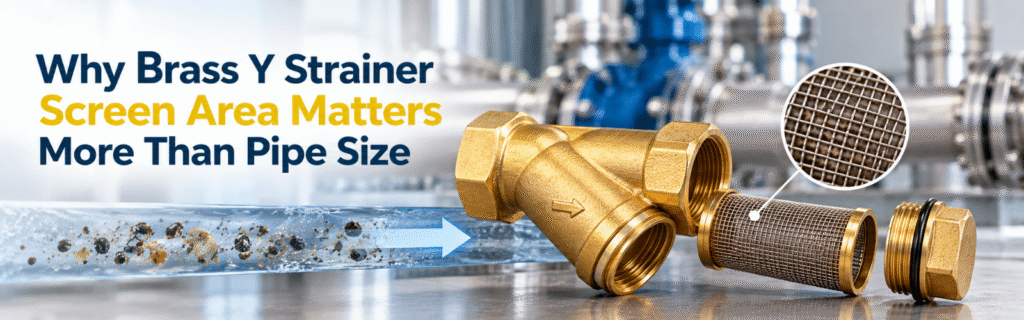
A Brass Y Strainer is a pipeline filtration component designed to mechanically remove solid particles from flowing liquids.
Its body has the characteristic Y-shaped configuration. Inside the angled branch is a perforated or mesh screen that traps contaminants while allowing the fluid to continue downstream.
Brass Y strainers are commonly used to protect equipment such as:
- Pumps
- Solenoid valves
- Control valves
- Pressure regulators
- Flow meters
- Heat exchangers
- Nozzles
- Other sensitive pipeline components
Without a strainer, debris circulating through a pipeline can enter small passages, interfere with valve movement, damage sealing surfaces, or contribute to premature component failure.
The Y strainer screen therefore becomes the actual working filtration surface of the assembly.
Pipe Size Tells You Connection Size—not Filtration Capacity
Suppose a system uses a 1-inch pipeline.
Selecting a 1-inch Brass Y Strainer ensures that the strainer can be connected correctly to that pipeline.
However, pipe size alone does not tell you:
- How much screen surface is available
- How quickly the screen will load with debris
- How much open area is available for flow
- How much restriction develops as contamination accumulates
- How frequently the screen will require cleaning
This distinction is important.
The connection size determines how the strainer fits into the system.
The screen determines how the strainer handles contamination and flow.
Both must be considered.
What Does Y Strainer Screen Area Mean?
The screen inside an Industrial Y Strainer contains many openings through which fluid can pass.
When discussing screen performance, engineers may consider several related factors:
Gross screen area is the overall physical surface area of the screen.
Open area refers to the portion available for fluid to pass through the holes or mesh openings.
Effective filtration area relates to the usable screen surface available under actual operating conditions.
These are not necessarily identical.
For example, two screens could have similar dimensions but different perforation patterns or mesh structures. One may offer substantially more open flow area than the other.
This is why simply looking at the physical size of a Y Strainer Screen can be misleading.
Why Larger Screen Area Can Improve Strainer Performance
Imagine contaminants entering a pipeline continuously.
As particles collect on the screen, some openings become partially or completely blocked.
If the available screen area is small, losing even a relatively small portion of it can significantly reduce the remaining flow area.
Restriction rises faster.
With a larger effective screen area, contamination can be distributed across more filtration surface.
This can provide several practical advantages.
Higher Dirt-Holding Capacity
A larger screen provides more surface on which contaminants can accumulate.
Consider two Brass Y Strainer Filters installed in similar operating conditions.
If Strainer A has considerably more effective screen area than Strainer B, the same amount of contamination may cover a smaller proportion of Strainer A’s total filtration surface.
As a result, Strainer A may continue operating effectively for longer before cleaning becomes necessary.
This becomes especially valuable in systems where rust, scale or process debris is common.
Screen Area Directly Influences Pressure Drop
Every strainer creates some resistance to flow.
When the screen is clean, this resistance should remain within the acceptable range for the system and operating conditions.
But as contamination accumulates, the available open area decreases.
This causes the Y Strainer Pressure Drop to increase.
The relationship can be visualized simply:
Clean screen → More available open area → Lower restriction
Loaded screen → Less available open area → Higher restriction
If a screen begins with limited effective area, it may reach an undesirable restriction level relatively quickly.
This can affect downstream equipment even before the screen appears completely blocked.
Why Pressure Drop Matters to the Entire System
A Y strainer does not operate independently. Any additional restriction it creates becomes part of the overall hydraulic system.
Excessive pressure loss across a dirty Pipeline Strainer can potentially contribute to:
- Reduced downstream pressure
- Lower available flow
- Poor valve performance
- Reduced process efficiency
- Increased pump operating demand in some systems
- Unstable equipment operation
This is why maintenance teams should not wait until a Y strainer is completely blocked before servicing it.
The screen can become operationally restrictive well before that point.
Screen Area Becomes More Important in Dirty Systems
Some systems carry very little contamination.
Others regularly encounter:
- Pipe scale
- Rust particles
- Installation debris
- Sediment
- Seal fragments
- Metal particles
- Process solids
In these environments, the screen is continually collecting contaminants.
A Brass Y Strainer with adequate effective screen area provides more capacity to accommodate this contamination before flow becomes excessively restricted.
This is particularly important during system commissioning.
New or recently modified piping can contain welding debris, scale, sealant fragments and other installation contaminants. Initial screen loading can therefore be much faster than expected.
Screen Area and Mesh Size Are Not the Same Thing
Another common mistake is treating screen area and filtration rating as interchangeable.
They describe different characteristics.
The opening or mesh size determines the approximate size of particles the screen is intended to retain.
The screen area determines how much filtration surface is available.
A finer screen may capture smaller particles, but it also has smaller openings.
That can influence resistance and loading behavior.
For example, selecting an unnecessarily fine screen can result in faster fouling in a heavily contaminated line.
Therefore, selecting an Industrial Y Strainer requires balancing:
Particle retention + available screen area + flow requirement + acceptable pressure drop.
Choosing the finest screen possible is not automatically the best solution.
Why Oversizing the Mesh Is Also a Problem
Going in the opposite direction creates another issue.
A very coarse screen may provide good flow but allow damaging particles to pass downstream.
Imagine a solenoid valve with relatively small internal passages.
If the upstream Brass Strainer allows particles large enough to interfere with those passages to pass through, the strainer is not providing the protection required by the application.
Those particles could contribute to:
- Valve sticking
- Incomplete closing
- Leakage
- Blocked passages
- Seal damage
- Increased maintenance
The correct Y strainer therefore needs to provide sufficient flow area without sacrificing the required level of downstream protection.
A Simple Example: Same Pipe Size, Different Screen Performance
Consider two Y strainers installed in identical 1-inch pipelines.
Both have the correct 1-inch connection.
Both initially allow the required flow.
But their screens differ.
Strainer A
It has relatively limited effective screen area.
As contamination collects, a significant percentage of its available openings becomes blocked quickly.
Pressure drop begins increasing.
Strainer B
It has greater usable screen area.
The same amount of contamination is distributed across a larger surface.
More open area remains available for fluid flow.
As a result, its pressure drop may increase more gradually under comparable conditions.
The example demonstrates why connection size alone cannot describe filtration performance.
Screen Area Can Influence Maintenance Frequency
Every Y strainer eventually requires inspection and cleaning.
However, the interval can vary significantly depending on:
- Contamination concentration
- Particle characteristics
- Flow rate
- Fluid properties
- Screen opening size
- Effective screen area
- System operating conditions
If the screen has inadequate capacity for the contamination load, maintenance teams may find themselves cleaning the Y Strainer Mesh repeatedly.
Frequent cleaning creates additional labor and may require process interruptions.
If a Y strainer needs cleaning much more often than expected, maintenance teams should investigate the cause rather than automatically treating frequent cleaning as normal.
The system may have unusually high contamination, the screen may be too fine, or the selected strainer may not provide enough effective screen area for the application.
Why Screen Design Matters for Solenoid Valve Protection
Solenoid valves are particularly sensitive to contamination.
Small particles can enter internal passages or settle around moving components and sealing surfaces.
An upstream Brass Y Strainer Filter helps remove larger debris before it reaches the valve.
But reliable protection depends on more than installing any strainer of the correct pipe size.
The screen must:
- Capture contaminants relevant to the downstream component.
- Provide adequate flow capacity.
- Offer sufficient screen area for expected contamination.
- Remain serviceable throughout the maintenance interval.
This is why strainer selection should begin with the requirements of the whole system, not simply the pipe connection.
Factors to Check When Selecting a Brass Y Strainer
Before selecting a Y strainer, engineers should evaluate several operating parameters together.
Pipeline Size
The strainer connections must be compatible with the piping system.
Flow Rate
Two pipelines of the same diameter can operate at very different flow rates.
The strainer must handle the actual design flow without creating unacceptable restriction.
Operating Pressure and Temperature
The body, seals, screen and connection design must be appropriate for system conditions.
Contamination Type
Understand what the strainer needs to capture.
Large rust flakes require a different filtration approach from fine process contamination.
Screen Opening
Select an opening that protects downstream components without creating unnecessary restriction.
Effective Screen Area
Ensure there is enough filtration surface to handle the expected contaminant loading and flow.
Acceptable Pressure Drop
The clean and progressively loaded strainer must remain compatible with the system’s pressure requirements.
Cleaning Requirements
Consider how easily the screen can be inspected, removed and cleaned.
Do Not Select a Y Strainer by Pipe Size Alone
This is the key engineering takeaway.
A specification such as:
“1-inch Brass Y Strainer”
is incomplete from a filtration-performance perspective.
A more complete evaluation should consider:
Connection size + screen design + filtration opening + flow rate + screen area + operating conditions.
These parameters work together.
Ignoring one of them can result in a strainer that physically fits the pipeline but does not perform efficiently in the application.
Warning Signs That Your Y Strainer May Have Insufficient Capacity
Maintenance teams should pay attention when a Brass Y Strainer repeatedly shows symptoms such as:
- Rapid pressure-drop increase
- Frequent screen blockage
- Reduced downstream flow
- Frequent cleaning requirements
- Pump or valve performance problems
- Heavy contamination concentrated over limited areas of the screen
These symptoms do not automatically prove that the strainer is undersized.
They can also indicate abnormal contamination or another system problem.
But they are good reasons to inspect the screen condition and reconsider whether its filtration area and opening size are appropriate.
Why MMHP Brass Y Strainers?
MMHP India manufactures filtration products for industrial applications, including Brass Y Strainers designed to protect downstream components from solid contamination.
When selecting a strainer, the objective should not simply be matching a threaded connection to the pipeline. Flow conditions, contaminant loading, filtration requirement and downstream equipment should all be considered.
For applications involving pumps, valves, regulators and other contamination-sensitive equipment, selecting the appropriate strainer configuration can help maintain cleaner flow and reduce avoidable equipment problems.
FAQs
1. What does a Brass Y Strainer do?
A Brass Y Strainer removes solid contaminants such as rust, scale and debris from a flowing fluid before they reach downstream equipment.
2. Is pipe size enough to select a Y strainer?
No. Pipe size determines connection compatibility, but engineers should also consider flow rate, screen opening, effective screen area, pressure drop, contamination level and operating conditions.
3. Why is Y strainer screen area important?
Greater effective screen area provides more surface for fluid flow and contaminant collection. This can help the strainer tolerate more loading before restriction becomes excessive.
4. Does a finer Y strainer mesh always provide better filtration?
Not necessarily. A finer opening captures smaller particles but can also become restrictive faster. The screen should be selected according to the contaminants and downstream equipment that need protection.
5. What happens when a Y strainer becomes clogged?
As the available open screen area decreases, pressure drop can rise and downstream flow or pressure can be affected.
6. How often should a Brass Y Strainer be cleaned?
There is no universal interval. Cleaning frequency depends on contaminant loading, flow conditions, screen design and the application’s acceptable pressure drop. Inspection should be based on actual system conditions and the equipment manufacturer’s maintenance requirements.
Conclusion
Choosing a Brass Y Strainer only by pipe diameter overlooks one of the most important parts of the component—the screen.
Pipe size determines whether the strainer fits the line. Screen area helps determine how effectively it handles flow and contamination over time.
Adequate effective screen area can provide greater dirt-holding capacity, slower restriction buildup and more manageable maintenance intervals. But screen area must be considered together with mesh or perforation size, flow rate, pressure drop and downstream equipment requirements.
For industrial applications, the right question is therefore not simply:
“What size is the pipe?”
It is:
“What screen configuration will protect the equipment while maintaining the required flow?”
For help selecting a Brass Y Strainer for your industrial application, contact MMHP India with your pipeline size, flow conditions, operating parameters and filtration requirements.